
20.05.1837–14.04.1904
Zofia Szeptycka
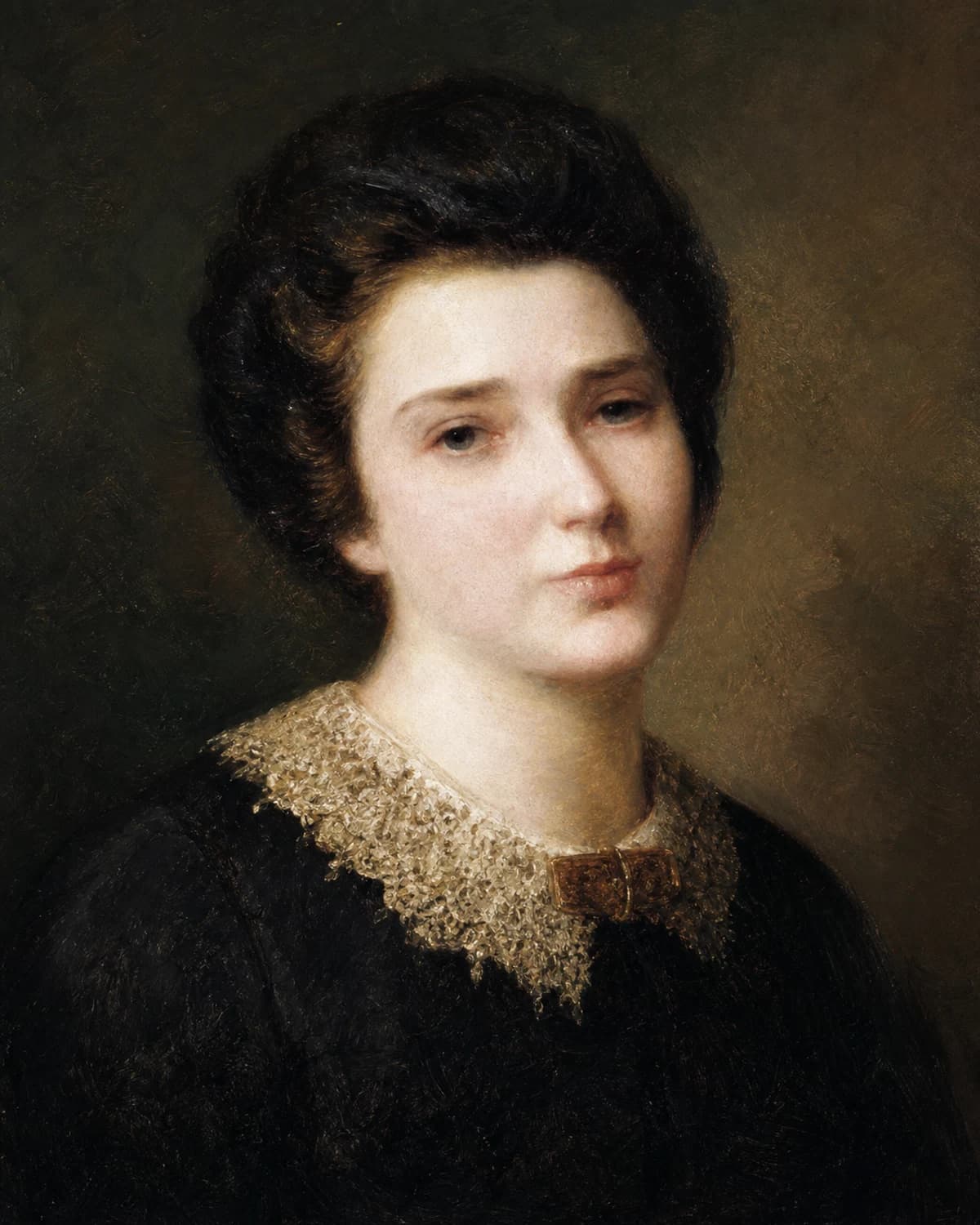
Zofia Szeptycka, born Fredro, the daughter of the comedy writer Aleksander Fredro, studied drawing with a Czech painter in Lviv and then in Paris, where she copied in the Louvre. Her religious paintings hung in churches in Lviv, Kraków and Zhovkva, and her portraits of her parents are considered the best of her work. She also wrote family memoirs, published in 1900–1903.
Biography
Around 1842 Aleksander Fredro hired the Czech painter Josef Swoboda to give his children their first lessons in drawing and painting. One of the pupils was his daughter Zofia.
She was born in Lviv, then part of the Austrian Empire, to the playwright Count Aleksander Fredro and Zofia Jabłonowska. Sources give her birth date differently: 20, 21 or 27 May 1837. She spent her childhood in Beńkowa Wisznia, and from 1858 until her marriage she lived in Lviv. Among her teachers is named Adela Defforel, a longtime mentor and friend.
In 1849 she went to Paris, where the painter Henryk Rodakowski, a friend of the family, noticed her talent. He advised her to study with Nicolas-François Chifflart, Rodakowski’s fellow pupil in the studio of Léon Cogniet. With Chifflart she copied academic drawings, then paintings in the Louvre. She was also educated in Vienna. In 1855, through her friendship with Maria Cecylia Czartoryska, she grew close to the residents of the Hôtel Lambert, the centre of the Polish emigration in Paris. Rodakowski painted her portrait in watercolour.
On his advice she painted portraits of her father and mother. These are regarded as the most important works in her output. There are also a self-portrait and a portrait of her brother; the portraits are reproduced as illustrations in her books. She also painted religious pictures, which decorated churches in Lviv, Kraków, Zhovkva and Bruchnal. For the Bernardine church in Lviv, where Blessed John of Dukla is buried, she painted his image. An icon of John of Dukla also stands in a side altar of the church of Saint Andrew the Apostle in Lviv, said to be a gift from the mother of Metropolitan Andrey.
On 1 October 1861 she married Jan Kanty Szeptycki, a landowner, and settled on his estate at Prylbychi. The dowry from her mother included Korczyna and Odrzykoń, so she was also connected with the Krosno region. In 1888 she travelled to Rome to see her son Roman, and Pope Leo XIII received her there.
She had seven sons. The two eldest, Stefan (1862–1864) and Jerzy (1863–1880), died in childhood. Roman (1865–1944) became a Basilian monk, took the name Andrey and in 1900 became head of the Ukrainian Greek Catholic Church. Kazimierz (1869–1951) became a Studite monk under the name Klymentiy and was later beatified by the Catholic Church. Stanisław (1867–1950) graduated from the military academy in Vienna and became a general of the Austro-Hungarian army and of the Polish Army. Aleksander (1866–1940) and Leon (1877–1939) were landowners. In September 1939 Leon and his wife Jadwiga were shot by the NKVD, the Soviet security service, at Prylbychi. Contemporaries say that she was deeply religious and taught her children the catechism herself.
She wrote prose as well: stories and essays, which she left in manuscript in the form of a family diary. The most valuable of them, “Memories of the Past Years”, were written in 1900–1903. Separately she set down recollections of the youth of Andrey Sheptytsky. After her death individual stories were first printed in the Lviv newspaper “Gazeta Narodowa” and the Kraków “Przegląd Polski”. A two-volume collection of her “Letters”, with a preface by Stanisław Tarnowski, appeared in Kraków in 1906–1907.
Zofia Szeptycka died on 17 April 1904 and was buried at Prylbychi, on the family estate.
Related context
Associations
Works connected through artistic movements, cultural context and period. Priced works available in this market appear first.








Profile notes
Profile and sources
Image
Artist image
На основе открытого изображения: op unknown; Wikimedia Commons; Public domain.
