
1716–03.01.1797
Yuan Mei
Yuan Mei (1716–1797) resigned at thirty-two from a county magistracy near Nanjing and spent half a century in his own Sui Garden on Xiaocang Hill: writing poetry, collecting ghost stories for the anthology “What the Master Would Not Discuss”, compiling a cookbook and teaching poetry to dozens of women students. His contemporaries called him “Mister Suiyuan”; far less is known about his paintings than about his verse.
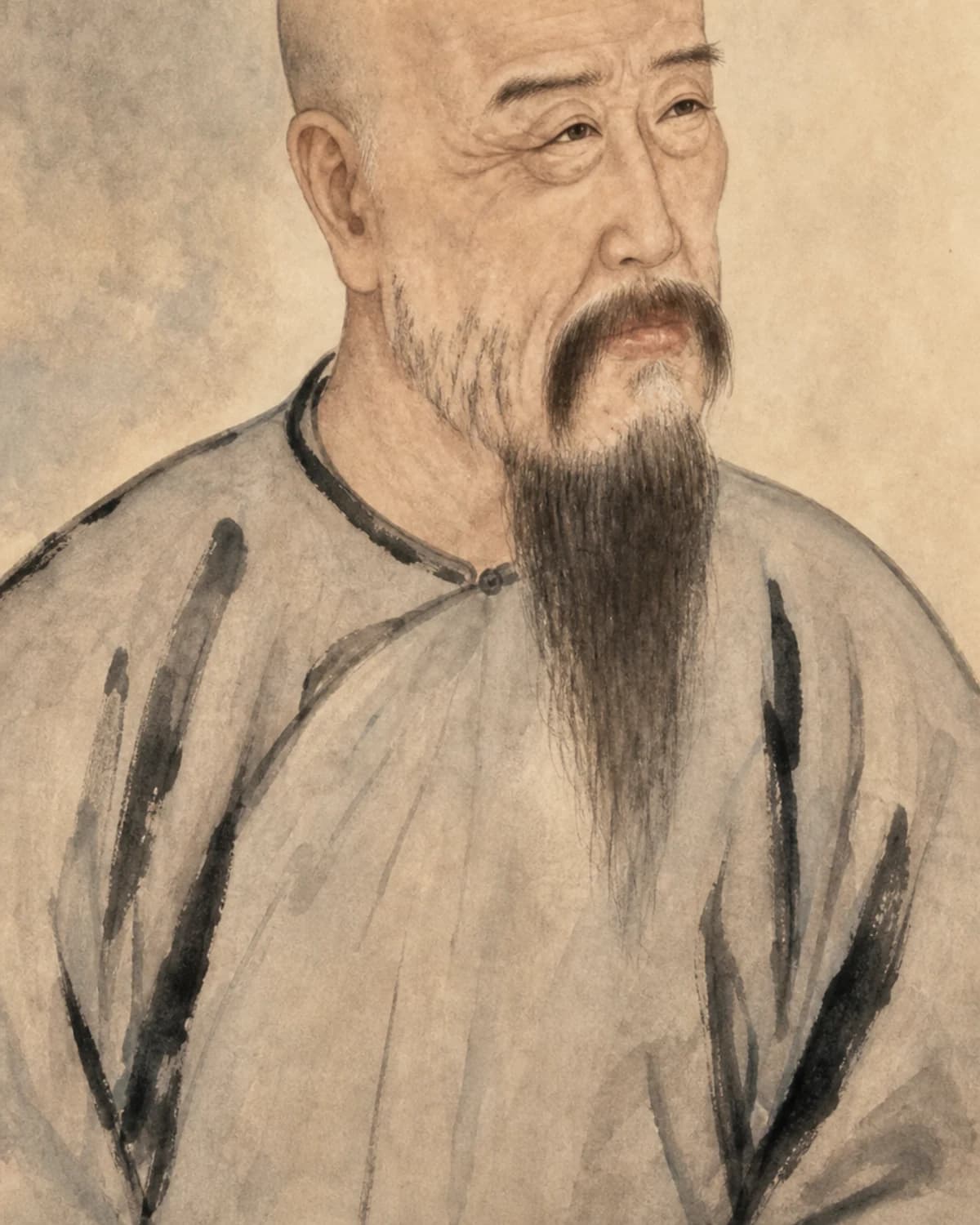
Biography
“Bird’s nest is beautiful, so why shape it into balls?” That is how Yuan Mei instructed cooks in “The Way of Eating”, his manual of gastronomy published in 1792. He complained that banquet menus had grown a hundred feet long and become mere display; after one such dinner he went home and cooked himself rice porridge to take the edge off his hunger. He advised cooks not to fuss with the natural state of the food just to show how clever they were.
The author was seventy-six and had been out of office for almost fifty years. To my mind, the advice about bird’s nest applies to his poems as well.
Yuan Mei was born in 1716 in Qiantang county, present-day Hangzhou, into a family of modest means and no rank: his father earned a living as a secretary in other men’s offices, his mother kept the house by needlework. The boy was regarded as a prodigy, and at twelve he passed the first, county-level examination. In 1736, at twenty, he was put forward for a special metropolitan examination for scholars, the youngest of the candidates, but was not selected. In 1739, however, at twenty-three, he obtained the highest degree, jinshi, and was at once admitted to the Hanlin Academy. Then for six years, from 1742 to 1748, he governed four counties of Jiangsu province one after another: Lishui, Jiangpu, Shuyang and Jiangning. In 1748, shortly after being given charge of part of Nanjing, he resigned and never returned to office.
On Xiaocang Hill in Nanjing he laid out the Sui Garden, collected books, wrote, received guests, and lived that way for fifty years. His wealth did not come from his salary: eight years of office left him savings, then wealthy houses paid him well for prefaces, postscripts and epitaphs, and he invested the money in land. The garden became a school as well. Yuan Mei took pupils, women among them, and helped them publish their poems under their own names; for the gatherings of women poets at Suiyuan he was both praised and attacked. Two of his sisters also wrote; to his sister Yuan Ji, who died in 1759, he dedicated eight years later a “Sacrificial Essay for My Sister”.
In poetry he defended living feeling against imitation of the ancients, and his treatise “Poetry Talks from the Sui Garden” demands of a poet personal experience and technical perfection at once. His contemporaries set him beside Ji Yun: “Yuan in the south, Ji in the north”. He travelled widely among the mountains of the south, to Huangshan, Guilin, Tiantai and Wuyi, and kept travel journals. His collection of stories about spirits and wonders he first called “What the Master Would Not Discuss”, after a line in the “Analects”, but on learning that a book of the Yuan dynasty had already appeared under that title, he renamed it “New Tales of Qi Xie”. The first edition of 1788 contained some seven hundred and fifty stories, and a sequel followed later; the author himself maintained that he was recording real events.
What paintings he made, and whether they survive, is hard to verify: his painting is mentioned in a single line, alongside the poems and essays. His son Yuan Chi (1779–1828), born when his father was past sixty, did become a painter.
Yuan Mei died on 3 January 1797 in Nanjing. He was buried there, on Xiaocang Hill, beside his garden; the inscription for the tomb was composed by Yao Nai. The stone was still standing in the years of the Republic, it was smashed during the Cultural Revolution, and in March 1974, when the Wutaishan Stadium was being built, the grave was cleared away for good.
Related context
Associations
Works connected through artistic movements, cultural context and period. Priced works available in this market appear first.








Profile notes
Profile and sources
Image
Artist image
На основе открытого изображения: Luo Ping; Wikimedia Commons; Public domain.
