
13.10.1920–18.01.2017
Yosl Bergner
Yosl Bergner grew up in Warsaw, arrived in Melbourne at seventeen and there painted pictures of Indigenous Australians and of the ghetto that caused a public stir. From 1950 he lived in Israel, designed plays by Nisim Aloni, illustrated Shmuel Yosef Agnon and painted kitchen graters and dented pots. Winner of the Israel Prize in 1980.
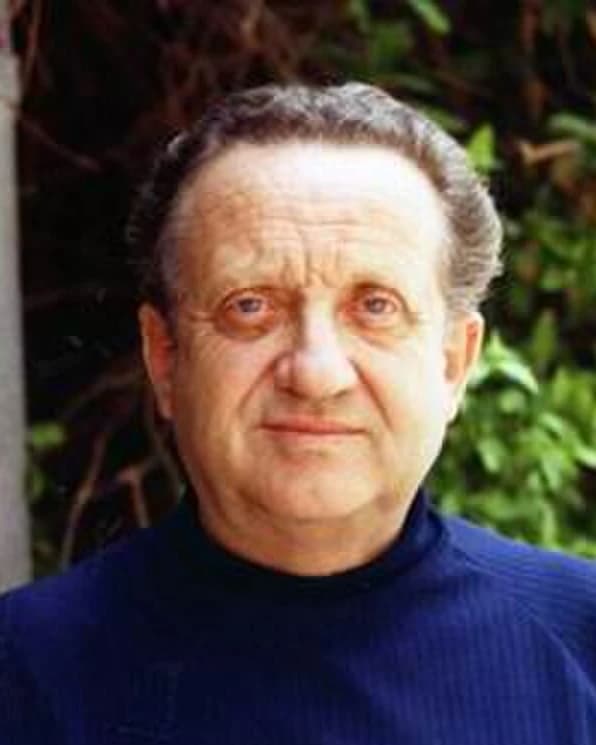
Biography
In his youth Bergner painted “Aborigines Chained to a Tree” from a newspaper photograph. Canvas was expensive, so the picture is in oil on cardboard. The work caused a noticeable public stir in Australia.
He was born in Vienna on 13 October 1920, his full name at birth being Vladimir Josif. He grew up in Warsaw and began to learn drawing there. His father, Melech Ravitch, wrote poetry in Yiddish; his mother, Fanya Bergner, was a singer. The house held books on German Expressionism, and this, it seems, shaped the future painter’s taste; Franz Kafka, a friend of the family, also influenced his outlook.
In the 1930s, as antisemitism grew in Europe, Ravitch decided to move the family to Australia. His son was then seventeen. On the ship Bergner met the Yiddish writer Yosl Birstein, with whom he later worked as an illustrator. In Melbourne he earned his living by manual labour and studied at the art school of the National Gallery of Victoria, and from 1939 he took part in exhibitions. He joined the Contemporary Art Society, which opposed academic conventions. Among his Melbourne acquaintances were Sidney Nolan, Albert Tucker, John Perceval and Arthur Boyd. According to one account, Bergner nudged them away from the habitual landscape towards an interest in the lives of working families.
From 1941 to 1946 he served in the Australian Army, in construction units. His first marriage, to Mary Tauman, soon ended. In 1944 another of his much-discussed works, “The Ghetto Wall”, was shown; the Australian art historian Bernard Smith called it postmodern. Bergner’s early style, which he himself preferred to call “social humanism”, was close to Expressionism: thick impasto, a gloomy range of grey, brown and black. “Itinerant Rat Catchers”, “Father and Sons” and “Jewish Shtetl on Fire” belong to this period.
In 1948, having finished at the gallery school, he left for France. In Paris he met the painter Audrey, a native of Sydney, who became his second wife. After two years of travelling and exhibiting in Paris, Montreal and New York, in 1950 they moved to Israel and settled in Safed. There Bergner befriended the painter Shalom Moskovitz. His first solo exhibition in Israel was held at that time, at the Katz Gallery. In 1957 the couple moved to Tel Aviv, where he lived for the rest of his life. In Australia Bergner had belonged to the Communist Party; what brought him to Israel, as he explained later, was not Zionism but a rejection of antisemitism worldwide.
In France and then in Israel his manner changed: the works became more elegant, at times nearly monochrome or non-representational, like “The French King” (1962). In the mid-1960s his own style emerged, an original version of Surrealism. In “Four Women” (1964), “The Butterfly Eaters” (1965) and “A Well-Furnished Desert” (1968), old, crumpled and broken objects lead an active life, while the people are frozen, their poses unnatural and their faces schematic. Kitchen graters appear most often: they dance, fly, weep and fall in love. “The Bride and the Butterfly Hunter” (1967) gave Nisim Aloni the idea for his play of the same name. In the same years the themes of Zionism and aliyah, immigration to Israel, appeared in symbolic form.
In the mid-1970s Bergner worked on a cycle after Kafka (“The Trial”, “The Castle”) and returned to Expressionism, but the palette became lighter than in his youth. In 1976 the cycle was shown in Paris, at the Ardi gallery. Later, around the turn of the 1970s and 1980s, he turned to the theme of the halutzim, the pioneer settlers, keeping the blurred faces but with almost no Surrealism.
He worked a great deal for the theatre, most often on productions of Aloni’s plays. As an illustrator he is known for the Yiddish translation of “The Trial”, published in New York in 1966 (translated by Melech Ravitch), and for his drawings for Shmuel Yosef Agnon. His works of 1963–1968 were included in an album of 1969 in Hebrew and English, and in 1990 a separate album of Kafka illustrations appeared. His autobiography, “What I Sought to Express”, recorded in interviews with Ruth Bondy, came out in 1997 with his own drawings.
His works were shown in the Israeli pavilion at the Venice Biennale in 1956 and 1958 and were often exhibited at the Tel Aviv Museum of Art. In 1985 he gave many works to the National Gallery of Victoria. Awards: the Dizengoff Prize (1955 and 1956), the Israel Prize (1980, shared with Anna Ticho and Pinchas Litvinovsky), the prize of the Sholem Aleichem House (1996) and honorary citizenship of Tel Aviv (2006).
Bergner died on 18 January 2017 at his home in Tel Aviv. He is buried in the cemetery of Kibbutz Einat.
Profile notes
Profile and sources
Image
Artist image
סטנלי בטקין; Wikimedia Commons; CC BY-SA 3.0.
