
02.10.1868–26.02.1958
Yokoyama Taikan
Yokoyama Taikan (1868–1958), Sakai Hidemaro in his youth, studied in the first intake of the Tokyo School of Fine Arts under Okakura Kakuzō and, together with Hishida Shunsō, gave up the contour line for blurred patches of colour; their opponents nicknamed it “mōrōtai”, the hazy style. Later he turned to monochrome ink. His forty-metre scroll “Metempsychosis” of 1923 is a designated Important Cultural Property of Japan.
Biography
The scroll “Metempsychosis”, forty metres long, in which a single drop of water becomes a stream, a river, the sea and a cloud, is painted in ink alone. Yokoyama Taikan showed it at the exhibition of the revived Nihon Bijutsuin in September 1923; on the day it opened, the Great Kantō earthquake destroyed Tokyo. The scroll survived and is kept in the National Museum of Modern Art, Tokyo.
He was born on 2 November 1868 in Mito, the eldest son of Sakai Sutehiko, a samurai of the Mito domain; by the old calendar that was the eighteenth day of the ninth month of the first year of Meiji. As a child he was called Hidezō, then Hidematsu. In 1878 the family moved to Tokyo, where his father entered the service of the Home Ministry. At the prefectural middle school the boy took to English and to Western oil painting and had lessons in pencil drawing from Watanabe Fumisaburō. In 1888 he was adopted by his mother’s relatives, the Yokoyama family, and became Yokoyama Hidemaro.
In 1889 he entered the first intake of the newly opened Tokyo School of Fine Arts, run by Okakura Kakuzō; he studied under Hashimoto Gahō, a master of the Kanō school, alongside Shimomura Kanzan and Saigō Kogetsu, with Hishida Shunsō a year behind him. After graduating in 1893 he spent two years copying Buddhist painting while teaching at the Kyoto City School of Arts and Crafts, and it was then that he took the art-name Taikan. In 1896 he returned to Tokyo as assistant professor at his old school, but two years later, when Okakura was forced out, he left with him and took part in founding the Japan Fine Arts Academy, the Nihon Bijutsuin. There he and Shunsō suppressed the contour line and built the picture on soft, blurred transitions of colour. The critics called it “mōrōtai”, a vague, listless style, and the word stuck, later without the sneer. The academy paid twenty-five yen a month for all the pictures painted, and he supported his family with difficulty. In 1903 he and Shunsō went to India and exhibited in Calcutta, where they met Abanindranath Tagore; in 1904 they showed work in New York and Boston, in 1905 in London, Berlin and Paris, and abroad the blurred painting was liked better than at home. Why is an open question; to my mind the fashion of the day for Whistler and the blurred landscapes of George Inness helped. In 1907 the Ministry of Education put him on the jury of the first state exhibition, the Bunten; there he returned to bright colour, and his “Eight Views of the Xiao and Xiang Rivers” of 1912 is now also an Important Cultural Property. In 1914 he was removed from the jury, and after Okakura’s death in 1913 he revived the Nihon Bijutsuin with Shimomura Kanzan and Kimura Buzan; its Inten exhibitions became the chief non-governmental outlet for the young. Money came from the silk merchant and collector Hara Tomitarō.
In April 1930 he brought more than ten works, among them “Cherry Blossoms at Night” of 1929, to an exhibition of Japanese art in Rome and went there himself.
In 1935 he became a member of the Imperial Art Academy, and in 1937 he was among the first to receive the Order of Culture, instituted that year. From the late 1920s Mount Fuji became his chief motif and an image of the Japanese spirit; he presented such paintings to the imperial house. In 1940 he donated the proceeds of the series “Ten Subjects of the Sea and Ten Subjects of the Mountains” to the army and navy for an aircraft, during the war he headed the Japan Art Patriotic Society, and after the surrender he was questioned by the occupation authorities as a suspected war criminal. His house at Ikenohata burned in the bombing of Tokyo, and he spent the first post-war years at Izusan. In 1951 he resigned from the Japan Art Academy and in the same year was named a Person of Cultural Merit. He painted to the end: in 1952 “A Day in the Pacific Ocean”, where a wave breaks on a rock beneath Fuji, and his last work for the Inten was shown in 1955. In 1954 he rebuilt the house at Ikenohata.
Yokoyama Taikan died in that house, in Tokyo’s Taitō ward, on 26 February 1958, at the age of eighty-nine; posthumously he received the Senior Third Rank and the Grand Cordon of the Order of the Rising Sun. He is buried in Yanaka Cemetery. The house is open as the Yokoyama Taikan Memorial Hall, and his paintings appeared three times, in 1967, 1983 and 1985, on Japanese stamps.
Related context
Associations
Works connected through artistic movements, cultural context and period. Priced works available in this market appear first.








Profile notes
Profile and sources
Image
Artist image
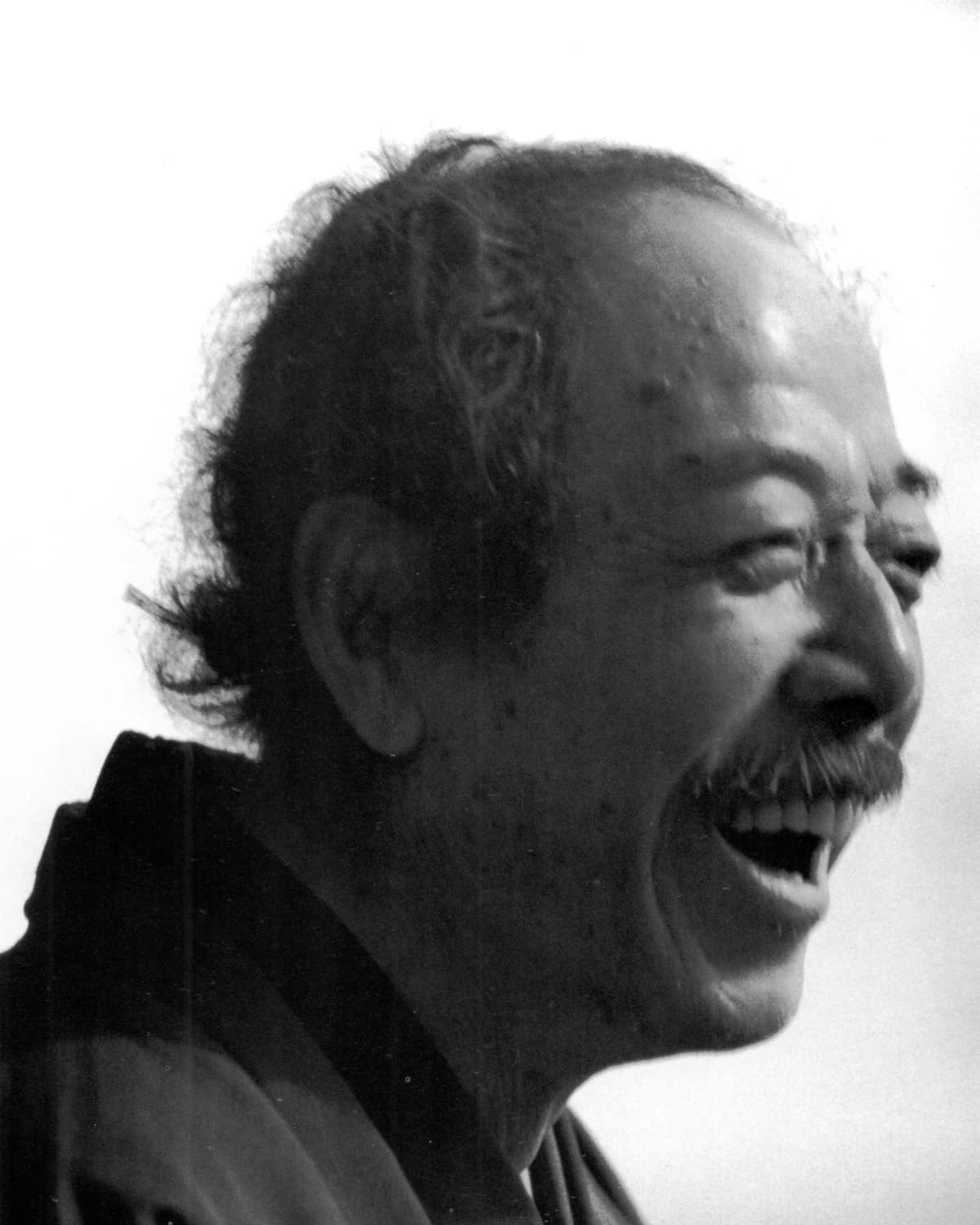
Ihei Kimura; Wikimedia Commons; Public domain.
