
1962–present
Yinka Shonibare
Yinka Shonibare (b. 1962) was born in London, grew up in Lagos and since 1994 has worked with brightly coloured “African” wax-printed fabric whose origins are in fact European. He dresses headless mannequins in eighteenth-century costume made from it, restages Gainsborough, Fragonard and Hogarth, and in 2010 placed “Nelson's Ship in a Bottle” on the Fourth Plinth in Trafalgar Square.
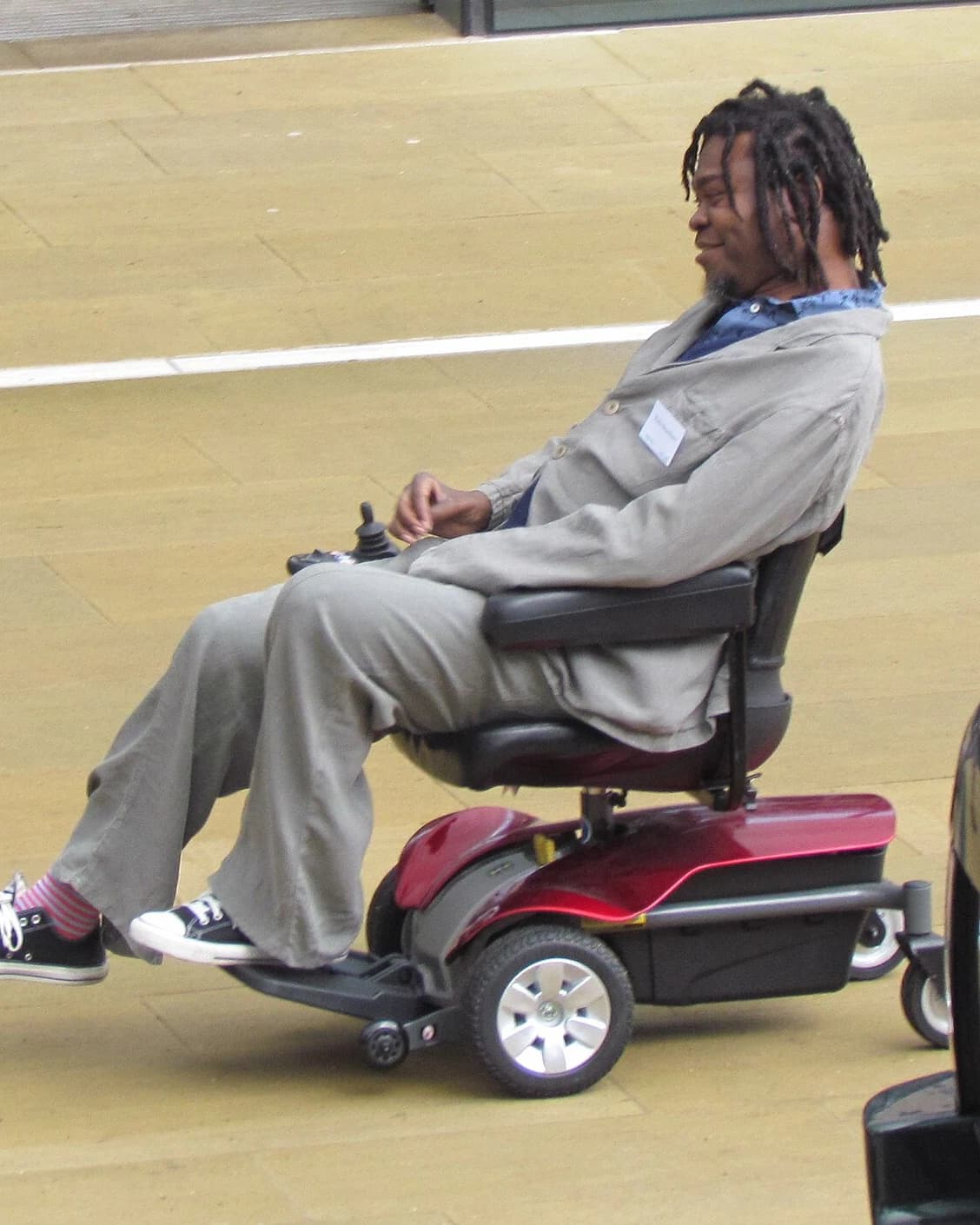
Biography
Since 1994 Yinka Shonibare has bought the fabrics for his work himself, from a shop in Brixton, in London. It is a bright wax-printed cotton that people in London think of as African. Its history is tangled: such fabrics were first made by British and Dutch mills on the model of Indonesian batik; they failed to catch on in the Indonesian market and went to West Africa, where they became everyday dress and a sign of authenticity. The main exporters are still based in Manchester and in Helmond in the Netherlands. Shonibare took up the fabric when he was expected to produce “authentically African” art, a demand he thought absurd. What he likes, he has explained, is the falseness of the sign: for him culture is an artificial construct.
The fabric with a double passport became his signature.
He was born on 9 August 1962 in London. When he was three, the family moved to Lagos, where his father practised as a lawyer, and at seventeen Shonibare returned to England to finish school. He studied at the Byam Shaw School of Art, where his first solo exhibition was held in 1989, and then took a master's degree at Goldsmiths College, alongside the generation of the Young British Artists. After his studies he worked for Shape Arts, an organisation that makes art accessible to disabled people. It took about six years before a commercial gallery took him on; he himself put this down to racism in the art market. Since the age of eighteen one side of Shonibare's body has been paralysed; he speaks about this openly and works with a team of assistants who make the pieces to his designs.
Recognition came in 1997, when he was included in “Sensation” at the Royal Academy of Arts. In 1998 came “Mr and Mrs Andrews Without Their Heads”: the couple from Gainsborough's painting in clothes of wax-printed fabric and without heads. In “Diary of a Victorian Dandy”, a reworking of Hogarth's “A Rake's Progress”, he played the dandy himself, although in that era black people were shown, if at all, as servants; around forty posters with these photographs hung in the London Underground. In “The Swing (After Fragonard)” (2001) the girl on the swing wears fabric with a fake Chanel pattern. The same year saw “Dorian Gray”, after Wilde's novel, about the transformations of the body, and here Shonibare drew on his own experience. In 2002 Okwui Enwezor commissioned him to make “Gallantry and Criminal Conversation” for Documenta 11, and it launched him on the international stage. In “Scramble for Africa” (2003) headless European politicians sit at the table of the Berlin Conference of 1884–1885 and carve up the continent; the artist said he wanted to show them as mindless in their hunger for what the Belgian King Leopold II called a slice of this magnificent African cake.
Headless mannequins in eighteenth-century outfits of “African” cotton look comic, and that, I think, is the trap: in laughing at the costume, the viewer has already joined the conversation about colonies.
In 2004 he was shortlisted for the Turner Prize for his exhibition “Double Dutch” at the Museum Boijmans Van Beuningen in Rotterdam and for his show at the Stephen Friedman Gallery in London; the prize went to Jeremy Deller. In the same year he made his first film, “Un Ballo in Maschera”, about King Gustav III of Sweden, assassinated in 1792, and was made a Member of the Order of the British Empire. He ironically incorporated the honour into his artistic name, comparing this to a Trojan horse that gets inside unnoticed. A major retrospective in 2008–2009 was shown at the Museum of Contemporary Art in Sydney, the Brooklyn Museum and the Smithsonian's National Museum of African Art.
On 24 May 2010 “Nelson's Ship in a Bottle”, a 1:30 model of the flagship HMS Victory, was placed on the long-empty Fourth Plinth in Trafalgar Square. It stayed there until 30 January 2012 and then, after a fundraising campaign by the Art Fund, moved to the National Maritime Museum in Greenwich. In 2013 Shonibare was elected a Royal Academician, in 2019 he was made a Commander of the Order of the British Empire, and in 2021 he received the Whitechapel Gallery's award. His “Wind Sculpture VII” has stood at the entrance to the National Museum of African Art in Washington since 2016, and “Hibiscus Rising” (2023) in Leeds commemorates David Oluwale, a homeless Nigerian man who was persecuted by the Leeds city police.
He runs Guest Projects, a space for young artists in the Broadway Market area of London, and founded a foundation in his own name, which has built a house for artists in Lagos and a residency farm three hours' drive from the city. In 2025 he became part of the Foster + Partners team chosen to design the national memorial to Queen Elizabeth II in St James's Park.
Profile notes
Profile and sources
Image
Artist image
Daren Clarke; Wikimedia Commons; CC BY 2.0.
