
20.07.1539–23.08.1609
Yi Sanhae
Yi Sanhae (1539–1609) is said to have been writing poems at the age of five, and by fifteen he was known for his calligraphy and painting. He later became leader of the Northerners faction at the court of King Seonjo and held the highest office in the state several times. In 1592, at the start of the Imjin War, he was sent into exile; after his return he helped Gwanghae to the throne.
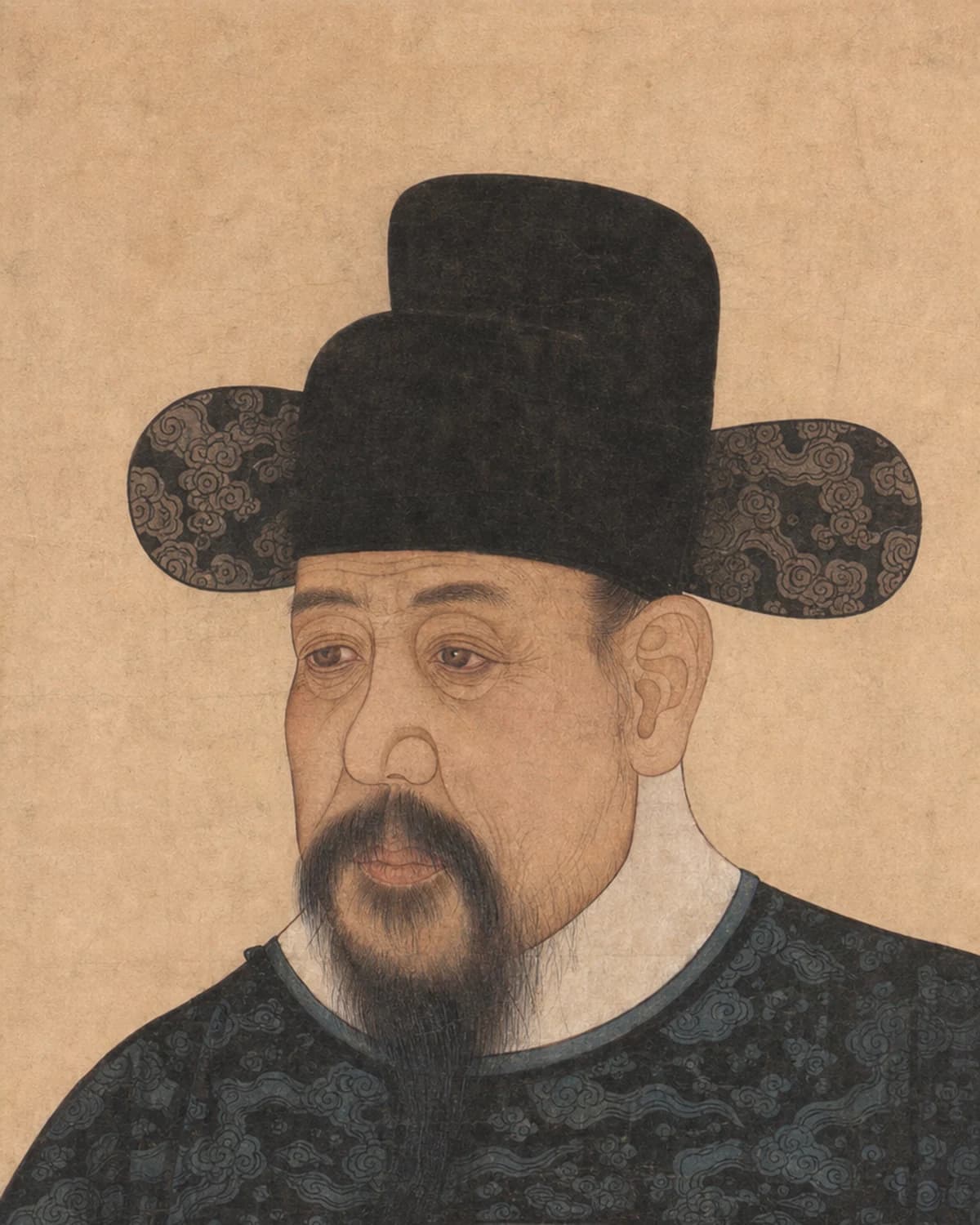
Biography
In 1591, when the court was debating whom to name as heir to the throne, Yi Sanhae said nothing. This is how English-language scholarship tells the episode: the officials gathered before King Seonjo named Prince Gwanghae one after another, while Yi and his ally Yu Sŏngnyong stayed silent. The king took this as a sign that they shared his own preference.
To see how he came to that moment, we have to go back.
Yi Sanhae was born on 20 July 1539 in Hanyang (now Seoul), into a yangban family (the hereditary scholar-official class) of the Hansan Yi clan. Among his direct ancestors, in the fifth generation, is named Yi Saek, a scholar and writer of the late Goryeo period. He studied under his uncle Yi Ji-ham and early gained a reputation as a gifted child: at five, so it is told, he wrote poems, and by fifteen he had sat the provincial examination several times and was known for his calligraphy and painting. His teachers are also said to have included Cho Sik and Yi Hwang. Classmates from these schools later found themselves on opposite sides of the factional struggle. In 1561 he passed the mungwa, the higher civil service examination, and received his first appointment, to the Office of Diplomatic Correspondence.
His career moved fast. From 1562 he was recommended to the Hongmun'gwan, the royal academy and library, and in 1570 he became one of the six royal secretaries. In 1574, after his father’s death, he left office, and he returned three years later. In 1578 he was put in charge of an investigation into corruption in which the brothers Yun Tusu and Yun Kŭnsu, prominent figures among the Westerners, were suspected. Yi belonged to the Easterners, and he had the brothers removed from their posts; the Westerners did not forget it. King Seonjo, however, valued his abilities and ignored the complaints. In 1583, within a single year, he served as head of the Ŭigŭmbu (the royal tribunal) and as Minister of Personnel, Rites and Military Affairs. Twice, in 1585 and 1586, he asked to resign, and both times the king kept him. In 1588 Yi became Right State Councilor and in 1589 Left State Councilor, and in 1590 he headed the government: the post of Chief State Councilor (Yŏngŭijŏng) was the highest at court.
In 1589, after Chŏng Yŏrip was accused of treason, the Westerners, led by Chŏng Ch'ŏl, carried out a purge and had many Easterners put to death. Attempts to implicate Yi Sanhae as well failed: Seonjo trusted him. Two years later the Easterners took their revenge, and the episode of the silence over the heir, with which this account began, was part of that struggle. According to the account of events, Yi had first reached an understanding with the brother of Lady In, the mother of Prince Sinseong, and he warned his sister of a threat to her son. Chŏng Ch'ŏl and his supporters were dismissed. A split followed among the Easterners: Yi Sanhae, an advocate of the hard line, insisted on Chŏng Ch'ŏl’s execution and became one of the Northerners. The faction he led gained the upper hand on the eve of the war.
When the Japanese invasion began in 1592, he was head of the government. After the defeats at Sangju and Tangeumdae, Seonjo wished to leave the capital; all the ministers were against it except Yi, who cited historical precedents. He was blamed for the military failures and the loss of the city and was exiled to Kangwon Province, where he remained until 1595. He returned despite the objections of the Westerners. During the war, according to the sources, he was more favourably inclined toward Wŏn Kyun than toward Yi Sun-sin, whom Yu Sŏngnyong supported. In 1596 he was charged with investigating the peasant rebellion of Yi Monghak.
After 1598, when the Japanese began to withdraw from Korea, the quarrels at court sharpened too. Yi Sanhae’s son Yi Kyŏngjŏn passed the examination and was recommended for a post in the Ministry of Personnel, but the Southerner Chŏng Kyŏngse objected to the appointment, citing the candidate’s character. This angered the father greatly and deepened his distrust of the Southerners.
In 1601 Yi received the title Aseong Buwongun and until 1609 held various posts. When the Northerners split into Greater and Lesser over the question of the succession, he supported Gwanghae, although he knew that the king leaned toward Prince Yeongchang, who was then about three years old. After Seonjo’s death in 1608, Yi Sanhae, by report, foiled a plot by the Lesser Northerners and secured Gwanghae’s accession. He retired in 1609 and died the same year, on 23 August, in Seoul.
His collected writings survive as the “Agye chip” and the “Agye yugo”; the latter contains poems and other texts and is regarded as an important record of the events of the Imjin War. Which of Yi Sanhae’s paintings survive, the sources available give no information.
Related context
Associations
Works connected through artistic movements, cultural context and period. Priced works available in this market appear first.

Profile notes
Profile and sources
Image
Artist image
На основе открытого изображения: Unknown author Unknown author; Wikimedia Commons; Public domain.
