
1745–1821
Yi Inmun
Yi Inmun (1745–1821) served in the court painting bureau of Joseon Korea and painted mainly landscapes. His best-known work is the silk scroll “Gangsan mujindo” (“Streams and Mountains Without End”), kept in the National Museum of Korea in Seoul. Besides his post as a painter, he held a military rank at court, and in 1968 a chamber symphony was composed after his scroll.
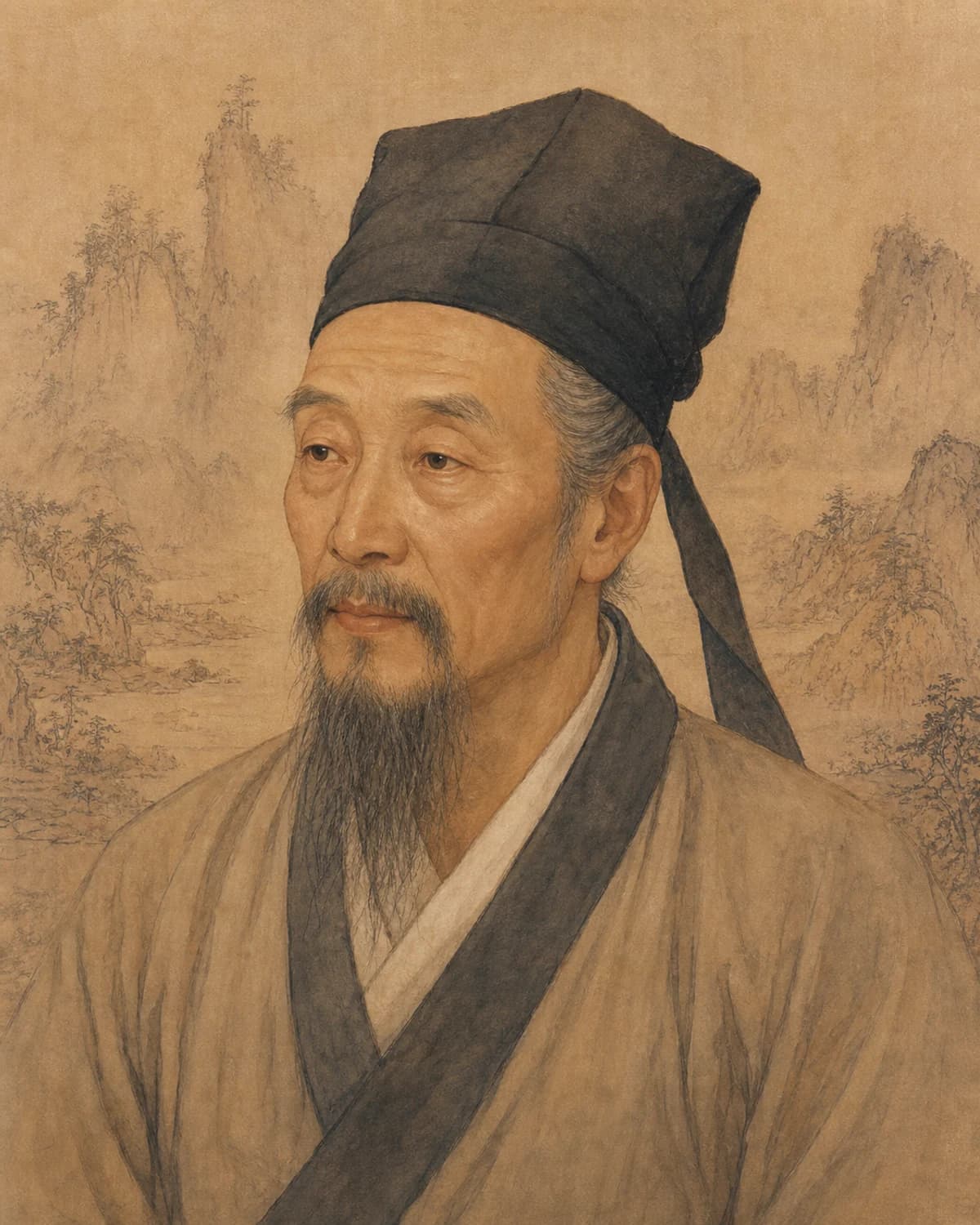
Biography
Yi Inmun’s principal scroll is called “Gangsan mujindo” (“Streams and Mountains Without End”). It is painted on silk and is now on display in the National Museum of Korea in Seoul. The title can also be rendered as “Mountains and Rivers Without End”: the landscape unfolds as the viewer unrolls the scroll.
Yi Inmun’s works are better known than his life. He was born in 1745 and died in 1821, although some sources give 1824. The places of his birth and death are not firmly established. His art name was Yuch’un; other names are also recorded: Munuk as a courtesy name, and Gosong Yusuganggwan doin and Jayeonong as pseudonyms. He belonged to the late Joseon period and worked as a court painter. He served in the Dohwaseo, the state painting bureau, and under King Jeongjo was selected among the court painters attached to the Kyujanggak, the royal library and institution. This was a circle of artists who painted on commission for the court. Besides his rank as a painter, he also held a senior military post: he is credited with the rank of cheomsa. He painted mainly landscapes. It is said that he rid the Korean painting of his day of looseness of composition and achieved a compact, clear structure on a modest scale. I think this is a useful point: it speaks more of discipline in drawing than of grandeur. There are reports that he followed the northern school tradition of Chinese painting, was noted for delicate construction and a confident brushstroke, and was among the first to use watercolour in landscape. The last claim is weakly supported, and I would treat it with caution.
Among his works are named “Gathering at a Pavilion” (Nugak ajido), “Gangsan mujindo”, “Landscape” (Sansuto), “Rainy Evening in a Riverside Village” (Gangchon usaekdo) and “Autumn Forest” (Churimdo). “Gangsan mujindo” has been designated in Korea as a national treasure.
In 1963 the American composer Alan Hovhaness visited South Korea. Inspired by this scroll, in 1968 he composed a chamber symphony, “Mountains and Rivers Without End”.
Related context
Associations
Works connected through artistic movements, cultural context and period. Priced works available in this market appear first.








Profile notes
Profile and sources
Image
Artist image
На основе открытого изображения: Yi Inmun; Wikimedia Commons; Public domain.
