
14.12.1887–09.04.1963
Xul Solar
Xul Solar (1887–1963), born Oscar Schulz Solari, reversed the Latin lux and made a name out of it. Twelve years in Europe, friendships with Pettoruti and Borges, small-format watercolours and temperas with ladders, roads and the letters of two languages he invented; then horoscopes, chess by the stars, a repainted piano and puppets of the signs of the zodiac. His house in Buenos Aires is kept by the foundation that bears his name, and a museum has been open since 1993.
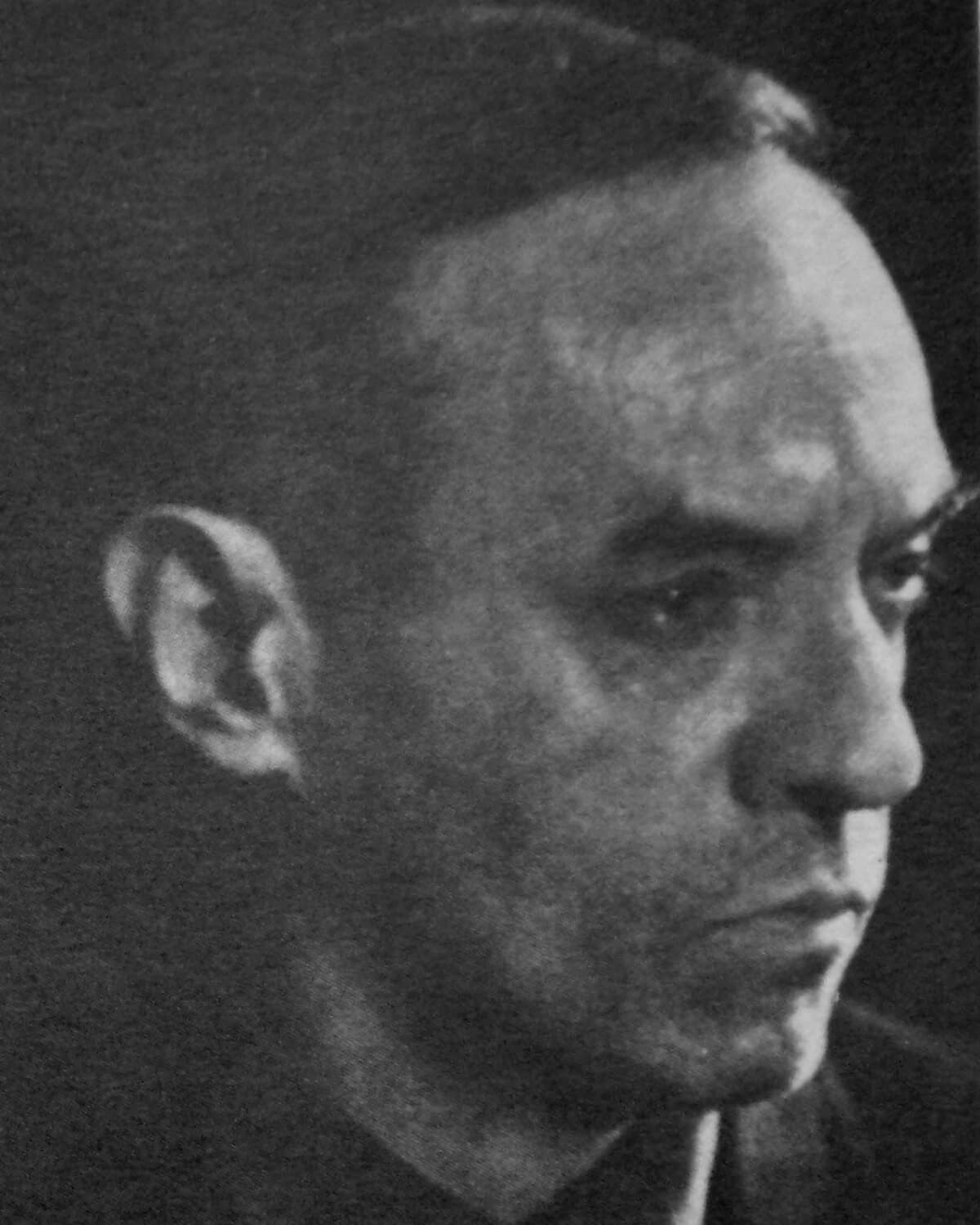
Biography
On 5 April 1912 the twenty-four-year-old Oscar Schulz Solari boarded a steamer in Buenos Aires, supposedly to work his passage to Hong Kong, got off in London and made his way to Turin. He stayed in Europe for twelve years and came back with a different name.
The name he assembled from his own: Xul, the Latin lux, light, read backwards; Solar, his mother’s surname Solari without its last letter. In Spanish, Xul and Schulz sound the same.
He was born on 14 December 1887 in San Fernando, in Buenos Aires Province. His father, Emilio Schulz Riga, was a Baltic German from Riga, then Russian; his mother, Agustina Solari, came from Liguria. In Buenos Aires he studied music first, in 1906 entered the university’s faculty of exact sciences to study architecture and left after a year, then taught school and worked in municipal offices. In Europe he travelled with his mother and aunt between Paris, Turin, Genoa and his mother’s native Zoagli, lived in Tours, Marseille and Florence, where in July 1916 he became friends with his compatriot Emilio Pettoruti, then close to the Futurists; towards the end of the war he served at the Argentine consulate in Milan. It was then that he took painting up in earnest, and watercolour remained his main medium for life; tempera was added to it, and oils he used rarely. He began signing his work “Xul Solar” in 1916. In the early watercolour “Burial” a procession of beings with luminous peaks above their heads follows a floating angel, and above the shrouded body, among tongues of flame, rises a figure resembling a foetus: not an end but a new birth. He showed his first major exhibition in Milan in November 1920, together with the sculptor Arturo Martini; the catalogue essay was written by Pettoruti. In 1921 he settled in Munich, studied at a school of applied art and read Kandinsky and Klee. In 1924 his works hung in Paris at an exhibition of Latin American art at the Musée Galliera, and the same year he and Pettoruti sailed back to Argentina.
In Buenos Aires he fell in at once with the avant-garde Florida group, otherwise the group of the magazine Martín Fierro, and there formed a lifelong bond with Jorge Luis Borges; they shared the German Expressionist poets, Swedenborg, Blake and Buddhism. Leopoldo Marechal put him into his novel “Adán Buenosayres” as the astrologer Schultze, Borges in 1940 made him a minor character in “Tlön, Uqbar, Orbis Tertius”, and in 1944 Xul Solar illustrated three hundred copies of “Un modelo para la muerte”, written by Borges and Bioy Casares under a joint pseudonym. In 1926 he exhibited with Norah Borges and Pettoruti, and in May 1929 his first solo exhibition in Buenos Aires opened at Amigos del Arte; from then on he showed regularly in Buenos Aires and Montevideo, but a major European exhibition came only in 1962, at the Musée National d’Art Moderne in Paris.
Painting was for him one craft among several. He invented two languages: Neocriollo, a fusion of Spanish and Portuguese in which he could also hold a conversation, and Panlingua, which was meant to link mathematics, music, astrology and painting. He devised the panjuego, chess by the rules of astrology, his own musical notation and keyboard; he repainted his wife’s piano, rounding the keys and adding relief to them to make learning easier, and in another version gave it three rows of keys. From 1939 he drew up horoscopes and gathered at his home the Pan Klub, a salon for kindred spirits. In 1951–1953 he made jointed puppets of wood and papier-mâché, the signs of the zodiac and Death, for a mystical theatre for adults. “I am master of a writing no one reads yet,” he said of himself. In his late works writing and painting grew together: six styles of signs, humanlike, animal-like, geometric, carry messages inside the picture, most often in Neocriollo.
In “Fiordo” (1943), tempera on paper, narrow mountains with undulating edges rise out of still water, ladders criss-cross the slopes, and in the bottom corner a lone figure holds a book and a lantern. To my mind it is his clearest self-portrait. In 1943–1944 he painted under the impression of the war, and these ascetic sheets are regarded as his summit.
Xul Solar died on 9 April 1963 at his house in Tigre. Five years later Pettoruti published his biography. His widow, Micaela Cadenas, founded the Fundación Pan Klub on the lines he had laid down, and in 1993 the Museo Xul Solar opened in Buenos Aires, in a building designed after his work; it holds the pieces he himself selected for the club and his archive, while the foundation also preserves his house and library. From 1980 to 1996 a literary magazine called Xul, named in his honour, was published in Argentina.
Related context
Associations
Works connected through artistic movements, cultural context and period. Priced works available in this market appear first.








Profile notes
Profile and sources
Image
Artist image
unkwon; Wikimedia Commons; Public domain.
