
19.07.1895–26.09.1953
Xu Beihong
Xu Beihong (1895–1953) learned painting from his father in Yixing, then studied in Paris, travelled around Europe, and returned to China convinced that Chinese ink painting needed European drawing from life and perspective. He is best known for his ink paintings of galloping horses and birds. He was one of the first in China to paint monumental oils on epic Chinese subjects, and from 1950 he was the first president of the Central Academy of Fine Arts in Beijing.
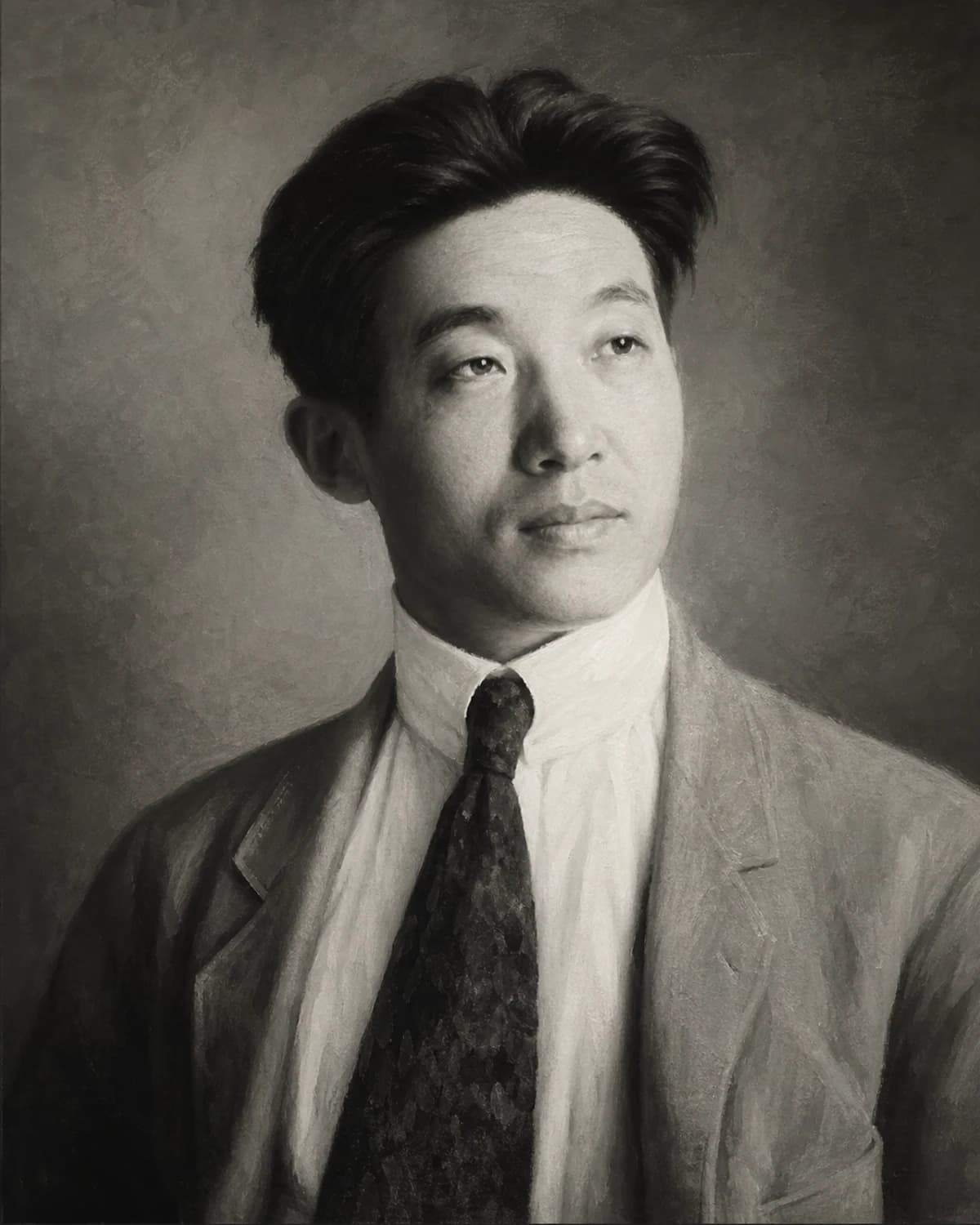
Biography
In March 1939 an exhibition opened at the Victoria Memorial Hall in Singapore in which paintings by Xu Beihong hung alongside works by Ren Bonian and Qi Baishi, 171 pieces in all. The proceeds went to victims of the war in China. From 1939 to 1941 he held solo exhibitions of this kind in Singapore, India and Malaya (in Penang, Kuala Lumpur and Ipoh) and gave all the money to help his compatriots.
In India he met Rabindranath Tagore and Mahatma Gandhi. These meetings led, among other things, to a huge painting, 4.21 metres wide, “The Foolish Old Man Who Removed the Mountains”; it is now in the Singapore Art Museum. “Put Down Your Whip” and “Portrait of Ms Jenny” were also painted during his travels in Southeast Asia. The Singaporean artists Chen Wen Hsi, Lee Man Fong and Chen Chong Swee regarded him as their mentor.
Xu Beihong was born on 19 July 1895 in Yixing county, Jiangsu province, in the last years of the Qing empire. His father, Xu Dazhang, kept a private school and wrote poetry and painted. He taught his son calligraphy from the age of six and painting from the age of nine.
In 1915 Xu moved to Shanghai and earned his living from commercial and private commissions; in 1916 he entered Fudan University to study French, and in 1917 he went to Tokyo to study art. On his return, at the invitation of Cai Yuanpei, he taught at the art school attached to Peking University. In 1919 he won a government scholarship and left for Paris, for the École Nationale Supérieure des Beaux-Arts, where he studied drawing and oil painting; Pascal Dagnan-Bouveret is named among his teachers. He remained in Europe until 1927, travelled to Germany, Belgium, Switzerland and Italy, looked at the old masters, and went on writing about painting and its history for the Peking University newspaper. In those years he gained a thorough command of drawing from life.
He came back in 1927 with his partner, Jiang Biwei. He was given the chair of painting at National Central University in Nanjing, founded the Nanguo Academy in Shanghai together with Tian Han and Ouyang Yuqian, and later headed the art faculty of Peking University. He pressed for a reform of art teaching: students should be taught European technique, drawing from life and perspective. It was at his invitation that Qi Baishi, too, became a professor. In 1933 Xu put together an exhibition of modern Chinese painting that was shown in France, Germany, Belgium, Italy and the Soviet Union. The 1930s brought the first flowering of his own painting.
He painted both in oil and in ink, but most of his work is in the traditional manner, on paper: horses, birds, flowers, people. His brush is free, yet the form is drawn precisely, and to Chinese ink technique he added European perspective and European methods of composition. The galloping horse became his most recognisable motif; on 5 May 1978 the post office of the People’s Republic of China issued a set of ten stamps and a souvenir sheet with his horses. Among his paintings, “Jiufang Gao” and “Spring Rain on the Li River” are also often named. It seems to me that what won the public over in these horses was the combination of a swift Chinese brush and a European draughtsman’s training. In oil he was one of the first in China to paint monumental pictures on epic Chinese subjects. As a teacher he saw it like this: technique serves the conception, and the conception grows out of the artist’s experience of life.
In 1946 the Kuomintang government appointed him president of the Beiping Art Academy. After the founding of the People’s Republic of China he became head of the China Artists Association, and in April 1950, when the academy was turned into the Central Academy of Fine Arts, he became its first president.
Xu Beihong died on 26 September 1953 in Beijing. His widow, Liao Jingwen, opened a memorial museum in their Beijing home.
Related context
Associations
Works connected through artistic movements, cultural context and period. Priced works available in this market appear first.








Profile notes
Profile and sources
Image
Artist image
На основе открытого изображения: Unknown author Unknown author; Wikimedia Commons; Public domain.
