
29.08.1919–25.06.2010
Wu Guanzhong
Wu Guanzhong studied in Hangzhou under Pan Tianshou and in Paris at the École des Beaux-Arts, and after returning to China heard himself accused of “formalism” for decades. All his life he looked for ways to nationalise oil painting and modernise Chinese painting, and he worked out his own painting in ink and colour on paper. In 1992 he became the first living Chinese artist to have an exhibition at the British Museum.
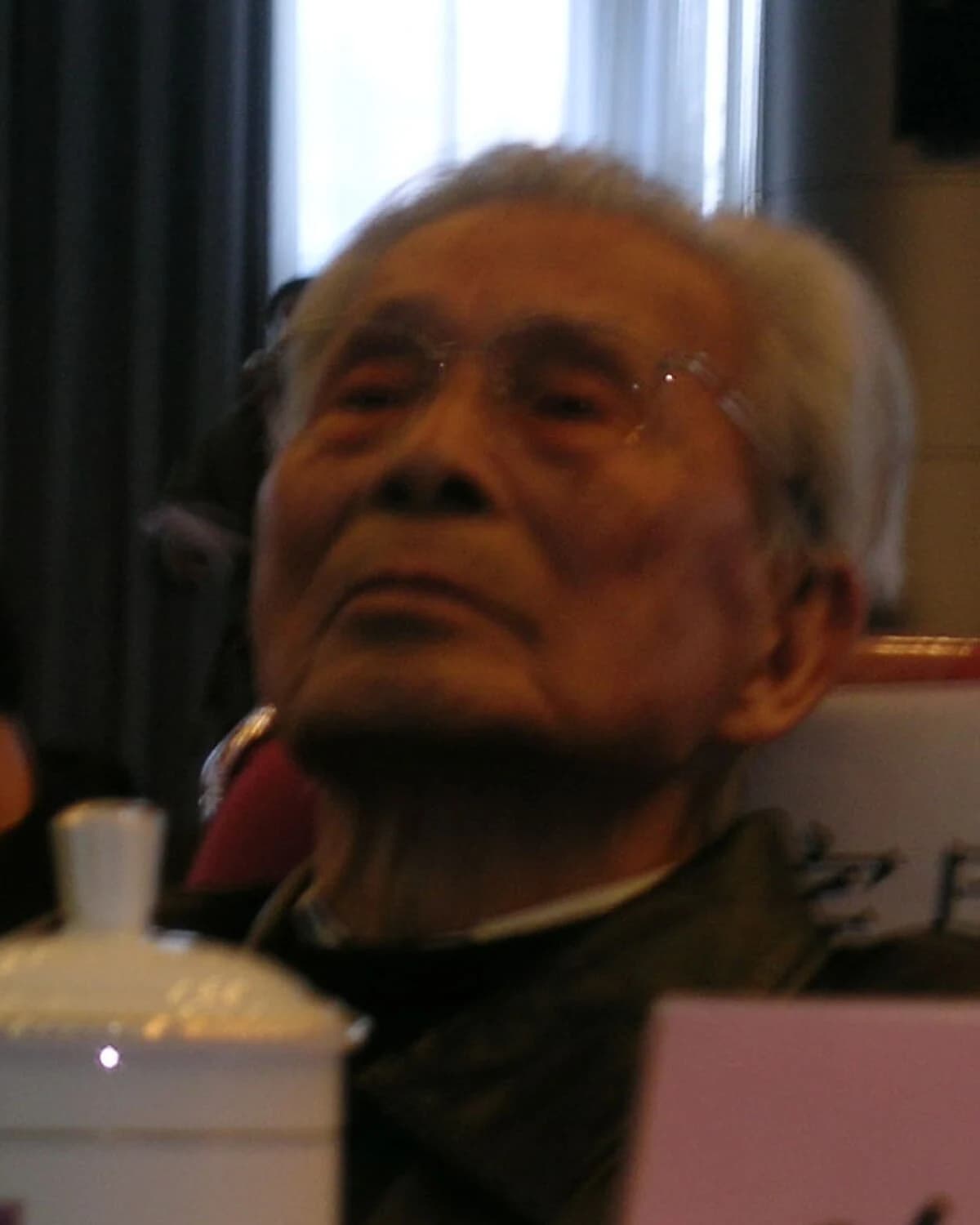
Biography
In May 1979 the Beijing journal Meishu published Wu Guanzhong’s article “The Beauty of Form in Painting”. The artist called for modern European painting to be opened up to Chinese artists and for the beauty of form to be discussed seriously, as a subject of science. There too is his short formula: oil painting must be nationalised, Chinese painting must be modernised.
He was nearly sixty, and by then he had lost most of his early work.
Wu Guanzhong was born on 29 August 1919 in a village in Yixing County, Jiangsu Province. His father was a teacher, and the family wanted the son to follow the same path. In the mid-1930s he enrolled in the electrical engineering department of an industrial school attached to Zhejiang University in Hangzhou, and there he met Zhu Dequn, a student at the art academy. Under his influence, in 1936, against his father’s wishes, he transferred to the National Academy of Art in Hangzhou. He studied both Chinese and Western painting, under Pan Tianshou, Fang Ganmin and Li Chaoshi, and also looked to Lin Fengmian and Wu Dayu.
A year later the Sino-Japanese War began, and the academy retreated into the interior: Zhuji, Mount Longhu in Jiangxi, Changsha, Yuanling in Hunan, Kunming, then Bishan County in Sichuan. For a time, out of admiration for Pan Tianshou, he moved to the department of Chinese painting, then went back to Western painting. After graduating in the early 1940s he taught drawing and watercolour in the architecture department of Chongqing University. In 1946, among the government scholarships for study abroad, there were two places for painters in France, and Wu achieved the best result in the country, partly because he had studied French. In the summer of 1947 he sailed for Paris and entered the École nationale supérieure des Beaux-Arts. In his first few days he went round all the city’s main museums. What interested him most were the Post-Impressionists: Cézanne, Gauguin and above all Van Gogh. It was Paris that made form the basis of his painting.
In 1950 he returned to China and until 1953 taught at the Central Academy of Fine Arts in Beijing. Socialist realism reigned there; his Western methods irritated colleagues, and he was dubbed “a fortress of bourgeois formalism”. He had to leave: in 1953 he moved to the architecture department of Tsinghua University, in 1956 to the Beijing Art Institute, and in 1964 to the Central Academy of Arts and Crafts. The work allowed him to travel around the country, and he went to places his colleagues did not; it was in these years that he became a landscape painter.
In August 1966, at the very start of the Cultural Revolution, he was forbidden to paint or to write about art, and many of his early works were destroyed. In 1970 he was sent for almost three years to do farm labour in Hebei Province. There he was allowed to paint only on Sundays and holidays. Having heard that artists were being persecuted and even killed, he burned his own paintings of nude figures. In the early 1970s he was brought back to Beijing to paint pictures for hotels. How much was lost in all is impossible to say: his early works can hardly be traced.
His first solo exhibition was held in 1978 at the Central Academy of Arts and Crafts, and in the 1980s recognition came. His way of working was this: he looked in nature for something that caught him, made a sketch, then spent a long time in the studio working out how to show the force of the form, and painted fast, with whatever brush came to hand, European or Chinese, for as long as his strength lasted. In “Twin Swallows” the white walls of Jiangnan houses become horizontal rectangles with a few black and grey lines, and two birds fly towards a tree. In “Lion Grove Garden” (1983) the largest rockery in Suzhou all but dissolves into sinuous lines, splashes of ink and dots of colour. He signed his works with the pen name Tu.
In 1991 the French Ministry of Culture made him an Officier of the Ordre des Arts et des Lettres. In 1992 Wu Guanzhong became the first living Chinese artist to be exhibited by the British Museum, and in 2002 he was elected a corresponding member of the Académie des Beaux-Arts of the Institut de France. He gave his works away to museums: in 2008 the Singapore Art Museum received 113 pieces, and at the same time the Palace Museum in Beijing received the painting “1974 · Yangtze River”.
Wu Guanzhong died on 25 June 2010 in Beijing, at the age of ninety. The Hong Kong Museum of Art, to which he and his family gave more than 450 works and documents on several occasions, opened the exhibition “Wu Guanzhong: Between Black and White” in 2024.
Profile notes
Profile and sources
Image
Artist image
Неизвестен; Wikimedia Commons; CC BY-SA 2.5.
