
16.12.1903–29.06.1938
Wolf Kibel
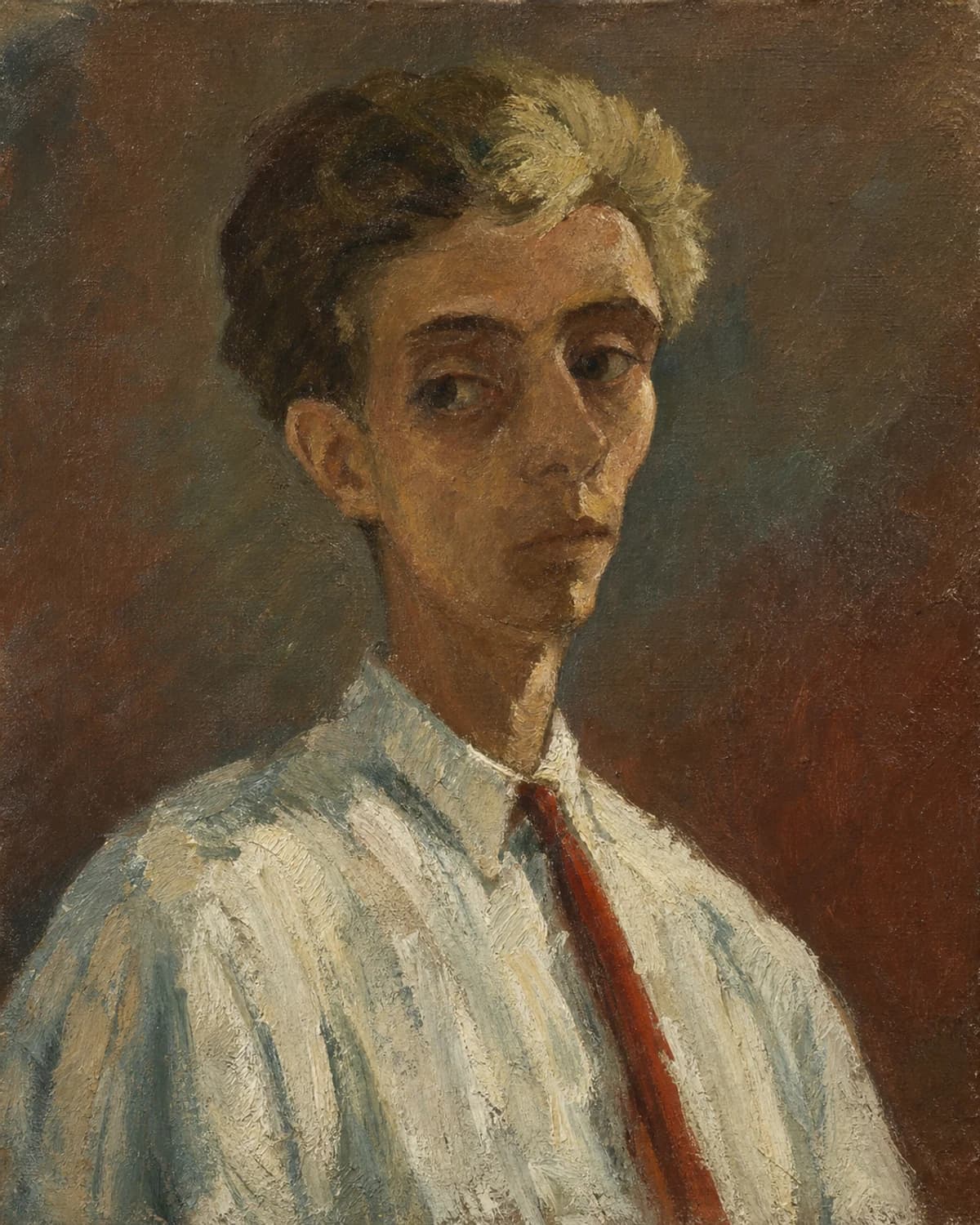
Wolf Kibel (1903–1938) grew up in a small town near Warsaw in a cantor’s family, walked as far as Vienna, spent four years in Palestine and in 1929 came to Cape Town to join his brother. South African audiences met his exhibitions of 1931 and 1935 with hostility. He was the first to show monotypes in South Africa in any number, including at the 1936 Empire Exhibition in Johannesburg.
Biography
In 1923 Wolf Kibel set out from Poland for Paris on foot. He got no further than Vienna: the journey through Czechoslovakia took several months and about 524 kilometres.
He was born on 16 December 1903 in Grodzisk Mazowiecki, a shtetl thirty-two kilometres from Warsaw, then part of Congress Poland. His father served the community as hazzan (cantor) and shochet (ritual slaughterer), came from a family of singers, and also carved miniatures, composed cantorial music, wrote verse and did bookbinding. Wolf was the third son and fifth of six children; he sang in his father’s choir and carved grotesques from his father’s oil-stones. His father died in 1911. When the First World War began, the family moved to Warsaw, where the boy was apprenticed to a bookbinder but lost the place after an accident. Back in Grodzisk he was apprenticed to a maker of shoe uppers, ran away to the countryside for several days, and after that was allowed to draw and paint freely. The first professional artist to see his work was a friend of relatives in London named Appelbaum, who had come to Poland to paint a synagogue. He took the young man to Warsaw, where Kibel met artists, visited galleries and read books and periodicals. He liked the paintings of Jozef Israëls and Jan Matejko.
After the Treaty of Versailles in 1919, a wave of pogroms swept through Poland. That hostility, and the prospect of conscription, drove Kibel west. In Vienna, impoverished and full of refugees, he often slept in the Prater park. An antique dealer introduced him to the portrait painter Edmund Pick-Morino, who found him a wealthy patron, a banker, and let him draw and paint his models, some of them society ladies wearing masks. It was probably then that Kibel saw the work of Oskar Kokoschka. Without papers he could not travel to Paris, and Pick-Morino persuaded him to go to Palestine.
In 1925 Kibel reached Haifa, then Jerusalem, and caught malaria on the way. His only possession was a letter of introduction to Boris Schatz, director of the Bezalel Art School. The patriotic pictures the pupils were expected to paint there disappointed him, and he left for Tel Aviv. There he slept on the beach until a cousin who worked as an immigration officer took him to a private doctor; a course of Salvarsan injections cured the malaria. A friend named Popek, who lived with his wife on a tiny dairy farm on the outskirts, took him in, and when Kibel insisted on leaving, pressed his savings book on him so that he could rent a room. He became friends with Yitzhak Frenkel, who had spent seven years in Paris, but was never his pupil. It was also then that he met his future wife, Freda. The Tel Aviv artists admired Paul Cézanne to the point of slavish imitation; Kibel thought this dangerous and told his friends so plainly. He himself admired Marc Chagall, and was impressed by the formalism of Henri Matisse. He worked mostly in watercolour and black-and-white drawing, since oil paint was more expensive, and he turned to oils when a certain Dr Zlockisty offered to pay for the materials. The Hebrew poet Hayim Nahman Bialik supported his work, and they became close friends.
After four years in Palestine Kibel passed the citizenship examination in Hebrew; until then he had been stateless since birth. At about the same time an affidavit arrived from his brother Sam, who had settled in Cape Town and did not know that Wolf had a wife. In December 1928 Freda left for Kraków, where she gave birth to their first child.
Kibel arrived in Cape Town on 27 June 1929, the day their son Joseph was born in Kraków. He lived with his brother, a cantor at the synagogue in the Company’s Gardens, but it soon became clear that his brother did not approve of his career in art, and Kibel regretted the move. He then took a room in the house of Roza van Gelden, principal of a primary school, who in exchange for lessons gave him a studio at the school. The Cape Town galleries held no interest for him, and the townspeople, he felt, cared nothing for painting. In December 1931 he held an exhibition at Martin Melck House to raise money to join his family. The public and a circle of critics, among them Bernard Lewis of Die Burger, who were unfamiliar with the avant-garde or hostile to it, were outraged. The art teacher Frank Barrington Craig praised the show, and the artist Hugo Naudé invited Kibel to his house in Worcester. Kibel stayed there and learned etching in Naudé’s studio. The Naudés’ kindness convinced Wolf and Freda that Paris would be too difficult a move, and Freda and Joseph arrived in Cape Town on 19 January 1933. By her account he was working a great deal from life in a wide range of media: pastel, oil, watercolour, tempera, chalk, pen, etching. The influence of Matisse seems to have faded, giving way to a style of his own.
He moved his studio to a dilapidated building in Roeland Street called Palm Studios, where he shared the upper floor with Lippy Lipshitz, who had just come back from Paris. Both took pupils to make ends meet. His 1935 exhibition at Ashbey’s Gallery, opened by Lipshitz, again drew abuse from the public, but Melvin Simmers of the Cape Times reviewed it favourably under the heading “Virile Exhibition by Wolf Kibel”. The failed exhibitions, the birth of a second child, Aaron, and the general hostility to his art led to tension between the two artists, and in 1937 they were evicted.
Kibel is often called an Expressionist, but his painting has none of the exuberance of Irma Stern or the pastoral quality of Maggie Laubser. He did not share the revolutionary anger of the first Expressionists; his influences were Matisse, Chagall and Soutine, and like them he came from an Eastern European Jewish background. Like Soutine, he painted with rich impasto and expressive brushwork. He was a strict formalist: he explained nothing, would not talk up a sale, and did not sign or date his works, and he despised exhibitions, which did not endear him to the public or the critics. He also avoided the picturesque, such as Cape Town’s Malay Quarter, which is still mined endlessly for saleable pictures. He himself wrote that he wanted a very high degree of complexity and order without losing spontaneity, “something like an orchestral effect in paint”. By the judgement of scholars, he brought the monotype, worked from metal plates, to expressive maturity and made it a respectable art form.
His last exhibition was held in 1937: forty-five works, among them a tempera portrait of his wife, bought by the South African National Gallery. Simmers wrote in the Cape Times on 24 June 1937 about his coloured monotypes. Kibel died in Cape Town on 29 June 1938, visited by friends, above all Cecil Higgs and Maggie Laubser. His works are held by the South African National Gallery in Cape Town, the Johannesburg Art Gallery, the museums of Pretoria and Durban and other collections across the country.
Related context
Associations
Works connected through artistic movements, cultural context and period. Priced works available in this market appear first.








Profile notes
Profile and sources
Image
Artist image
На основе открытого изображения: Wolf Kibel; Wikimedia Commons; Public domain.
