
24.02.1836–29.09.1910
Winslow Homer
Winslow Homer (1836–1910) earned his living for almost twenty years as an illustrator, including at the fronts of the Civil War, and then became America’s foremost painter of the sea. From 1883 he lived on the Prouts Neck peninsula in Maine, painting the struggle between man and the ocean, and on trips to Florida, the Bahamas and the Adirondacks he worked in watercolor.
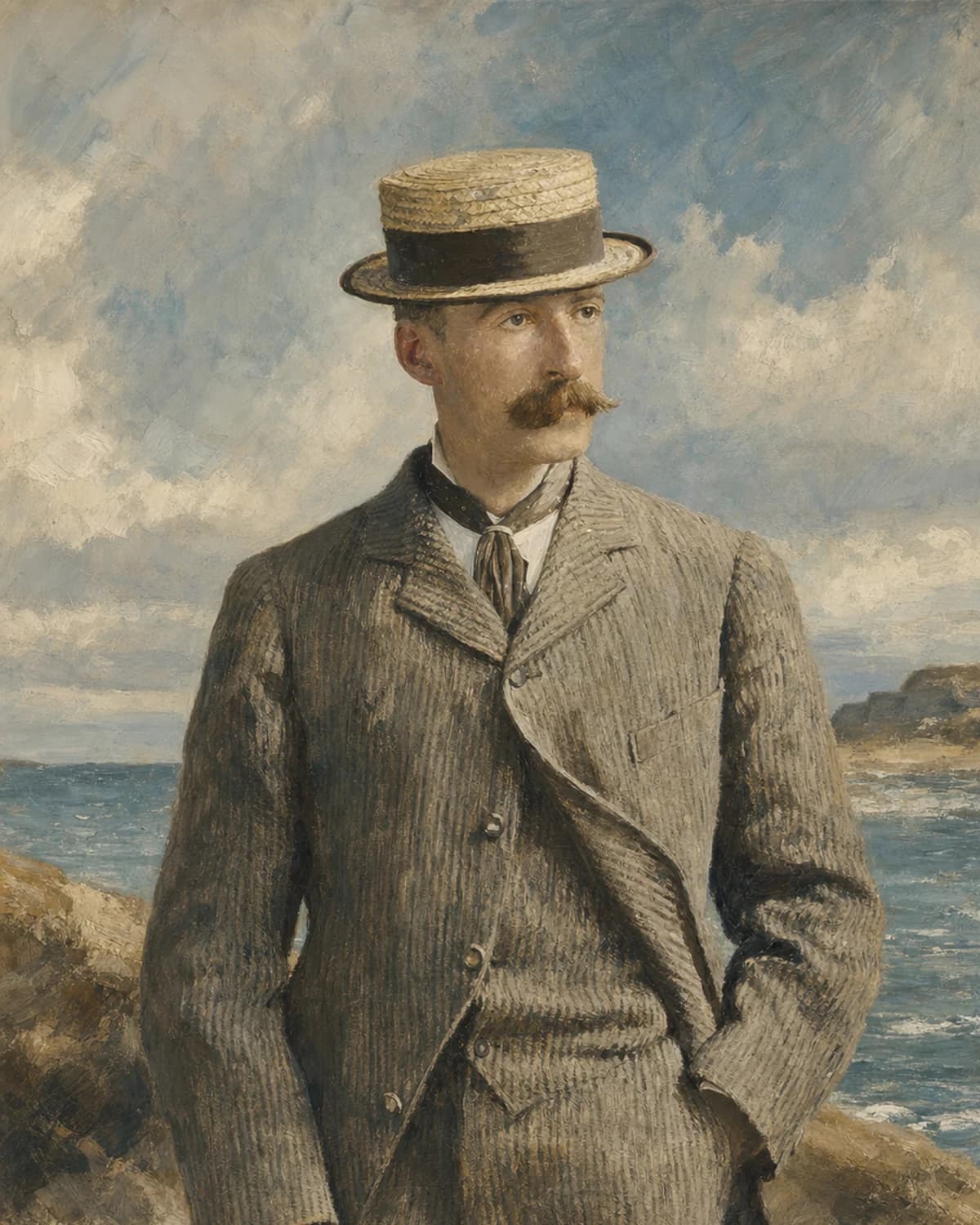
Biography
“From the time I took my nose off that lithographic stone, I have had no master, and never shall have any,” Winslow Homer used to say. The stone stood in the Boston lithography shop of John Bufford, where he was apprenticed after school. There he drew sheet music covers and other commercial work over and over, and he later remembered those years as a treadmill.
After that he studied only in snatches: classes at the National Academy of Design, a few lessons from Frederick Rondel, and the rest on his own.
Homer was born on 24 February 1836 in Boston, the second of three sons of Charles Savage Homer and Henrietta Benson Homer, both from old New England families. He grew up in Cambridge, then still almost rural. His mother was a gifted amateur watercolorist; she became his first teacher and, until her death in 1884, remained the person closest to him. His father, a restless businessman, gave up his hardware business in 1849 for the California gold rush, then looked for money in Europe and came back with nothing. Perhaps that is why the son was so careful with money all his life.
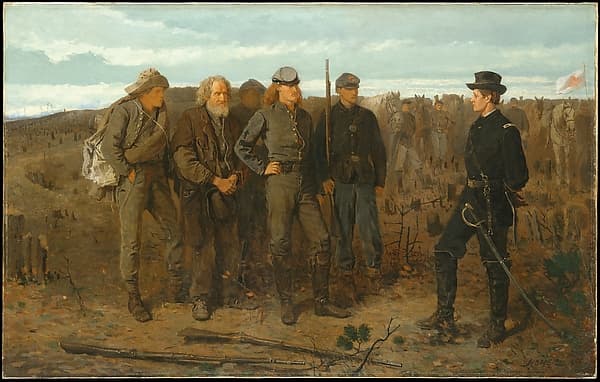
Homer worked as an illustrator for almost twenty years. From 1857, having turned down a staff position at Harper’s Weekly, he worked freelance for it and for Ballou’s Pictorial, and in 1859 he opened a studio in New York. His early wood engravings of city and country scenes are marked by clean outlines, simple forms, sharp contrasts of light and shade and lively groups of figures, qualities he kept for good. In 1861 Harper’s sent him to the front of the Civil War; he made his first sketches in October with General McClellan’s army on the Potomac. From them came “Sharpshooter on Picket Duty” (1862), “Home, Sweet Home” (1863) and “Prisoners from the Front” (1866). “Home, Sweet Home”, with its soldiers listening to the evening band and thinking of home, was especially praised, and in 1865 Homer became a full Academician of the National Academy.
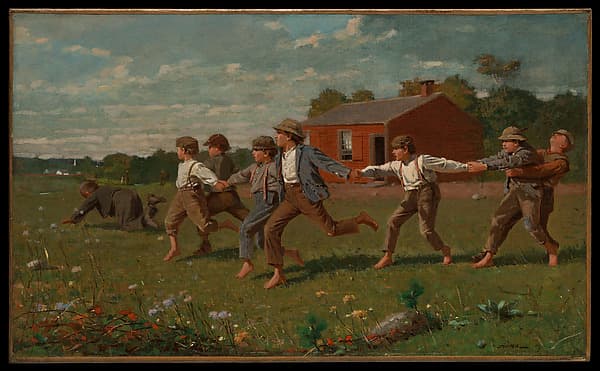
In 1867 he went to Paris for a year, where “Prisoners from the Front” was hanging at the Exposition Universelle. He painted peasant life, closer to the Barbizon painters and Millet than to Manet and Courbet, and did no formal study anywhere. According to his fellow artist Eugene Benson, Homer believed that an artist should never look at pictures at all, but should stutter in a language of his own. The 1870s brought “Country School” (1871), “Snap the Whip” (1872) and “Breezing Up” (1876), with a father and three boys out sailing. In 1875 he gave up illustration and resolved to live by painting alone. Around 1876, after a stay in Virginia, he painted “A Visit from the Old Mistress” (1876), in which four freed slaves stand before their former owner, and “Dressing for the Carnival” (1877).
He took up watercolor in earnest in the summer of 1873 at Gloucester. At first critics wrote that a child with an ink bottle could not have done worse, but the watercolors sold more easily than the oils and noticeably improved his finances. By the end of the 1870s he had withdrawn from city life and for a time even lived at the Eastern Point Lighthouse with the keeper’s family.
In 1881–1882 Homer lived in the fishing village of Cullercoats on the English coast of the North Sea. “The women are the working bees,” he wrote, and he drew them cleaning fish, mending nets and waiting for the men at the water’s edge. His palette grew restrained, his sheets larger, his conception more deliberate; when in November 1882 he showed the English watercolors in New York, critics at once saw a different Homer.
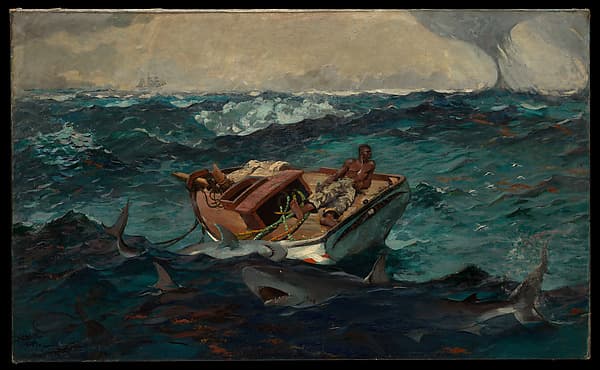
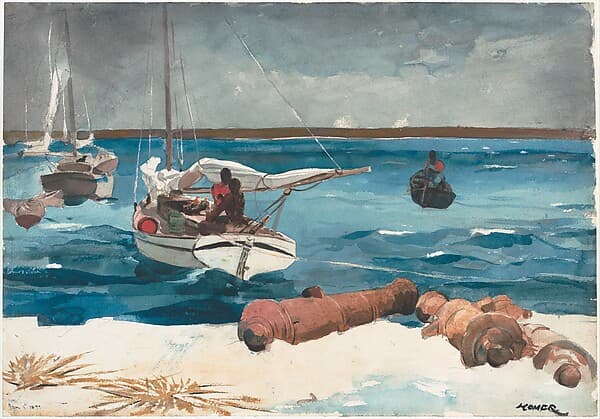
In 1883 he settled at Prouts Neck in Maine, in a remodeled carriage house on the family estate, a little over twenty meters from the ocean, and lived there to the end. The large sea pictures followed: “Undertow” (1886), in which two lifeguards pull two women bathers out of the surf, and “Eight Bells” (1886), with sailors taking the ship’s bearings. He was called a Yankee Robinson Crusoe and a hermit with a brush. He spent the winters of 1884–1885 in Florida, Cuba and the Bahamas on a commission from Century Magazine, from 1888 to 1903 he often stayed in Key West, and in summer he went fishing in the Adirondacks, where he painted his boldest watercolors. In “The Fox Hunt” (1893), his largest painting, starving crows descend on a fox floundering in deep snow; the Pennsylvania Academy of the Fine Arts bought it at once, and it was his first work in a major American museum. In “The Gulf Stream” (1899) a Black sailor lies in a broken boat among sharks while a waterspout approaches. To my mind, this is his harshest picture.
By 1900 he had at last become well off. In the late seascapes there are hardly any people, only waves breaking against rocks in changing light. In 1907 he advised a young artist to leave rocks for old age, because they are easy.
Homer died on 29 September 1910 in his studio at Prouts Neck, at the age of seventy-four, and was buried in Mount Auburn Cemetery in Cambridge. The painting “Shooting the Rapids, Saguenay River” remained unfinished. The studio now belongs to the Portland Museum of Art.
Artist works
Works by the artist
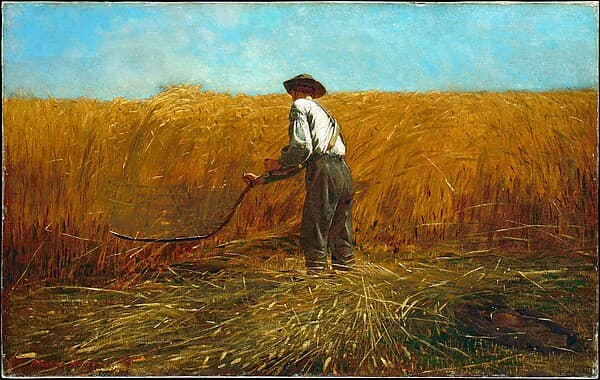
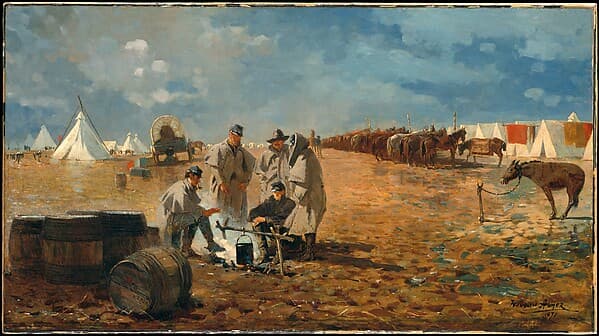
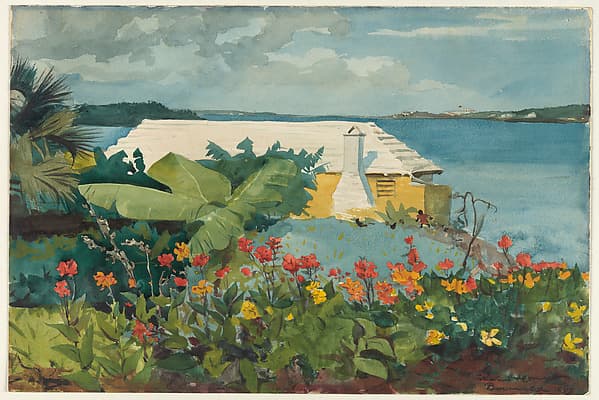
Works by Winslow Homer available in this edition of NEOARCA.
Related context
Associations
Works connected through artistic movements, cultural context and period. Priced works available in this market appear first.








Profile notes
Profile and sources
Image
Artist image
На основе открытого изображения: Napoleon Sarony; Wikimedia Commons; Public domain.
