
24.04.1904–19.03.1997
Willem de Kooning
Willem de Kooning (1904–1997) arrived in the United States from Rotterdam as a stowaway in 1926 and lived in New York and East Hampton for seventy years. He was one of the leaders of Abstract Expressionism and the New York School. He is best known for his black-and-white abstractions of the late 1940s and the “Woman” series begun in 1950; in the 1970s he also worked as a sculptor.
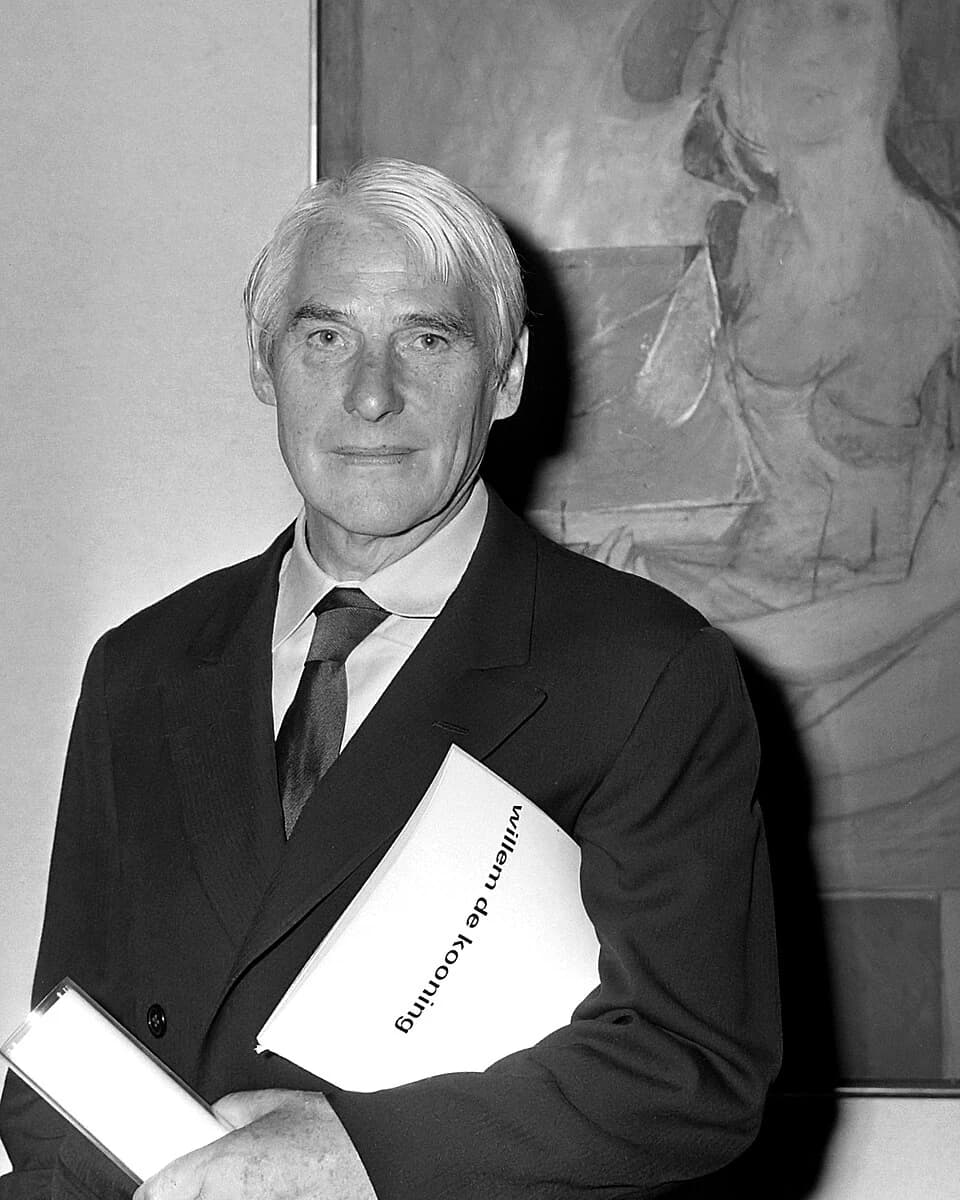
Biography
On 15 August 1926 a stowaway from the British freighter Shelley, bound for Argentina, came ashore at Newport News, Virginia. The twenty-two-year-old Dutchman did not know a word of English and meant to draw for pulp magazines: American illustrators, he recalled in 1969, were the artists who inspired him most. His name was Willem de Kooning.
He kept a strong Dutch accent for the rest of his life.
He was born on 24 April 1904 in Rotterdam, into a poor family in the working-class district of Oude Noorden. His parents, Leendert de Kooning and Cornelia Nobel, divorced in 1907, and the boy lived first with his father, then with his mother. In 1916 he left school to become an apprentice in a firm of commercial artists, and until 1924 he attended evening classes at the Rotterdam Academy of Fine Arts and Applied Sciences, which now bears his name.
In America he first lived in Hoboken, at the Dutch Seamen’s Home, and worked as a house painter. In 1927 he moved to Manhattan, took a studio on West Forty-fourth Street and earned his keep with carpentry, house painting and commercial art. He began painting in his spare time and in 1928 joined the art colony at Woodstock. At the same time he got to know the American Stuart Davis, the Armenian Arshile Gorky and the Russian John Graham, whom he called the “Three Musketeers”. Gorky, whom he met at Misha Reznikoff’s, became a close friend and for at least ten years influenced his painting; one contemporary said that De Kooning virtually worshipped Gorky. The drawing “Self-portrait with Imaginary Brother” (about 1938) may show the two of them together. In 1934 De Kooning joined the Artists Union, and in 1935 he found work on the Federal Art Project and designed murals, among them some for the Williamsburg housing project in Brooklyn. None was carried out, but a sketch went into the exhibition “New Horizons in American Art” at the Museum of Modern Art, his first group show.
In 1937, lacking American citizenship, he had to leave the project, and from then on he lived by art alone, on commissions and lessons. He was given a portion of the mural “Medicine” for the Hall of Pharmacy at the 1939 World’s Fair in New York, and it caught the critics’ attention. His still lifes of the 1930s are abstract, built of geometric and biomorphic shapes in strong colour, with an eye on Arp, Miró, Mondrian and Picasso; alongside them came solitary men, standing or seated against an undefined background, and many of these canvases were left unfinished. In 1938 he met a young painter, Elaine Fried, taught her and strictly criticised her drawings, and on 9 December 1943 they married.
By 1946 he had begun a series of black-and-white paintings, which he continued until 1949. His first solo exhibition, at the Charles Egan Gallery in New York in 1948, consisted mainly of these works, with only a few passages of bright colour here and there. Densely packed forms, mixed media and the handling itself made them a significant chapter in the history of Abstract Expressionism. The black calligraphic images of those years show the influence of Franz Kline, one of his closest friends. Together with Kline and Jackson Pollock, De Kooning was counted among the Abstract Expressionists, the “action painters”, the New York School.
He had painted women before, but only in 1950 did he take them up in earnest. The “Woman” series, carried through to “Woman VI”, owes much to Picasso: the figure and the space around it are broken apart sharply, almost aggressively. The critic Harold Rosenberg wrote that in De Kooning’s work Woman is at once an object of desire, of inner conflict and of pleasure, and a problem demanding an engineer’s precision. The works in the series are painted in oil, enamel and charcoal on canvas; “Woman III” and “Woman VI” are dated 1953, and 1955 brought “Interchange” and “Police Gazette”. In the late 1950s the figures receded, the paintings became more abstract, and landscape motifs appeared in them.
In 1957 the couple separated. On 13 March 1962 De Kooning became a United States citizen; the following year he moved from Broadway to East Hampton on Long Island, into a house bought from Elaine’s brother, built a studio nearby and lived there to the end. He and Elaine never divorced, and in 1976 they lived together again. In the 1970s he made sculpture: “Clamdigger” and “Seated Woman on a Bench” are dated 1972–1976.
Between 1948 and 1966 he had fourteen solo exhibitions. He was the first artist to receive the Praemium Imperiale. The retrospective at the Museum of Modern Art in 2011–2012 was the most visited exhibition in New York in 2012.
In the late 1980s his memory began to fail, his last paintings are dated 1991, and ever since scholars have argued over how far the late works are his own. I would leave that question open.
Willem de Kooning died on 19 March 1997 in East Hampton, at the age of 92.
Related context
Associations
Works connected through artistic movements, cultural context and period. Priced works available in this market appear first.








Profile notes
Profile and sources
Image
Artist image
Jack de Nijs for Anefo; Wikimedia Commons; CC0.
