
08.12.1902–11.09.1982
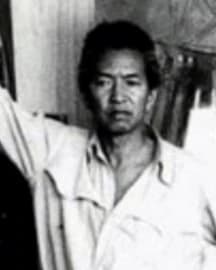
Wifredo Lam
Wifredo Lam, the son of a Chinese immigrant and the grandson of a former slave woman from the Congo, grew up in Sagua la Grande in Cuba, studied in Havana and Madrid, fought for the Republic and in 1938 in Paris became close to Picasso. Back in Cuba he painted “The Jungle” (1943), in which figures with mask-like faces grow into the sugar cane. From the 1950s he lived in France and Italy and also worked in ceramics and sculpture.
Biography
On a large sheet of paper mounted on canvas, four figures with mask-like heads stand in dense undergrowth. Sugar-cane stalks and palm leaves pass straight through their bodies; the figures have enormous feet, and the one on the far right holds a pair of scissors. This is “The Jungle”, which Wifredo Lam began in Havana in 1943. The same year the picture was shown at the Pierre Matisse Gallery in New York, where it caused controversy, and it was later bought by the Museum of Modern Art.
He was born on 8 December 1902 in Sagua la Grande, a small town in the sugar-growing province of Villa Clara. His mother, Ana Serafina Castilla, was the daughter of a former slave woman from the Congo and a Cuban mulatto; his father, Lam Yam, had come to Cuba from Canton. The house had Chinese porcelain and screens, and nearby lived many people of African descent who, like the Lams, combined Catholicism with African rites. The boy’s godmother, Mantonica Wilson, was a Santería priestess and a healer known throughout the district. Lam never went through initiation, but he knew the rituals of the orishas from childhood, and later it was this that became the main source of his art.
In 1916 his family sent him to Havana to study law. Instead of law he went to the botanical garden to study tropical plants, and from 1918 to 1923 he studied painting at the School of Fine Arts, although the academic manner did not appeal to him. In the autumn of 1923 he left for Madrid. In the mornings he worked in the studio of the conservative Fernando Álvarez de Sotomayor, curator of the Prado and Dalí’s teacher, and in the evenings with young rebels; at the Prado he was struck by Bosch and Bruegel.
In 1929 he married Eva Piris. Soon afterwards both she and their small son died, and for a long time Lam’s work was filled with dark motifs, the theme of motherhood among them.
When the Civil War began he sided with the Republic and drew posters, then was called up to defend Madrid; at the end of 1937 he was invalided out and sent to Barcelona. There he met the researcher Helena Holzer and the Catalan sculptor Manolo Hugué. Manolo gave him a letter of introduction to Picasso, whose exhibition Lam had seen in Madrid a year earlier. In 1938 Lam arrived in Paris. Picasso received him at once, put him in touch with Léger, Matisse, Braque and Miró and introduced him to the dealer Pierre Loeb. Lam’s first solo exhibition was held in the summer of 1939 at Loeb’s gallery, and in the autumn his gouaches hung beside drawings by Picasso at the Perls Gallery in New York. In these years he worked mainly in gouache: angular figures, despairing women, couples, echoing African sculpture more and more strongly. He is often compared with Picasso, and the comparison is fair, but I think Lam had begun to simplify his forms even before he saw Picasso’s work.
When the Germans entered Paris in 1940, Lam went to Marseille. There he illustrated the poem “Fata Morgana” by André Breton, whom he had met in 1939. In 1941, together with Breton, Claude Lévi-Strauss and other refugees, he sailed for Martinique, spent forty days there under arrest and by midsummer had reached Cuba.
At home he saw that the descendants of slaves were still without rights and that Afro-Cuban culture had been turned into exotica for tourists. In an interview with Max-Pol Fouchet he explained that he had wanted to be a Trojan horse from which figures would emerge to disturb the sleep of the exploiters. This is how his hybrid creatures came about, half human, half animal and plant, joining the devices of Cubism and Surrealism with the imagery of Santería. In 1944 he married Helena Holzer (they divorced in 1950), and in 1946 he spent four months with Breton in Haiti, where he watched vodou ceremonies. In 1950, with René Portocarrero and other artists, he worked on ceramics in Santiago de las Vegas.
From 1952 Lam lived in Paris but did not break his ties with Cuba. In 1955 he exhibited paintings at the University of Havana in support of the students protesting against Batista’s dictatorship, and in 1965–1966 he painted “The Third World” for the Presidential Palace; it is now in the National Museum of Fine Arts in Havana. In 1960 he set up a studio in Albissola Marina on the Ligurian coast and settled there with his wife, the Swedish artist Lou Laurin, and their three sons. In 1964 he received the Guggenheim International Award, and in 1966–1967 retrospectives of his work were held in Basel, Hanover, Amsterdam, Stockholm and Brussels. On the advice of Asger Jorn he took up ceramics, showing them for the first time in 1975, and in his last years he modelled figures resembling the characters of his paintings and cast them in metal.
Wifredo Lam died on 11 September 1982 in Boulogne-Billancourt near Paris; in accordance with his will, his ashes were buried in Cuba. In 1983 the Wifredo Lam Contemporary Art Centre opened in Havana, and it still organises the Havana Biennial.
Related context
Associations
Works connected through artistic movements, cultural context and period. Priced works available in this market appear first.








Profile notes
Profile and sources
Image
Artist image
Unknown author Unknown author; Wikimedia Commons; CC0.
