
04.12.1866–13.12.1944
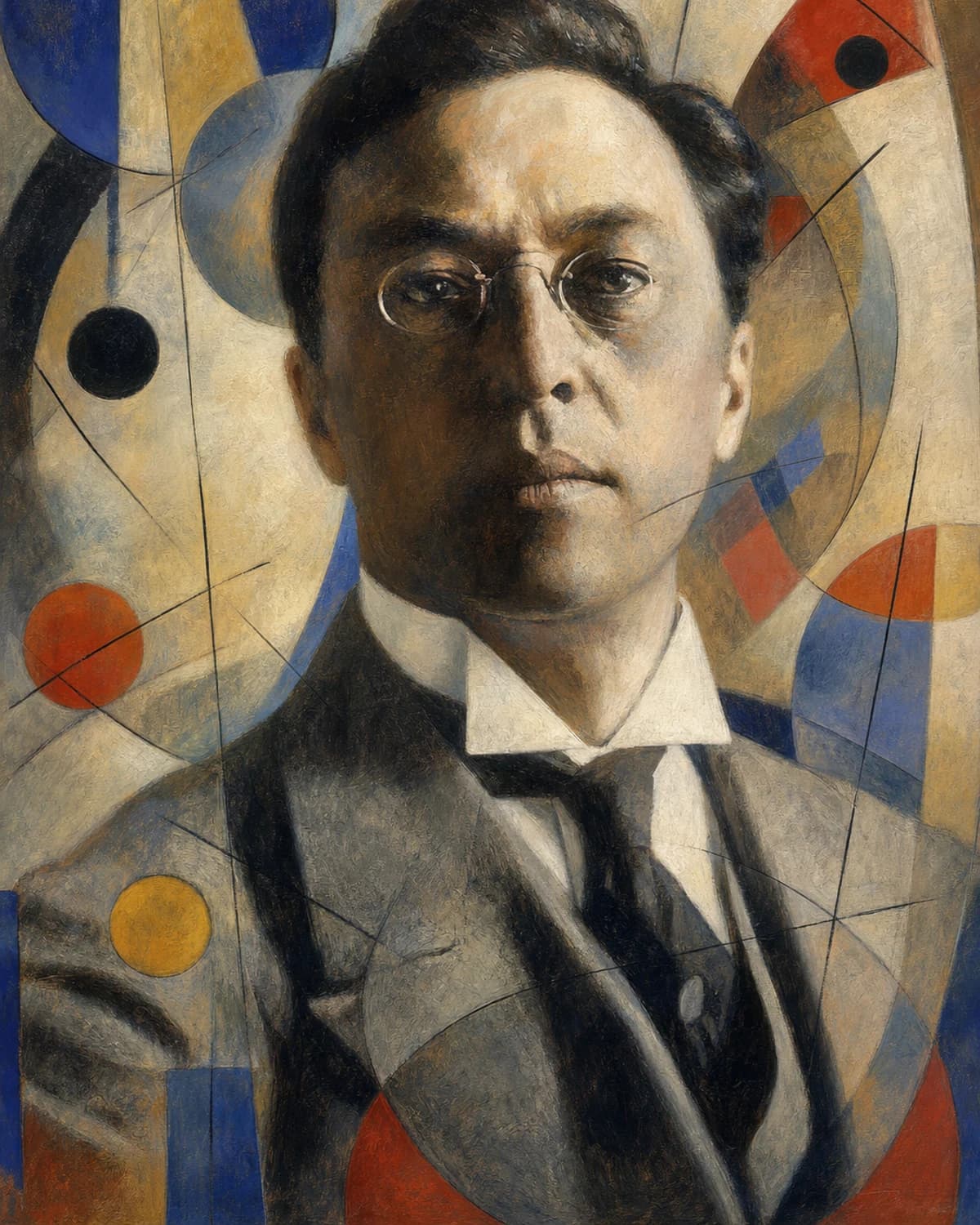
Wassily Kandinsky
Until the age of thirty Wassily Kandinsky was a lawyer and economist preparing for a professorship at Moscow University. In 1896 he left to study painting in Munich, where he founded Der Blaue Reiter with Franz Marc and wrote the treatise “Concerning the Spiritual in Art”. After the revolutionary years in Moscow he taught at the Bauhaus, and from 1933 he lived in France.
Biography
At an exhibition of French Impressionists in Moscow in 1896, Kandinsky stood in front of Claude Monet's “Haystack” and could not make out what it showed. That it was a haystack, he learned from the catalogue. He later recalled that at first he was annoyed (a painter, it seemed to him, had no right to paint so unclearly), but the picture lodged in his memory, and the colour in it lived almost without an object. To my mind, the whole of his later story begins with that irritation.
He was thirty, and until then he had intended to become a university professor.
He was born on 22 November (4 December) 1866 in Moscow, into the family of a tea merchant, Vasily Silvestrovich Kandinsky. His childhood was spent travelling around Europe and Russia, and from 1871 the family lived in Odessa, where the boy finished gymnasium and studied drawing and music. In 1885 he entered the law faculty of Moscow University and studied political economy and statistics under Professor Alexander Chuprov. From 28 May to 3 July 1889 he travelled with an ethnographic expedition through the northern districts of Vologda Governorate. The peasant houses and churches there were painted so brightly that on stepping inside he felt he was walking into a picture. In 1892 he received a first-class diploma and was kept on at the university to prepare for a professorship, and in the same year he married his cousin Anna Chemyakina. In 1895–1896 he ran the art department of Kushnerev's printing house in Moscow, and in November 1895 he wrote to Chuprov that he was giving up scholarship: he was ever more strongly drawn by “an old and once hopeless love of painting”. He turned down a post as privatdozent at the University of Dorpat.
In Munich Kandinsky spent two years at Anton Ažbe's private studio and came away dissatisfied; in 1900 he entered the Academy of Fine Arts under Franz von Stuck, and in 1901 he founded the Phalanx association, with a school where he did the teaching himself. At the school's summer classes in 1902 he grew close to one of the students, Gabriele Münter, and until 1914 they were together: they travelled around Europe and North Africa, and from 1909 spent long periods in Murnau, in a house Münter had bought. The early works are still figurative. In “The Blue Rider” (1903) the horseman on his galloping horse looks more like a dense patch of blue than a man. In “Blue Mountain” (1908–1909) the details are almost gone: a mountain, a yellow tree and a red one, and below a procession in which each rider's face and clothes are a single colour.
In 1909 he was elected chairman of the New Munich Artists' Association. The association could not cope with radical ideas, and in 1911 Kandinsky and Franz Marc started their own venture: the almanac “Der Blaue Reiter” and two exhibitions, joined by August Macke, Münter, Alexej von Jawlensky and Paul Klee. In the same year he finished the treatise “Concerning the Spiritual in Art”. In December 1911 Nikolai Kulbin read it as a paper at the All-Russian Congress of Artists in St Petersburg (the author was unable to come); in 1914 the book came out in English. Kandinsky called his freest works improvisations and his most carefully planned ones compositions, as in music. With “Composition VI” he got stuck: six months of sketches, a huge board with outlines, and it would go no further. Münter, so the story goes, advised him to repeat aloud the German word for “deluge” (Überflut), thinking of its sound, and he finished the painting in three days. In 1913 an Englishman, Michael Sadler, bought a fragment for “Composition VII”; it was one of the first of his works to enter a British collection.
The war sent him back to Moscow by way of Switzerland and Sweden. He met Münter once more, in Stockholm in 1916, and with that they parted. On 29 January (11 February) 1917 Kandinsky married Nina Andreevskaya. At that time he painted mostly landscapes, realistic and semi-abstract, and after the revolution he almost stopped painting and went into institutional work: the board of the Fine Arts Department of Narkompros, the purchasing commission, the Museum of Painterly Culture, Vkhutemas, a course on “Contemporary Art” at the university, the post of vice-president of the Russian Academy of Artistic Sciences. In 1918 his “Steps” was published. At the Institute of Artistic Culture, which he had helped to set up, his radical colleagues found his programme for the analysis of colour and form too individualistic and bourgeois.
In December 1921 he went to Berlin to open a branch of the academy and never came back.
From the summer of 1922 Kandinsky taught at the Bauhaus: the introductory course on form, theory, a painting class. His pictures became geometric, with circles, semicircles, angles, straight lines and curves. In the two-metre canvas “Yellow-Red-Blue” (1925) a vertical yellow rectangle, a tilted red cross and a large dark blue circle collide. In 1926 his book “Point and Line to Plane” came out. From 1923, together with Klee, Lyonel Feininger and Jawlensky, he belonged to the Blue Four, whom Galka Scheyer promoted in the United States, and in 1928 in Dessau he staged Mussorgsky's “Pictures at an Exhibition” as a performance of moving forms and colour. That same year he became a German citizen.
In 1933 the Nazis closed the Bauhaus, and Kandinsky left for France. He worked in his Paris flat, right in the living room. The forms on his late canvases are soft, like organisms under a microscope, and sometimes he mixed sand into the paint. In 1936 and 1939 came the last two large compositions, IX and X. In Germany, meanwhile, his works were being removed from museums as “degenerate art”. The first three “Compositions” were lost in the war and are known only from Münter's black-and-white photographs, but many of his other paintings Münter hid in the cellar of the Murnau house and saved.
In 1939 Kandinsky became a French citizen. He died on 13 December 1944 in Neuilly-sur-Seine near Paris and is buried in the New Cemetery of Neuilly.
Related context
Associations
Works connected through artistic movements, cultural context and period. Priced works available in this market appear first.








Profile notes
Profile and sources
Image
Artist image
На основе открытого изображения: 未知上傳者; Wikimedia Commons; Public domain.
