
16.12.1885–31.05.1953
Vladimir Tatlin
Vladimir Tatlin (1885–1953) conceived the Monument to the Third International: a leaning double spiral of iron four hundred metres high with rotating glass volumes inside. The tower was never built, but its model became an emblem of the whole Russian avant-garde. Before the revolution Tatlin made counter-reliefs of wood and metal; later he built Letatlin, an engineless flying machine, and designed stage productions and books.
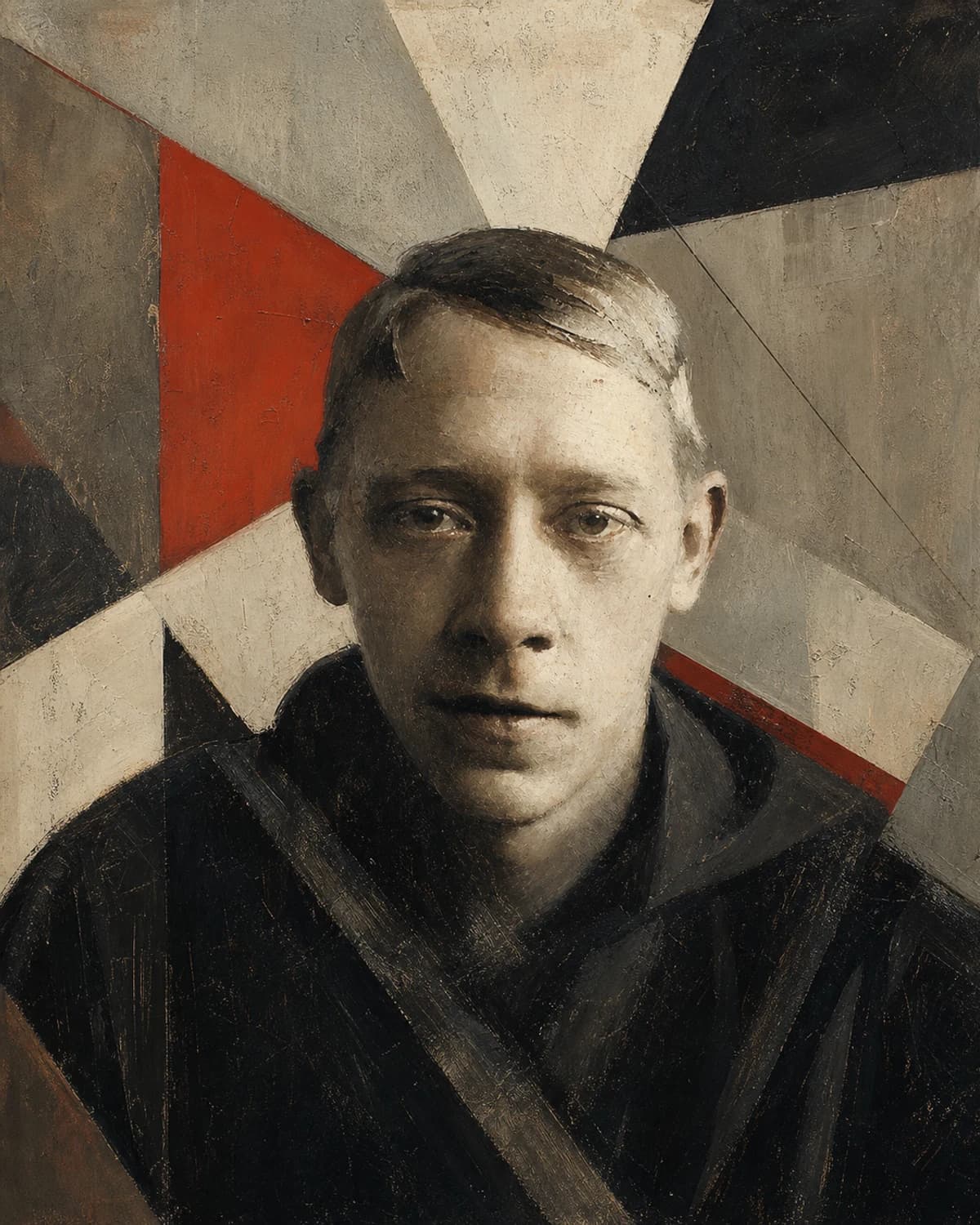
Biography
Inside the tower three glazed volumes were to rotate: the cube would turn once a year, the pyramid once a month, the cylinder once a day. They were to be held from outside by a leaning double spiral of iron and steel, a third taller than the Eiffel Tower, around four hundred metres. The building was meant to house the bodies of the Comintern and a propaganda centre. Tatlin began the project for the Monument to the Third International in 1919, and the first model was assembled in 1920–1921, but there was no money to build the structure itself and, to tell the truth, nothing to build it with.
The man who thought this up never received a proper art education.
Vladimir Tatlin was born on 16 (28) December 1885 in Moscow; according to other accounts, in Kharkov. His father, Evgraf Nikiforovich, a hereditary nobleman of Oryol province, was a technical engineer and worked on the railway. His mother, Nadezhda Nikolaevna, née Bart, wrote poetry and sympathised with the Narodnaya Volya revolutionaries; she died before her son was four. His father remarried, and the family moved to Kharkov.
His youth was restless. By some accounts he ran away from home at thirteen, sailed to Turkey as a ship’s boy, and helped icon painters and theatre scene painters. In 1902 he entered the Moscow School of Painting, Sculpture and Architecture and a year later was expelled “for poor progress and unsatisfactory conduct” (according to other sources, he simply failed the entrance examinations). After his father’s death in 1904 he gave up his studies in Kharkov and entered the Odessa School of Merchant Navigation; in his recollections he wrote that the sea gave him both a living and material for his work, and that he had sailed all over the Black Sea and as far as Egypt. From 1905 to 1910 he studied at the Penza Art School, and in the holidays he travelled to Moscow and St Petersburg to see exhibitions.
In 1911 Tatlin settled in Moscow at his uncle’s and started out as an icon painter. From that year come “The Sailor” (a self-portrait, 1911, Russian Museum) and “The Fishmonger” (1911, Tretyakov Gallery), whose dense, almost flat figures seem to owe more to the icon than to Cézanne. He exhibited with the World of Art, the Jack of Diamonds and the Donkey’s Tail, was among the organisers of the Union of Youth, and went to Futurist gatherings frequented by the Burliuks, Khlebnikov and Mayakovsky. While still in Kharkov he had learned to play the bandura, and he performed as a professional bandura player, accompanying himself.
It was with the bandura that he went to Berlin in 1914, as part of an exhibition of Russian folk crafts. From there he made a short trip to Paris and visited Picasso’s studio. After this journey the counter-reliefs appeared: wood, copper, roofing iron and zinc assembled into a relief, and later into corner constructions suspended between two walls. In 1915 he showed them at “The Last Futurist Exhibition of Paintings 0,10”, and there he quarrelled publicly and bitterly with Malevich. Malevich stood for colour and form; Tatlin wanted to “put the eye under the control of touch”. I think this dispute explains a good deal in his later work: material always mattered more to him than the picture.
After the revolution he worked in the Fine Arts Department of Narkompros and designed the tower. In Berlin the Dadaists George Grosz and John Heartfield had themselves photographed holding a placard that read “Art is dead. Long live Tatlin’s machine art!” Tatlin himself did not consider himself a Constructivist and argued with many of the movement’s ideas. He designed clothing and everyday objects (“normal clothing”), and in 1923 he staged Khlebnikov’s poem “Zangezi” at GINKhUK, serving in the production as director, designer and actor. In 1925–1927 he headed the theatre, film and photography department of the Kiev Art Institute, then taught at VKhUTEMAS in Moscow until 1930. In 1929–1932 he built Letatlin, an ornithopter meant to be powered by a person’s own strength; the shape of its wing recalls Leonardo’s drawings. The machine was shown at Tatlin’s only one-man exhibition in his lifetime, in 1932 at the Museum of Fine Arts, but it was never tested in the air. One of the Letatlins is now kept at the aviation museum in Monino.
In 1931 Tatlin was named Honoured Art Worker of the RSFSR, but the time for formal experiment was running out. He designed books and productions for Moscow theatres, worked in Gorky during the war, in 1944 designed “Deep Reconnaissance” for the Moscow Art Theatre, and returned to easel painting: “Meat” (1947), bouquets, “Skull on an Open Book” (1948–1953). In 1948 he was harshly criticised for supposedly anti-Soviet views and lost his job, although he was not subjected to repression. In the early 1950s he led a team of artists making visual teaching aids for Moscow University.
Tatlin died on 31 May 1953 in Moscow. He was cremated, and his urn stands in the columbarium of the Novodevichy Cemetery.
Related context
Associations
Works connected through artistic movements, cultural context and period. Priced works available in this market appear first.








Profile notes
Profile and sources
Image
Artist image
На основе открытого изображения: Unknown author Unknown author; Wikimedia Commons; Public domain.
