
26.01.1846–21.02.1920
Vladimir Makovsky
Vladimir Makovsky (1846–1920) painted scenes of town and village life in post-reform Russia, from “The Nightingale Lovers” to “The Collapse of the Bank”, and Pavel Tretyakov bought many of them straight from the Peredvizhniki exhibitions. For twelve years he taught the life class at the Moscow School of Painting, Sculpture and Architecture, and from 1894 to 1918 he ran the genre studio attached to the Academy of Arts in St Petersburg.
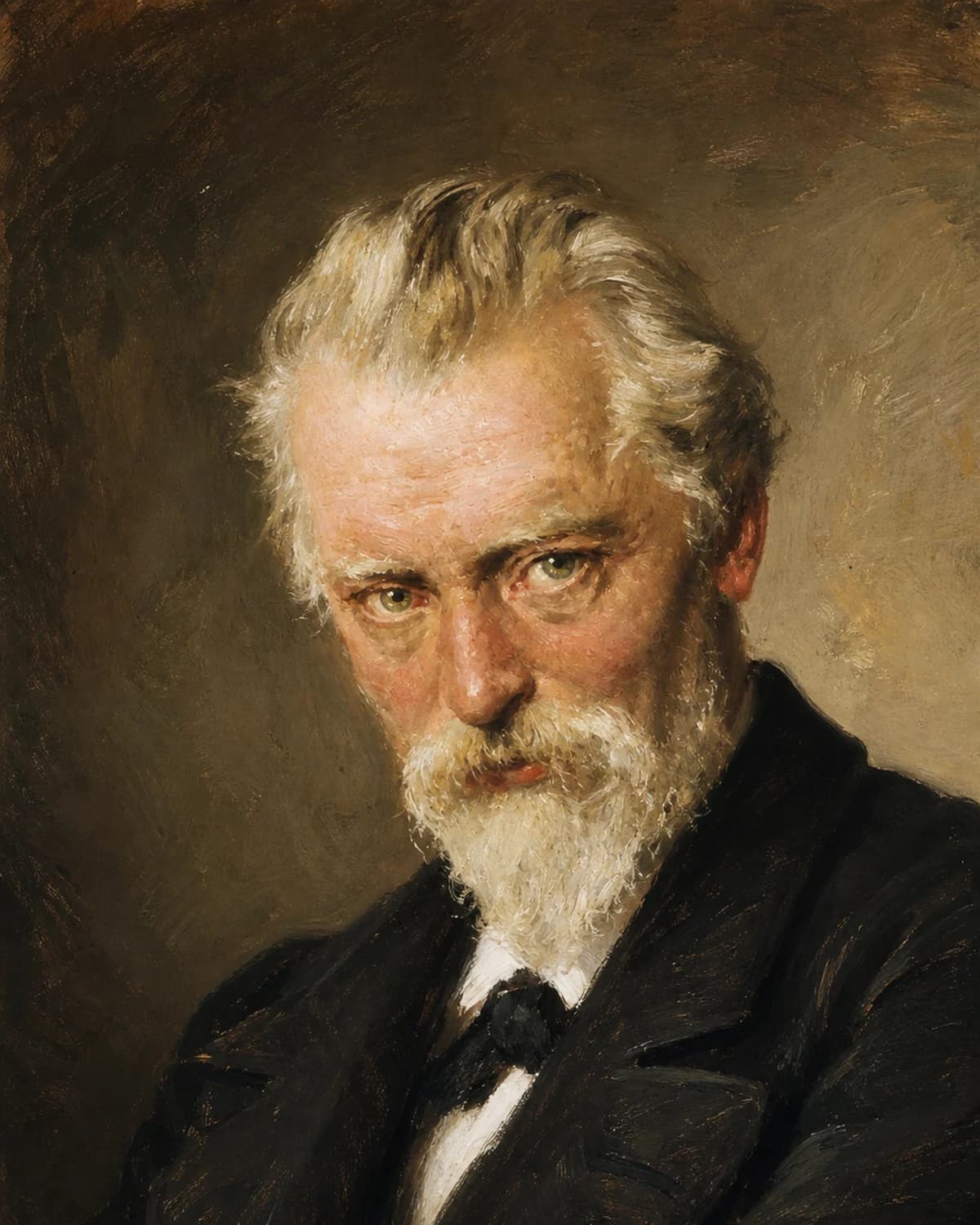
Biography
In January 1905 Vladimir Makovsky, a professor at the Academy of Arts, happened to witness the shooting of a workers’ procession in St Petersburg. Soon afterwards came the painting “9 January 1905 on Vasilyevsky Island”. He did not send it to any exhibition: fearing persecution, he kept the canvas at home for a long time and showed it only to close friends.
The man who hid this canvas was nearly fifty-nine, and in matters of art he was considered something of a conservative. Igor Grabar recalled in his memoirs how in 1888, after Tretyakov bought Valentin Serov’s “Girl in Sunlight”, Makovsky reproached the collector at a Peredvizhniki dinner, in front of everyone and in the coarsest terms: to him the purchase was a betrayal of realism.
He was born on 26 January (7 February) 1846 in Moscow, the youngest child of a family in which everyone lived for art. His father, Yegor Ivanovich Makovsky, collected pictures and was among the founders of the life class on Bolshaya Nikitskaya Street from which the School of Painting and Sculpture later grew. His mother, Lyubov Kornilovna, née Mollenhauer, sang in concerts, and from 1866, at Nikolai Rubinstein’s invitation, taught singing at the newly opened Moscow Conservatory. His elder brothers Konstantin and Nikolai and his sister Alexandra became painters; his sister Maria went on the stage. The family lived in a government flat on the Sofiyskaya Embankment, with windows facing the Kremlin. The boy’s first real drawing lessons came from a friend of the household, Vasily Tropinin.
In 1861, at fifteen, he entered the School of Painting and Sculpture (the word “Architecture” was added to its name later). In his very first year, under his father’s eye, he painted “The Kvass Seller”, a boy selling kvass; the picture is now in the Tretyakov Gallery. In 1866 he completed the course with a small silver medal for “An Artist Selling Old Things to a Tatar” and the title of class artist of the third degree. Three years later “Night Pasture”, based on Turgenev’s story “Bezhin Meadow”, brought him the title of class artist of the first degree.
In 1868 Makovsky married Anna Petrovna Gerasimova; a year later their son Alexander was born, the future painter and academician, and children began to appear in his father’s pictures. “Playing Knucklebones” (1870) was the first of his works bought by Tretyakov; in 1873 it was shown in the Russian section of the World’s Fair in Vienna. At the same time he was working on books and albums: fourteen illustrations for Vladimir Odoevsky’s “Grandfather Irinei’s Tales” (1871), and twenty-one genre paintings, made together with Illarion Pryanishnikov, for the photographic album “Episodes of Sevastopol Life, 1854–1855”, whose subjects were taken from Tolstoy’s stories.
He showed at the Peredvizhniki exhibitions from the very first, in 1871; in November 1872 he was unanimously elected to the Association, and in January 1874 he joined its board. “The Nightingale Lovers” (1872–1873) won first prize from the Society for the Encouragement of Artists, and in the same year, 1873, the Academy made its author an academician “for excellent knowledge in the painting of popular scenes”. The picture travelled to the World’s Fairs in Vienna and Paris, and Dostoevsky wrote about it with delight. “Visiting the Poor” (1874), “Waiting” (1875), “The Collapse of the Bank” (1881) and “On the Boulevard” (1886–1887) Tretyakov bought straight from the opening days. Makovsky was called “a short-story writer in paint”, and to my mind no one has put it better: almost every picture of his has a plot set in motion, and the viewer supplies the ending. He had another line as well. In the late 1870s he attended the trials of the Narodniki, after which came “The Convict” (1879), and in 1904 he would paint “Interrogation of a Revolutionary Woman”.
In 1882, after the death of Vasily Perov, Makovsky began teaching at the Moscow School of Painting, Sculpture and Architecture, where he ran the life class until 1894. His students included Abram Arkhipov, Vasily Baksheev and Nikolai Chekhov, the writer’s brother. He lived at the time in a house belonging to the Court Department in Denezhny Lane and, so the story goes, watched from his own windows for scenes for “The Flea Market” and “The Collapse of the Bank”. He painted portraits mostly of relatives, colleagues and collectors, among them his father (1880) and Pryanishnikov (1883). He also worked for churches, including icons for the church at Borki in Kharkov Province, built in memory of the wreck of the imperial train. While the work for Borki was under way he painted “The Artist’s Family”, also known as “The Family Despot”: its hero is copying an icon for that very church.
In 1892 he received the title of professor, and in 1893 he became a full member of the Academy of Arts.
The reform of the Academy in 1894 brought him to St Petersburg. Makovsky was given the genre studio of the Higher Art School, which he ran until 1918, and for the first two years he was also the school’s rector. The critics of the World of Art reproached the Peredvizhniki for being too literary, and Sergei Diaghilev called Makovsky’s late genre painting “the thousand-and-first painted banality”. Meanwhile two of his pictures, “Khodynka” (1897) and “At Vagankovo Cemetery: The Burial of the Khodynka Victims” (1901), were removed from exhibitions by the censors and banned from public display. In 1905, on the eve of his sixtieth birthday, he painted “Self-Portrait with a Palette” and was given the rank of Actual State Councillor.
After 1917 he stayed in Petrograd and went on working in his studio. In 1918, when the Academy was turned into the Free Art Studios, he was dismissed from his professorship: his general’s rank stood in the way. The new authorities, however, granted him a life pension. In his last years he lived in an apartment building on the 1st Line of Vasilyevsky Island. Vladimir Makovsky died on 21 February 1920 in Petrograd and was buried in the Smolensky Orthodox Cemetery; the occasional statements that he lies in the Volkovo Cemetery are mistaken.
Related context
Associations
Works connected through artistic movements, cultural context and period. Priced works available in this market appear first.








Profile notes
Profile and sources
Image
Artist image
На основе открытого изображения: Vladimir Makovsky; Wikimedia Commons; Public domain.
