
14.05.1891–21.11.1967
Vladimir Lebedev
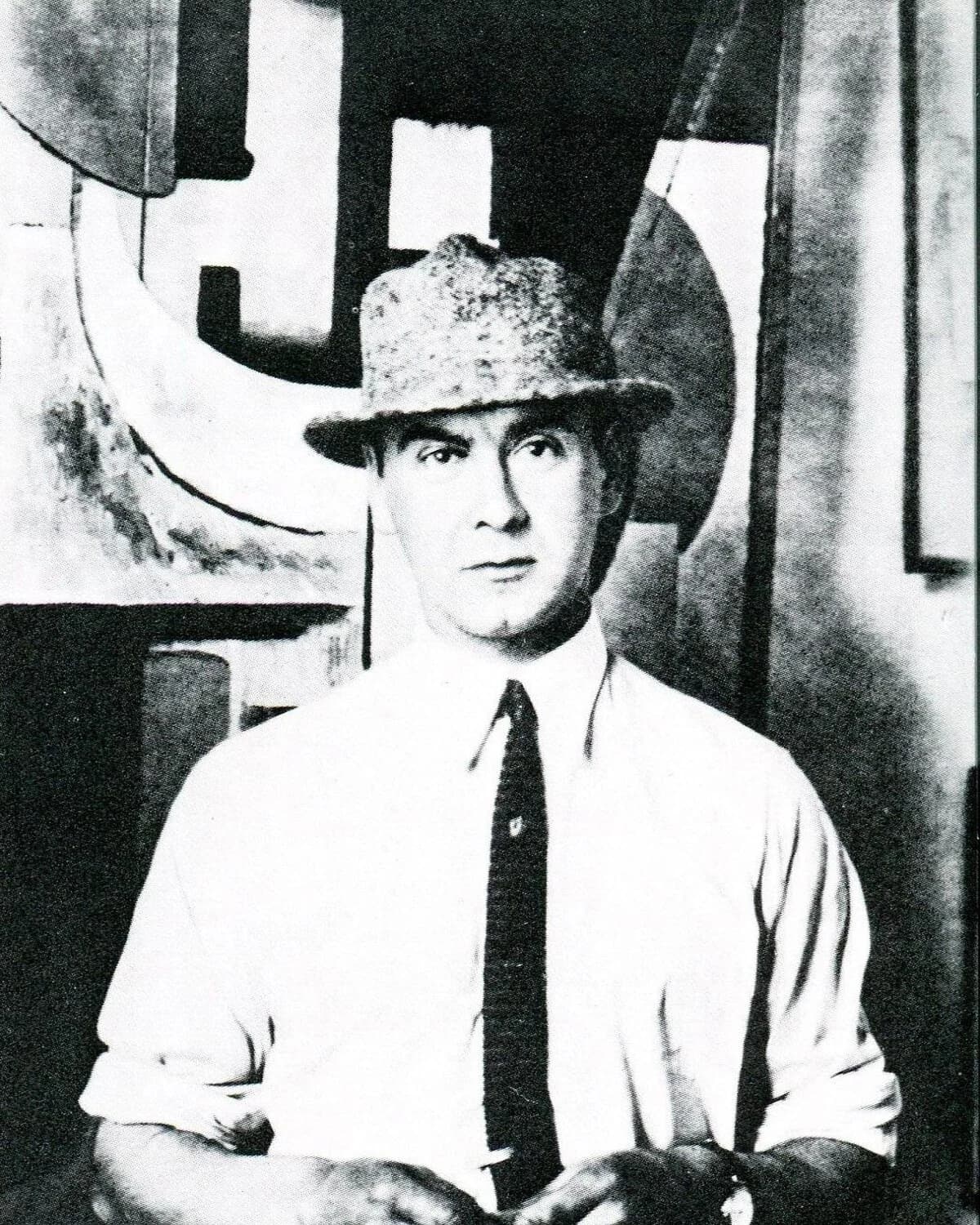
Vladimir Lebedev (1891–1967) began as a cartoonist for Satirikon, made posters for the Petrograd ROSTA Windows in 1919–1920, and from 1924, together with Samuil Marshak, ran the children’s department of the State Publishing House in Leningrad. Their picture books “Circus”, “Ice Cream”, “Luggage” and “Moustached and Striped” set the look of the new children’s book. Alongside them he painted still lifes and portraits of women.
Biography
On 1 March 1936 Pravda came out with an article entitled “On Artist-Daubers”. Two weeks earlier Komsomolskaya Pravda had printed “Daubs Instead of Drawings”, subtitled “Formalist Antics Have No Place in Children’s Books”. Such articles dealt, among others, with Vladimir Lebedev, Marshak’s illustrator, and the verdicts on him were as damning as could be. In those years a publication of this kind could be followed by persecution, and it broke something in Lebedev.
He was forty-five. Critics would later agree that he had done his best work before this break.
Lebedev was born on 14 (26) May 1891 in St Petersburg, the son of a mechanic, and graduated from the Petrovsky Commercial School. He began drawing to order early: at fourteen he was painting postcards for a shop in St Petersburg. He studied in private studios: with A. I. Titov (1909), in Franz Roubaud’s studio of battle painting (1910–1911), and in 1912–1914 at M. D. Bernstein’s school, where he met his first wife, the future sculptor Sarra Lebedeva. He began exhibiting in 1910, and in 1913 joined the Union of Youth.
In the 1910s he drew political cartoons for Satirikon and New Satirikon and illustrated the children’s magazines Galchonok and Blue Journal. In 1918–1921 he taught at the Petrograd State Free Art Studios. In 1919–1920, together with Vladimir Kozlinsky, he made the Petrograd ROSTA Windows, posters of the Russian Telegraph Agency that were hung in factories, clubs, shop windows and on agitation steamers. Usually each is a single figure at work, assembled from simple geometric forms and flooded with flat colour. He engraved the posters and coloured them by hand with the lubok, the Russian popular print, in mind, but he rejected stylisation in the manner of the lubok from the start.
He drew children’s books from 1918 until his death. In 1922 Kipling’s “The Elephant’s Child” appeared in Korney Chukovsky’s translation with his drawings, and Nikolai Punin rated this modest little book very highly. Then came Lev Klyachko’s private publishing house Raduga (“Rainbow”) and a long collaboration with Marshak: “Circus”, “Ice Cream”, “Tale About a Foolish Mouse” (1925), “Luggage” (1926), “How a Plane Made a Plane” (1927), “Moustached and Striped” (1930), and later “Mister Twister” (1933). After “Circus” and “Ice Cream”, Punin wrote, the shops filled with imitations, and illustrations in the World of Art manner began to look impotent beside them. Lebedev was the first children’s book artist to make lettering a means of expression. In 1924 a children’s department opened at the State Publishing House, housed in the Singer Company building at 28 Nevsky Prospekt; Marshak became its literary editor and Lebedev its art editor, and he stayed in that post until 1933, when Detgiz was created on the basis of the department. He made only one demand of artists: a book had to be a whole, constructively resolved organism. So very different people worked with him, from pupils of Filonov and Malevich to Tatlin and Konashevich, and he regarded Vera Ermolaeva, Nikolai Lapshin and Nikolai Tyrsa as comrades-in-arms. Alexei Pakhomov, Yuri Vasnetsov, Evgeny Charushin, Valentin Kurdov and Tatyana Shishmaryova made their start in books under him; at times he redrew their drawings.
Books did not crowd out his easel work. In the early 1920s, largely under the influence of his friendship with Ivan Puni, he painted still lifes and made counter-reliefs: “Still Life with Palette” (1919), “Coffee Pot, Spoon, Mug” and “Saw and Board” (1920), “Selection of Materials: Iron, Wood, Cardboard” (1921). There were graphic series too: the gouaches and appliqués “Laundresses” (1920–1925), twenty-three ink drawings “Pavement of the Revolution” (1922), “NEP”, “New Way of Life”, models, ballerinas, acrobats. Later Lapshin and Tyrsa, both taken with French art, were close to him, and he himself looked at Seurat and Picasso, then at Renoir and Manet. In 1928 the Russian Museum published a catalogue of his works of 1920–1928 with Punin’s essay on the significance of Cubism in his art. In 1930–1932 came the still lifes with a guitar; in one of them, with lemons and shells, the space, as Vera Anikieva observed, is built by the laying of colour alone, as on a shop sign. From the late 1920s he painted women a great deal: “Portrait of the Actress N. S. Nadezhdina” (1927), “Girl with a Jug” (1928), “Woman with a Guitar” (1930), and the ironic series “Sportswomen” (1933).
After 1936 there were still portraits of Shishmaryova, Sarra Lebedeva and the writer Susanna Georgievskaya, “Red Navy Man” and “Turkish Wrestlers” (1937). In 1942–1945 Lebedev lived in Moscow and worked for the TASS Windows. On returning to Leningrad in 1945 he received the title of Honoured Art Worker of the RSFSR. Of his post-war books the best are considered to be Marshak’s “Where Did the Table Come From?” (1946) and “Book of Many Colours” (1947) and Leo Tolstoy’s “The Three Bears” (1948), but by the end of the 1940s his drawings for children had become naturalistic. I think this is where the price of 1936 shows: the experiment was over.
In the 1950s and early 1960s he worked in his studio, restored old paintings, illustrated new books and received old friends. He painted little; a portrait of a young girl in a headscarf is dated 1957. Honours came: a silver medal at the exhibition of book art of the socialist countries in Leipzig (1959), the title of People’s Artist of the RSFSR (1966), election as a corresponding member of the USSR Academy of Arts (1967).
Vladimir Lebedev died in Leningrad on 21 November 1967 and was buried in the Bogoslovskoe Cemetery. On house no. 11 on Belinsky Street, formerly Simeonovskaya Street, where he lived from 1922 until the end of his life, there is now a memorial plaque.
Related context
Associations
Works connected through artistic movements, cultural context and period. Priced works available in this market appear first.








Profile notes
Profile and sources
Image
Artist image
Unknown photographer; Wikimedia Commons; CC BY-SA 4.0.
