
24.07.1757–06.04.1825
Vladimir Borovikovsky
The son of a Cossack icon painter from Mirgorod, Vladimir Borovikovsky came to St Petersburg after Catherine II admired the allegories he had painted for her rooms in Kremenchug. In the capital he became one of the most sought-after portraitists at the turn of the nineteenth century: intimate portraits of Lopukhina and Arsenyeva, state portraits of Paul I and Prince Kurakin, miniatures on tin, and in his later years icons for the Kazan Cathedral.
Biography
Vasily Kapnist was preparing rooms in Kremenchug for Catherine II, who was travelling to the Crimea, and commissioned their decoration from a painter he knew in Mirgorod. The painter produced two allegories: Peter I and Catherine as peasants sowing a field, and the empress as Minerva. Catherine liked the pictures and expressed the wish that the artist should move to St Petersburg.
So it was that in 1788 a thirty-year-old icon painter from a Cossack regiment arrived in the capital, already too old to study at the Academy of Arts.
He was born on 24 July (4 August) 1757 in Mirgorod, into the family of a Cossack, Luka Ivanovich Borovik. His father, uncle and brothers painted icons, and the boy had his first lessons at home, from his father. From 1774 he served in the Mirgorod Cossack regiment without giving up painting, and in the first half of the 1780s he retired with the rank of poruchik (lieutenant) and took it up in earnest: he painted icons for the churches of the district and portraits in the manner of the Cossack Baroque. He had become close to Kapnist, the poet and playwright, as early as the 1770s. His Petersburg surname, Borovikovsky, came later: by one account, he exchanged his father’s “Borovik” for it only after reaching the capital.
His first years in St Petersburg were spent in the house of Nikolai Lvov, architect, poet and connoisseur, whose ideas about painting had a marked influence on him. Through Lvov he entered the circle of Gavrila Derzhavin, Ivan Khemnitser and the composer Yevstigney Fomin. Dmitry Levitsky became his teacher, and later he took lessons for several years from the Austrian Johann Baptist Lampi. The same life in Lvov’s household produced the double portrait “Lizonka and Dashenka” (1794): two maids of the Lvov family, soft curls, white faces, a light flush on the cheeks.
In 1794 he showed “Catherine II Walking in the Park at Tsarskoye Selo” at the Academy of Arts and was made a candidate (“designated”) academician. A year later a portrait of Grand Duke Konstantin Pavlovich made him a full academician, and in 1803 he became a councillor of the Academy. Fame came to him comparatively late, at the end of the 1790s, but after that he had commissions for the rest of his life: in all he painted about five hundred portraits, of which some four hundred survive. He had his own studio and often left the secondary parts of a portrait to assistants. He painted with his left hand. From 1798 to 1820 he lived in an apartment building on Millionnaya Street. His sitters included members of the imperial family, courtiers, generals and writers, and among foreigners Murtaza Quli Khan and, in 1816, the Serbian prince Karađorđe.
The intimate portrait predominates in his work. E. N. Arsenyeva (1796), M. I. Lopukhina (1797), “Khristinya, a Peasant Woman from Torzhok” (1795) and E. A. Naryshkina (1799) are painted against landscape, in quiet poses, with attention to what the sitter feels rather than to her rank. Echoes of “Khristinya” can later be heard in his pupil Alexey Venetsianov. The state portraits are built differently: Paul I in the white dalmatic, the robe of a Grand Master of the Order of Malta, or the vice-chancellor Prince Alexander Kurakin (1801–1802). In these the fabric and the shine come first: velvet, satin, gold, gemstones. In the 1810s his sitters grow more restrained, and the landscape behind them gives way to an interior, as in the paired portraits of the Dolgorukovs of 1811. To my mind, though, his liveliest works are the small ones: the miniatures, which he often painted on tin, portraits of the architect Menelas, of Kapnist, of Natalia Lvova, now in the Russian Museum.
On 25 January 1802 Borovikovsky was admitted to the Masonic lodge of the Dying Sphinx, headed by Alexander Labzin; Levitsky was also a member. Later he left the lodge, and from 26 May 1819 he belonged to Yekaterina Tatarinova’s religious circle, the Union of Brotherhood. To this period belongs “The Appearance of Jesus Christ to E. Tatarinova”, a picture now kept in the reserve collection of the Tretyakov Gallery.
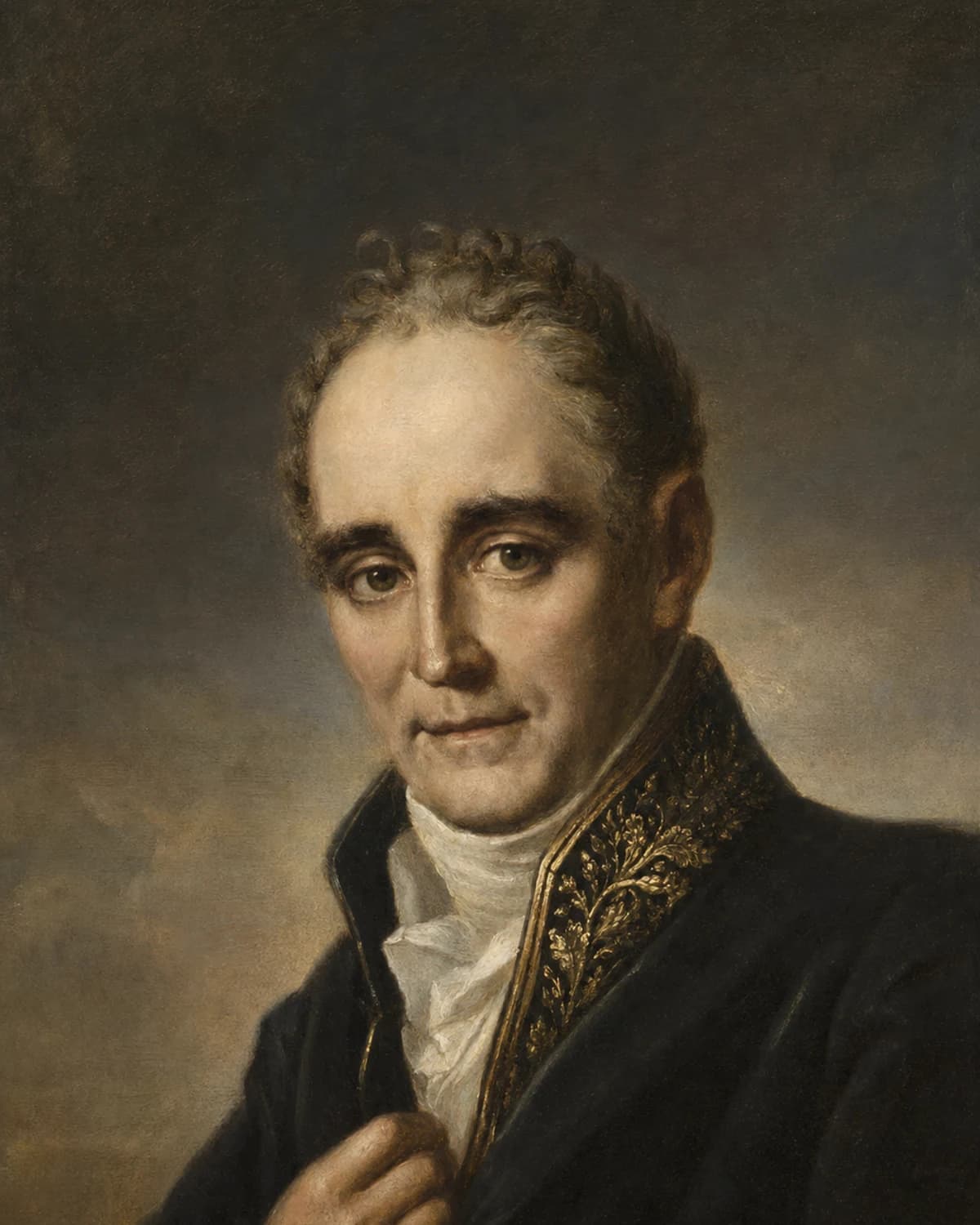
He never taught at the Academy, but pupils lived in his house. Among them were Venetsianov and Alexey Bugaevsky-Blagodarny, the author of the only surviving portrait of his teacher. In his last years Borovikovsky returned almost entirely to church painting: he painted icons for the Kazan Cathedral, then under construction, and the iconostasis of the church at the Smolensky Cemetery.
He never married and left no children. He died on 6 (18) April 1825 in St Petersburg and left his property to be distributed among the needy. He was buried in that same Smolensky Cemetery for whose church he had painted the iconostasis. In 1931 his remains and his tombstone, a granite sarcophagus on lion’s paws, were moved to the Lazarevskoe Cemetery of the Alexander Nevsky Lavra.
Related context
Associations
Works connected through artistic movements, cultural context and period. Priced works available in this market appear first.








Profile notes
Profile and sources
Image
Artist image
На основе открытого изображения: After Ivan Bugaevsky-Blagodarny; Wikimedia Commons; Public domain.
