
30.03.1853–29.07.1890
Vincent van Gogh
Vincent van Gogh (1853–1890) took up painting at twenty-seven, after failed attempts to become an art dealer and a preacher, and in ten years produced about 2,100 works, most of them in the last two years. His main work was done in France: in Arles, in the asylum at Saint-Rémy and in Auvers. What we know of his views comes mostly from the hundreds of letters he wrote to his brother Theo.
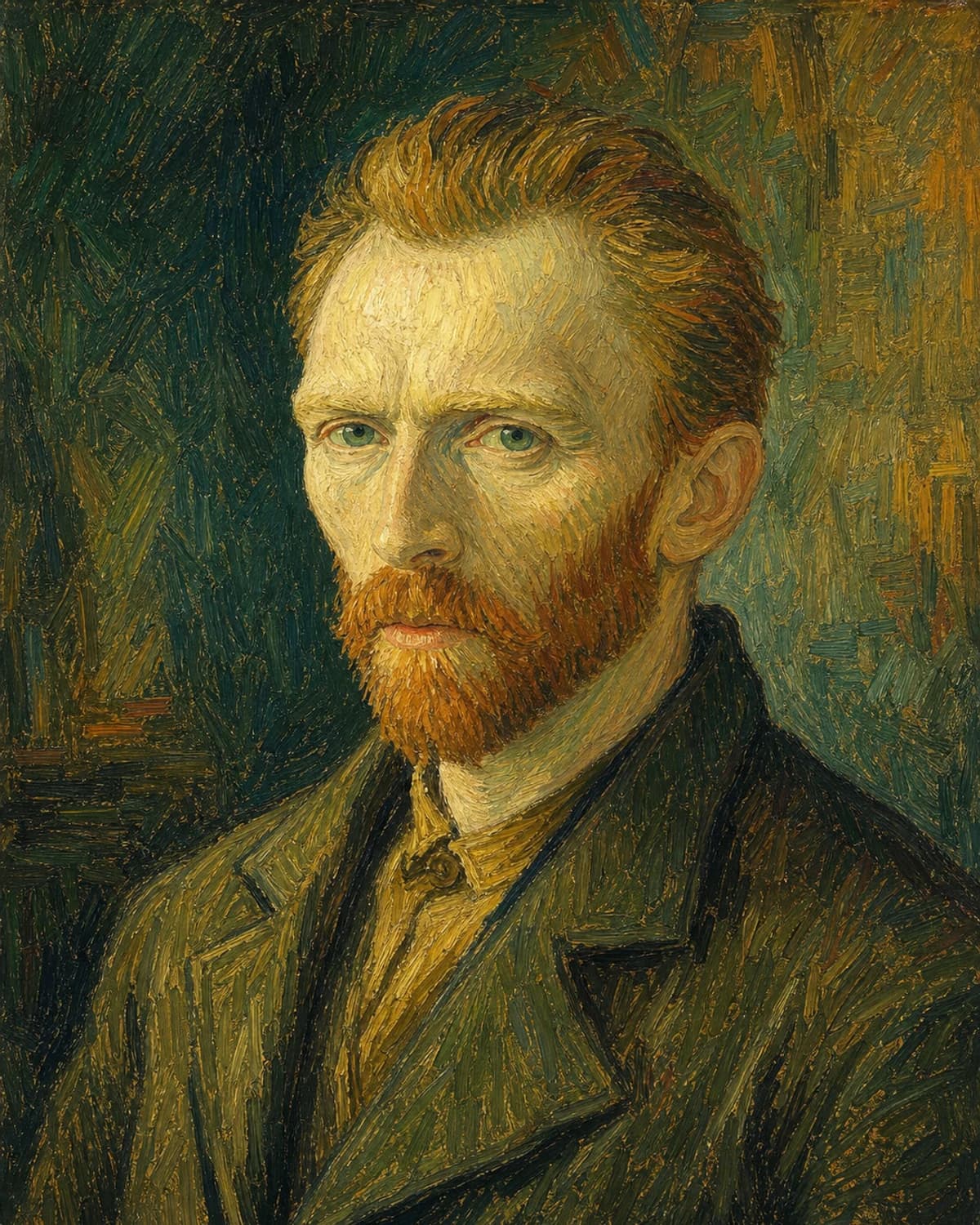
Biography
In March 1880 Vincent van Gogh walked about eighty kilometres to the village of Courrières, where Jules Breton lived, one of the most successful artists of the day. When he got there, he saw the high wall around the estate and turned back without making himself known. Breton, it seems, never learned of the visit.
Van Gogh was almost twenty-seven. He would not start drawing seriously until the autumn.
He was born on 30 March 1853 in Groot-Zundert, in North Brabant, the son of Theodorus van Gogh, a pastor of the Dutch Reformed Church. He was named after his grandfather and after a brother who had been stillborn exactly a year earlier. Four years later Theo was born. He hated the boarding schools in Zevenbergen and Tilburg, and in March 1868 he simply went home; that was the end of his schooling. His childhood, he wrote later, had been “austere and cold, and sterile”.
The next decade looks like a string of attempts. At sixteen his uncle found him a place in the Hague branch of the art dealers Goupil & Cie; in 1873 he was transferred to London, where at twenty he was earning more than his father, then to Paris, from where he was dismissed in 1876. There followed unpaid teaching at schools in England, a bookshop in Dordrecht, preparation for the entrance examination in theology in Amsterdam, abandoned in July 1878, and a missionary course near Brussels. In the Borinage, a coal-mining district of Belgium, he preached, gave his lodgings to a homeless man and slept on straw, and the church authorities removed him for lowering the dignity of his office. In the autumn of 1880, on Theo’s advice, he began drawing the miners. In November he enrolled at the Royal Academy of Fine Arts in Brussels. From then until the end, Theo sent him money.
Then came Etten, with his parents; The Hague, where a relative, Anton Mauve, gave him lessons; his first attempts in oil in 1882; Drenthe; and, from December 1883, Nuenen. There, in two years, he produced almost two hundred oil paintings, dark and earthy brown: weavers, their cottages, peasants. He sent “The Potato Eaters” to his brother in May 1885 as his first major work, and Theo replied that it was too dark for Paris. In Antwerp, where he moved in November, he lived on bread, coffee and tobacco, looked at Rubens, added carmine, cobalt and emerald green to his palette and bought Japanese prints at the docks. The story that he was expelled from the Antwerp Academy is not borne out by the documents: at the end of March 1886 the board simply made him repeat the year, and by then he was already in Paris.
Paris gave him colour. He lived with Theo in Montmartre, in the spring of 1886 attended Fernand Cormon’s studio, made friends with Émile Bernard, Anquetin and Toulouse-Lautrec, saw Cézanne’s paintings in Père Tanguy’s shop, collected hundreds of Japanese prints, and at Asnières, alongside Signac, tried painting in dots. In two years he made more than two hundred paintings, and his palette grew lighter. In February 1888, a few hours before leaving for the south, he and Theo visited Seurat’s studio, the only time he went there.
He lived in Arles for just over a year and painted about two hundred pictures, as well as more than a hundred drawings and watercolours. On 1 May 1888 he rented four empty rooms in the Yellow House on Place Lamartine and planned a studio there for several artists. To decorate it he painted “The Night Café”, “Café Terrace at Night”, “Starry Night Over the Rhône”, “The Bedroom” and his own chair; of the café he explained to his brother that he had wanted to show a place where one can ruin oneself, go mad or commit a crime. While waiting for Gauguin he produced four versions of the “Sunflowers” in a single week. Gauguin arrived on 23 October. Together they painted the avenue of the Alyscamps, in December they went to Montpellier to see Courbet and Delacroix, and then the quarrels began. What happened on the evening of 23 December is not known for certain; Gauguin’s later story about a razor is corroborated by nothing. That night Van Gogh cut off his left ear, wholly or in part, and in the morning found himself in hospital in the care of a young doctor, Félix Rey. Gauguin left and never saw him again.
The portrait of Rey (1889) was, so the story goes, used by the doctor to patch up a chicken coop. It is now in the Pushkin Museum of Fine Arts in Moscow.
In March 1889 thirty neighbours signed a petition against the “redheaded madman”, the police closed the house, and on 8 May Van Gogh admitted himself to the asylum of Saint-Paul-de-Mausole at Saint-Rémy. Of his two barred rooms he made one into a studio; on supervised walks he painted cypresses and olive trees; and it was there that he painted “The Starry Night”, of which he later said that in it he had strayed too far from reality. He copied Millet and compared these copies to a musician playing Beethoven. To my mind, this is the best explanation of his late manner.
In January 1890 Albert Aurier published an enthusiastic article about him in the Mercure de France; in the spring ten of his canvases hung at the Salon des Indépendants, and Monet called them the best in the show. The old story of the single painting sold in his lifetime should be laid to rest: fourteen sales are documented, beginning in 1882. In May he moved to Auvers-sur-Oise, to be nearer Theo and Dr Paul Gachet, whom Pissarro had recommended. In seventy days he painted about seventy pictures: the portraits of Gachet, his only etching, wheat fields “boundless as the sea”. “Wheatfield with Crows” was painted in July, but it was not his last work.
Van Gogh died early in the morning of 29 July 1890 at the Auberge Ravoux; Theo was with him and remembered his words: “The sadness will last forever.” He was buried on 30 July in the cemetery at Auvers. Theo outlived his brother by half a year. In 1914, when most of their correspondence was published, Theo’s widow, Johanna van Gogh-Bonger, moved his remains to Auvers, beside Vincent.
Artist works
Works by the artist
Works by Vincent van Gogh available in this edition of NEOARCA.






Related context
Associations
Works connected through artistic movements, cultural context and period. Priced works available in this market appear first.


Profile notes
Profile and sources
Image
Artist image
На основе открытого изображения: Vincent van Gogh; digital image: National Gallery of Art; Wikimedia Commons; CC0 1.0 Universal.
