
1952–present
Vincent Forrester
Vincent Forrester was born in 1952 in Alice Springs and grew up on a cattle station in the Angas Downs area. He helped found the Central Australian Aboriginal Congress and the Central Land Council, and in the 1980s advised governments on Indigenous affairs. Since the early 1990s he has painted Dreamtime stories with pigments ground at Uluru.
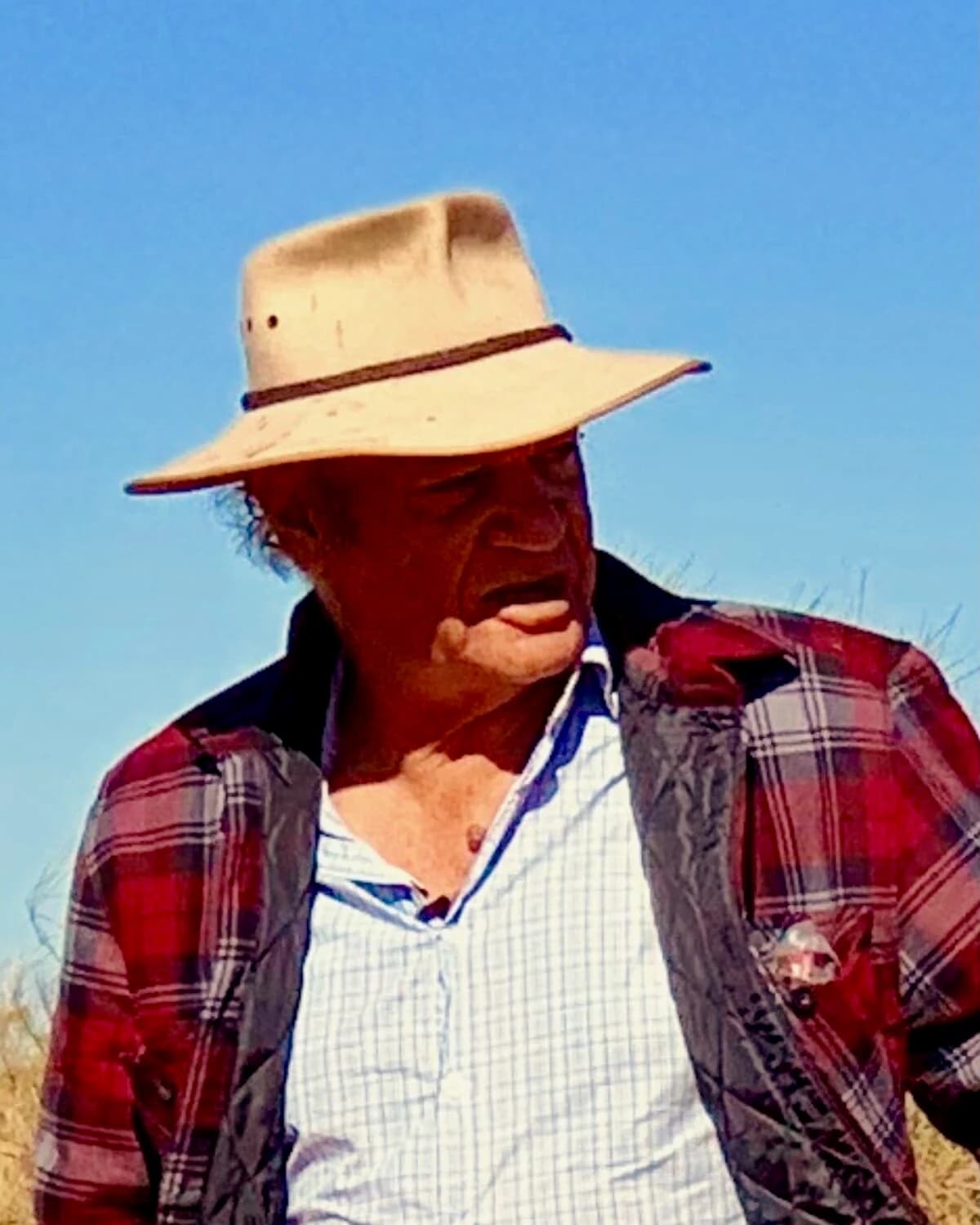
Biography
In 1982 Vincent Forrester travelled to Geneva and represented Australia at the first session of the United Nations Working Group on Indigenous Populations. Nothing in the early life of a man raised on a cattle station in the centre of the country promised such a journey.
He was born in 1952 in Alice Springs. His family is Luritja and Aranda, and one of his grandfathers was Scottish. Forrester grew up on a cattle station in the Angas Downs area: from his grandparents he learned the sacred stories of his country, about bush foods and bush medicine, and on reaching maturity he went through initiation. His first language is Luritja; he also speaks English and Arrernte.
As a teenager he worked on the station as a stockman and station-hand, then in an abattoir, and he served three years in the army in Townsville. At various times he worked as a horse-riding clown and rode in rodeos. His anger at the lack of rights for Indigenous people, by his own account, dated from the 1960s; in his school years he rebelled against the government’s assimilation policies, and then joined the campaign for land rights.
After the army, in the 1970s, Forrester helped to set up the Central Australian Aboriginal Congress, a health service for Indigenous people: he worked first as a field officer and later as its secretary. He also took part in founding the Central Land Council. In November 1977, in his mid-twenties, he was a founding member of the National Aboriginal Conference, and in October 1981 he was elected its chairman for the Northern Territory. In that role he advised the governments of Malcolm Fraser and Bob Hawke. In the middle of the 1980s he helped to set up the Central Australian Aboriginal Media Association (CAAMA), where he served as treasurer, manager and board member of its television network, Imparja.
In 1979 members of a movement calling itself the National Aboriginal Government occupied Capital Hill in Canberra and set up the Tent Embassy, demanding negotiations for a treaty with Aboriginal people. Fraser replied that he would talk only to the National Aboriginal Conference, as the one elected body representing Aboriginal people. The government would not accept the word “treaty”, so the Conference took a word from the Yolngu language: Makarrata. Forrester was placed on the subcommittee drafting the proposal. It envisaged a treaty recognising the sovereignty of Aboriginal nations, with which the state would deal as it would with any other sovereign nation under international law. After talking with communities in his region he was convinced that people favoured a treaty, but he insisted that negotiations be overseen by the United Nations. The Hawke government dissolved the Conference in 1985; work on the principles of Makarrata continued, and the campaign reached its height in 1988. In 1989 Forrester gave an interview to Kevin Gilbert on CAAMA radio.
As more Aboriginal people around Uluru went into tourism, he became a guide at Kings Canyon, later a ranger at Uluru-Kata Tjuta National Park and a mentor at Alice Springs Desert Park, where he trained young Aboriginal people as guides and rangers. He was firmly against an economy built on uranium mining. He called the shortage of jobs in central Australia “economic apartheid” and put it down partly to racism, but he also acknowledged that most adults in the communities could not read and write English, and for several years he worked on developing school curricula. When the Ayers Rock Resort at Yulara was sold to the Indigenous Land Corporation in May 2011, two of its 700 employees were Indigenous; by the start of 2013, it was reported, there were 170, 35 per cent of them from Mutitjulu.
In 2006 an ABC television programme reported sexually transmitted diseases among children in the community of Mutitjulu, and the Indigenous Affairs Minister, Mal Brough, said that children were being sexually abused. During Brough’s visit in October, Forrester shouted at the minister and demanded an apology. An official inquiry later found that alcoholism and child sexual abuse were widespread in remote communities of the Territory. In 2007 the government of John Howard introduced measures known as “the intervention”. Forrester, like many others, considered them racially discriminatory, called them an “occupation” of Indigenous land by the military, and urged Aboriginal people in the Territory to disobey the laws. In February 2008 he went to the Tent Embassy in Canberra to hear Prime Minister Kevin Rudd apologise to the Stolen Generations, and there discussed the effects of the intervention with other people from the Territory. He argued that the problems could be prevented with the right kind of schools and services, and he held that the community was still in crisis, although the number of sex crimes against children in Mutitjulu was, by the statistics, falling and the population had shrunk by more than 40 per cent.
In 2009 Forrester was made chairman of the Mutitjulu Community Council. His brother, who ran the community corporation, was accused of corruption, and the council, under pressure from Vincent, forced his resignation. Around 2012 his cousin Sammy Wilson became chairman. Forrester lives semi-retired in Victoria, but continues to lead work in ethnobotany, Indigenous archaeology and land management.
He began to paint in the early 1990s: his subjects come from the Dreamtime, and he says that for him the pictures are a story and a “spiritual legacy” for his descendants. At first he used acrylic, then moved to natural paint made from pigments ground at Uluru and mixed with a binder; the colours are those of ceremonial body paint. His painting “Resurrection at Mutitjulu Waterhole”, showing the waterhole at Uluru and the story of the Wanampi (Rainbow Serpent), was a finalist for the Togart Contemporary Art Award in 2012; it belongs to a series dedicated to women.
Profile notes
Profile and sources
Image
Artist image
Trisha Morton-Thomas; Wikimedia Commons; CC BY-SA 4.0.
