
15.03.1894–29.09.1941
Vilmos Aba-Novák
Until 1912 Vilmos Aba-Novák appeared in documents as Vilmos Novák. He painted frescoes for churches and state clients, among them the Heroes' Gate in Szeged and the Mausoleum of Saint Stephen in Székesfehérvár, while in easel paintings he kept returning to village fairs and the circus. He won the jury's Grand Prize at the Paris World Exhibition in 1937 and at the Venice Biennale in 1940.
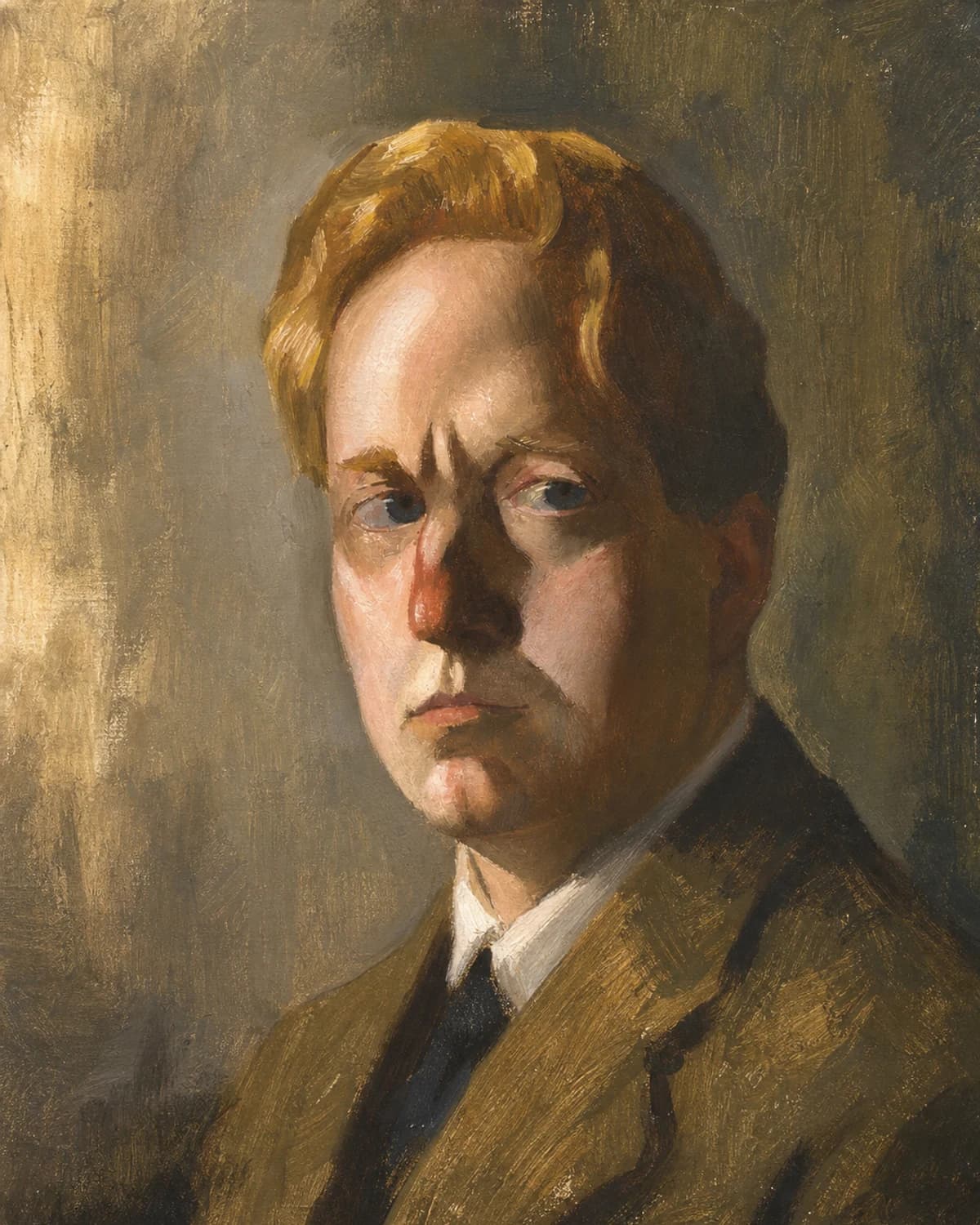
Biography
His full name at birth was Zsigmond Vilmos József Novák. He took the double surname Aba-Novák in 1912, when he finished art school and went to work in the studio of Adolf Fényes.
He was born on 15 March 1894 in Budapest. His father, Gyula Novák, was of Czech-Hungarian origin; his mother, Róza Waginger, had been born in Vienna. His childhood was spent in Krisztinaváros, and as a small boy he began going to the flea market, where he bought drawing materials. From 1912 to 1914 he studied at the Hungarian Royal School of Drawing in Budapest, today the Hungarian University of Fine Arts. The war interrupted his studies. In October 1914 he joined the 29th Home Guard (Honvéd) Regiment and served on the Eastern Front. He received decorations, but in his diary he called the war completely pointless and an obstacle to his plans. He was wounded, and his right arm remained paralysed for a long time. Between engagements, the sources report, he took drawing lessons from Viktor Olgyai.
After the war he returned to painting. From 1921 to 1923 he spent his summers in the artists' colonies at Szolnok and Baia Mare (Nagybánya) in Romania; from 1930 he returned constantly to the Szolnok colony. His first solo exhibition took place in 1924. In 1925 he settled in Zugliget, painted in Felsőbánya that summer with Károly Patkó, and won a travel-abroad prize from the Pál Szinyei Merse Society. In 1926, at the first Spring Exhibition in the National Salon, the same society awarded him its grand prize for graphics, for the etching “Girolamo Savonarola”. In the spring he travelled through Venice, Verona, Milan, Bern and Paris. In 1928 he was elected a member of the Szinyei Merse Society, began teaching at the Free School of Fine Arts, and from then on took part in every Venice Biennale. His daughter Judit was born in the same year. From 1928 to 1930 he held a scholarship at the Hungarian Academy in Rome; the sources give the length differently, three years or fourteen months. He showed his Roman work in 1931 at the Ernst Museum. The painting “The Farewell to the Ferry on the Tisza” was bought by the Museum of Modern Art in New York. From 1930 to 1937 he ran a private painting school.
In 1932 he won a gold medal at the Ecclesiastical Art Exhibition in Padua, and his painting “Flood”, shown at the Fränkel Salon in Budapest, earned him the city's grand prize. In 1934 he exhibited in London and founded the American-Hungarian Art Academy. In 1935 his exhibitions in America were held together with Béla Iványi-Grünwald.
His best-known commission of those years was the Heroes' Gate in Szeged, a memorial to the soldiers of the First World War, painted in 1936 together with Henrik Stefan, Mihály Patay and János Rozs. After 1945 the frescoes were whitewashed; they were restored between 1986 and 2000. He also painted the Roman Catholic church in Jászszentandrás, the Mausoleum of Saint Stephen in Székesfehérvár and the church in Városmajor in Budapest (1938). To my mind, his late works are best read as commissions: he had to take account of the themes and wishes of his clients, the state and the Church.
In easel painting he remained faithful to village fairs, taverns and travelling circus troupes. The scenes are densely populated and brightly coloured, with echoes of both Expressionism and the Italian Novecento, and a caricaturist's hardness in the faces. It is said that, on seeing his pictures in Paris, Pablo Picasso asked, “Who is this barbarian?”; I have found no confirmation of the remark.
At the Paris World Exhibition in 1937 the jury awarded him its Grand Prize, and in 1940 he received the same top award at the Venice Biennale. From 1939 he taught at the Royal School of Drawing.
Vilmos Aba-Novák died in Budapest on 29 September 1941, at the age of 47. He is buried in the Farkasréti Cemetery.
Related context
Associations
Works connected through artistic movements, cultural context and period. Priced works available in this market appear first.








Profile notes
Profile and sources
Image
Artist image
На основе открытого изображения: Vilmos Aba-Novák; Wikimedia Commons; Public domain.
