
08.02.1925–23.08.1990
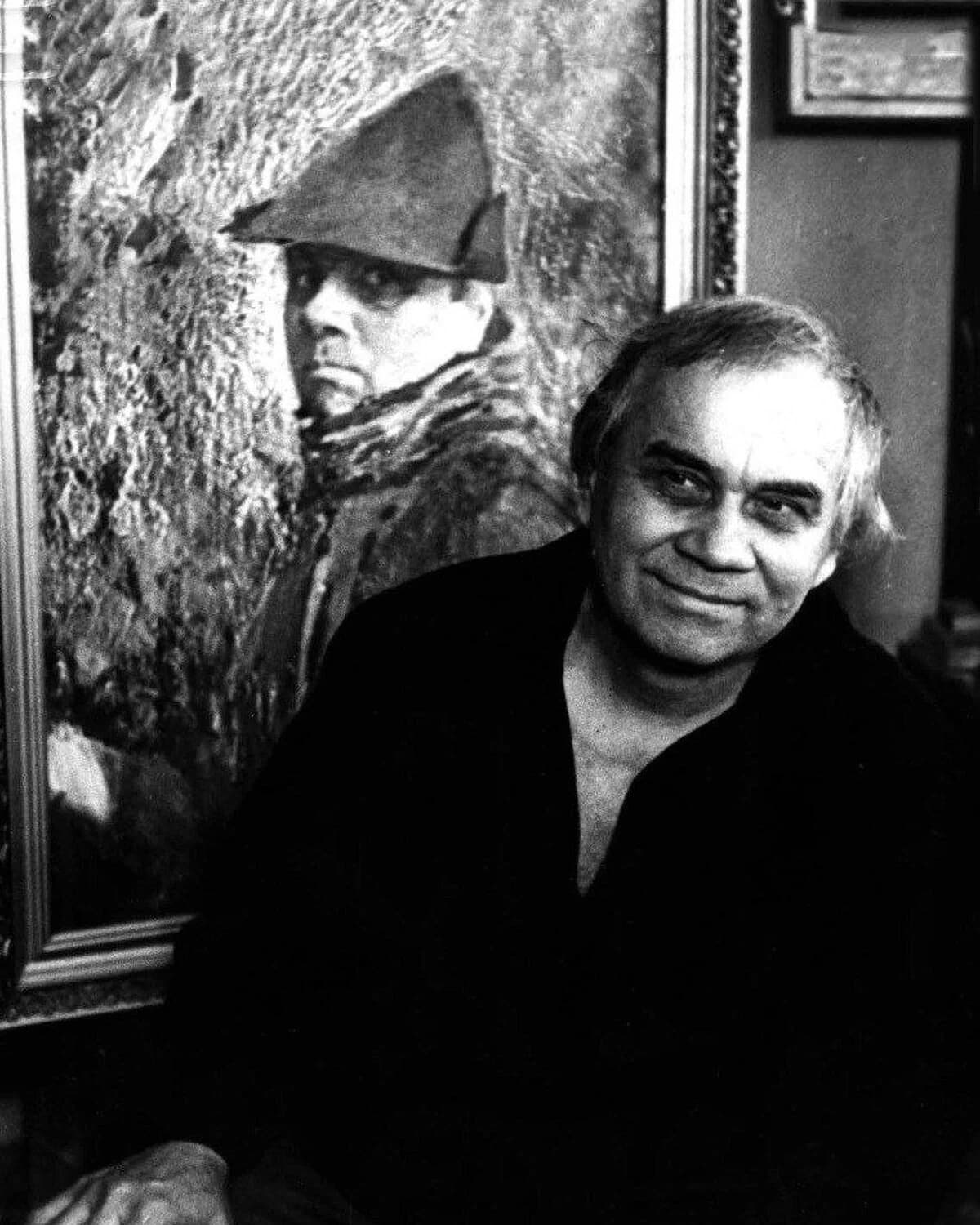
Viktor Zaretsky
Viktor Zaretsky (1925–1990) studied at the Kyiv Art Institute, stayed on to teach there, and with his wife Alla Horska made mosaics for a school in Donetsk and a museum in Krasnodon. From 1978 he ran his own studio, which more than two hundred students attended, Arsen Savadov among them. His only solo exhibition in his lifetime took place in 1989, and he received the Shevchenko Prize posthumously.
Biography
Zaretsky’s diploma painting was called “The Queue to Lenin’s Mausoleum” (according to other accounts, “To the Mausoleum”), and his supervisor Serhiy Hryhoriev gave it the highest mark. The author held both the Stalin and the Repin scholarships, which is to say he was a thoroughly reliable graduate of 1953.
He was born on 8 February 1925 in Bilopillia, in the Sumy region. In the same year the family moved to the Donbas: relatives had supported General Denikin’s Volunteer Army in 1918–1919 and feared persecution. His childhood was spent in the working-class settlements of Horlivka and Stalino, where his father, Ivan Antonovych, worked as an accountant at a chemical plant then under construction. His mother, Maria Andriivna, was a pianist and music teacher. In 1943 Zaretsky was drafted; he served in a reserve regiment and was demobilised in 1945. He then lived briefly with his parents in the settlement of Obidimo near Tula and took private lessons from a local painter. In 1946 he entered the art school attached to the Kyiv Art Institute, and in 1947 the institute itself, where his teachers were Kostiantyn Yeleva, Mykhailo Sharonov and Serhiy Hryhoriev.
After graduating Zaretsky stayed at the institute to teach. In 1953 he married a fellow student, Alla Horska, and in 1954 their son Oleksiy was born, later an art historian. From 1955 the painter worked in the Donbas. The magazine Ogonyok printed his “Miners. The Shift”, and at the mine he painted “After the War”, “A Hot Day”, “The Mine Yard” and “After the Shift”. The last of these went to an exhibition in Moscow, won a first-class diploma and was put forward for a medal of the World Festival of Youth and Students, but then lay in his studio for about thirty years. In 1961 he set out for Polissia to paint portraits of collective-farm workers, lived in a village near Chornobyl, returned there more than once with his wife, and in 1962 met Maria Prymachenko.
He also worked with Horska in murals and mosaics for public buildings. Their team made mosaics of smalt and ceramic: “Prometheus”, “Earth” and “Fire” for a school in Donetsk (1965–1966), “The Tree of Life” and “The Dream Bird” for the Ukraina restaurant in Zhdanov, now Mariupol (1967), and the panel “The Banner of Victory” for the Young Guard Museum in Krasnodon (1968–1970). The influence of folk art is plain in these works: bright flat areas of colour, ornament.
In 1963 Zaretsky took over the Kyiv Club of Creative Youth, “Suchasnyk” (“Contemporary”), from Les Taniuk; as a conscripted veteran, a Party member and a member of the Artists’ Union, he seemed to the authorities a compromise figure. The club’s line did not change, however, and it was soon dissolved. He belonged to the Sixtiers, the generation of Ukrainian intellectuals who came of age in the 1960s thaw. By one account, in the late 1960s he was expelled from the Artists’ Union after signing an open letter against political trials; by another, the letter dates from 1965–1966 and the matter ended with a reprimand from the Party, so I would treat this detail as not firmly established.
On 28 November 1970 Alla Horska was murdered in Vasylkiv, in the home of Zaretsky’s father. The investigation named Ivan Zaretsky as the killer, who killed himself the following day, but many researchers suspect the involvement of the KGB. The painter later married Maia Hryhorieva, the daughter of his teacher.
In the 1970s he designed the interiors of theatres in Ivano-Frankivsk, Simferopol and Sumy and painted a gallery of portraits of Ukrainian public figures: Vasyl Kasiian and Mykhailo Yatskiv (1972), Oleksandr Horskyi, Iryna Zaslavska and Liza Myronova (1973), Raisa Nedashkivska (1974) and his son Oleksiy (1975). In 1978 he opened his own studio. His teaching method, “Reflections Before the Canvas”, was first printed in the journal Obrazotvorche mystetstvo in 1993. His students included Arsen Savadov, Olesia Avramenko, Kostiantyn Kuntsevych, Larysa Pisha and Taras Loboda.
In the early 1980s Zaretsky became absorbed in Secession art, above all Klimt. His pictures of this time are built on folk colour, ornamental stylisation and golden and ruby tones; subject and figure give way to the decorative whole. In 1989 his friends organised his first solo exhibition at the Kyiv House of Scientists.
Zaretsky died on 23 August 1990. He is buried in Berkovtsi Cemetery in Kyiv, in his parents’ grave; the monument is by Lesia Dekermendzhi. In 1994 he was posthumously awarded the Shevchenko National Prize of Ukraine for his late paintings, among them “A Soldier’s Wife”, “Summer” and “Spring Chores”. He also wrote memoirs, published as a separate book, “The Artist Viktor Zaretsky. In Search of Roots”, in 2009.
Profile notes
Profile and sources
Image
Artist image
SemenetsOlena; Wikimedia Commons; CC BY-SA 4.0.
