
03.05.1848–23.07.1926
Viktor Vasnetsov
Viktor Vasnetsov, the son of a village priest in Vyatka province, left the seminary for the Academy of Arts and made epic songs and fairy tales a subject for large-scale painting: “Alyonushka”, “The Knight at the Crossroads”, “Bogatyrs”. He spent ten years painting St Vladimir's Cathedral in Kiev, and the façade of the Tretyakov Gallery was built to his design. He did not accept the revolution but stayed in Moscow, working to the end on the cycle “The Poem of Seven Fairy Tales”.
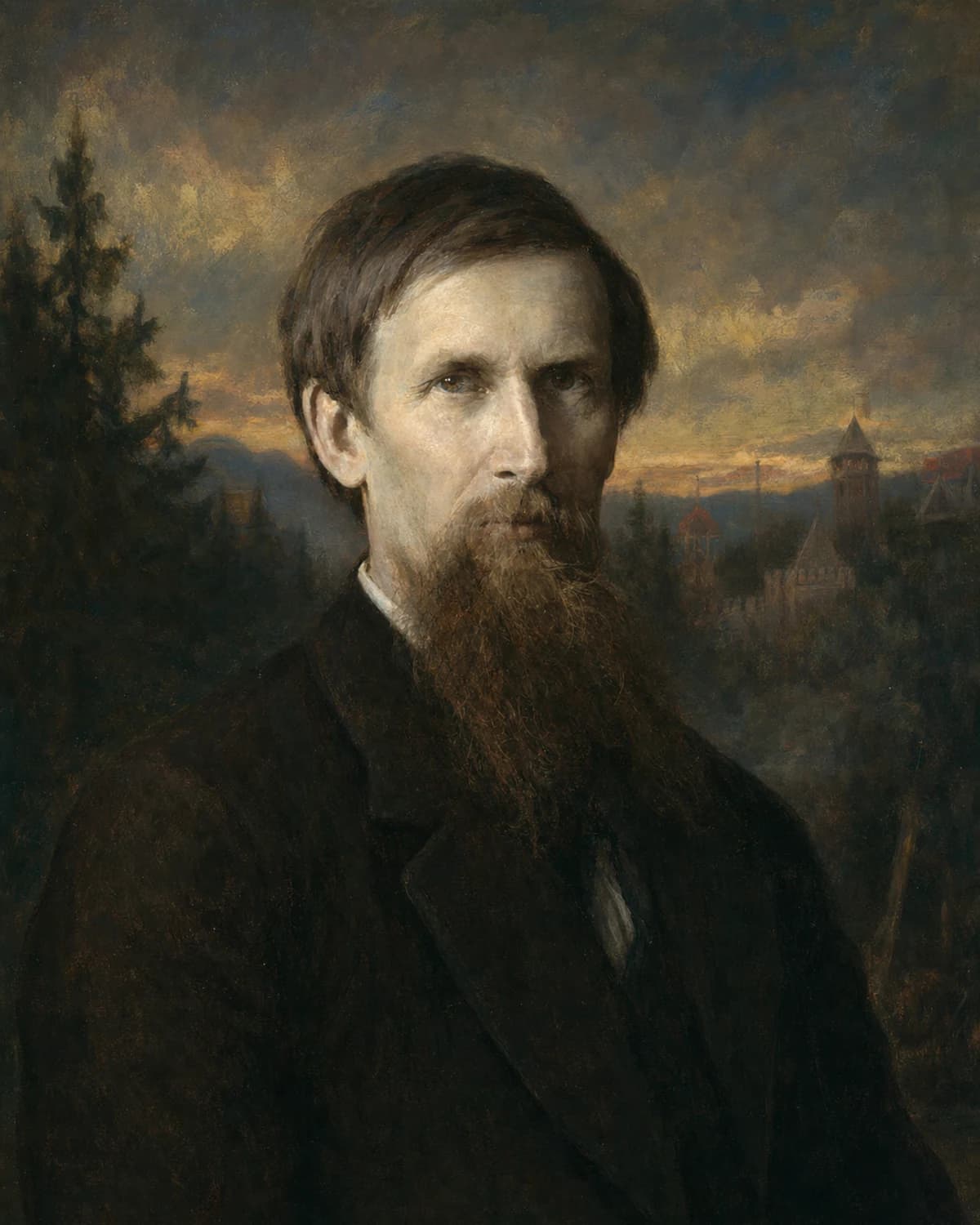
Biography
“Listen, why should you be a priest?” This was the question that Elwiro Andriolli, a Polish artist exiled to Vyatka after the uprising of 1863, put to a Vyatka seminarian. Vasnetsov was helping him paint the Alexander Nevsky Cathedral in Vyatka, and Andriolli urged him to leave the seminary and go to St Petersburg, to the Academy. In 1867, with his father's blessing, Vasnetsov did just that. The money for the journey, according to one version, he raised by selling two of his pictures at auction, “The Reaper” and “The Milkmaid”.
He was born on 3 (15) May 1848 in the village of Lopyal in Urzhum district, Vyatka Governorate. For eight generations almost all the men of the family had been priests; his father, Mikhail Vasilyevich, served in the village Trinity Church, and later the family moved to neighbouring Ryabovo. His father drew well from life and, going through his sons' drawings in the holidays, would shyly show them his own oil studies. Of the six brothers, Apollinary also became a painter. Viktor himself recalled that as a child he drew ships and sea battles most of all, “thrice nine lands away from any sea”. From 1858 he studied at the Vyatka Theological School, and from 1862 at the seminary.
His first months in St Petersburg were spent in want. Help came from the brother of a Vyatka teacher, who worked at General Ilyin's cartographic establishment: Vasnetsov was taken on to give lessons to the general's children and to copy seventeenth-century weapons and armour from the Tsarskoye Selo Arsenal onto wooden blocks. At the same time he studied under Ivan Kramskoi at the Drawing School of the Society for the Encouragement of the Arts; in 1868 he was enrolled in the Academy and soon became a pupil of Pavel Chistyakov. He drew “The Rag-Picker”, “Monk Collecting Alms”, an old beggar woman with firewood, and made pictures for popular primers. At evenings at Repin's and Antokolsky's a student named Savenkov chanted the byliny aloud, rounding his o's in the northern way. In the autumn of 1871 Vasnetsov saw Savrasov's “The Rooks Have Come Back” at the first Peredvizhniki exhibition and wrote later: “There it is, the homeland dear to the heart.” On 4 (16) February 1875 he left the Academy without waiting to complete the course.
He began as a genre painter. “Tea-Drinking in a Tavern” (1874) was his first work in an exhibition of the Association, followed by “The Book Stall” and “Moving House”. In 1876, accepting help from Polenov and taking an advance from a woman publisher, he went to Paris and lived there with the Kramskois. Repin, looking for a face for his “Sadko”, dressed him up in a merchant's fur coat and a boyar's hat. In the Louvre and in a small Paris museum Vasnetsov stood before Rembrandt, while the Paris Salon irritated him. It was in Paris too that he made the first sketch for “Bogatyrs”.
In 1878 he moved to Moscow, and this settled everything that followed.
Savva Mamontov commissioned three paintings from him for the board of the Donetsk Railway, among them “The Three Princesses of the Underworld”: gold, precious stones and coal, and the Princess of Coal, a dark-haired girl in a black dress, came out best of all. From June 1880 Vasnetsov was often at Abramtsevo, where he and Polenov built the Church of the Saviour Not Made by Hands and he painted icons for it. At the same time came “After Igor Svyatoslavich's Battle with the Polovtsy”, “The Flying Carpet”, “Alyonushka” (1881) and “The Knight at the Crossroads”. Radical critics decided that the artist had betrayed Peredvizhniki realism, and even Tretyakov refused to buy these pictures. I think this was the first time Vasnetsov found himself alone against everyone, and it did not hold him back.
In 1885 Adrian Prakhov invited him to paint the newly built St Vladimir's Cathedral in Kiev. The work took about ten years: the dome, the altar apse, the pillars, the main iconostasis, “The Baptism of Prince Vladimir”, “The Baptism of the Kievans”. The young Vrubel worked alongside him. Stasov reproached the paintings for playing with religious feeling; other critics wrote that Vasnetsov had thrown a bridge across the two-hundred-year gap between the educated and the common people. Then came mosaics for the Church of the Saviour on Spilled Blood in St Petersburg and the Alexander Nevsky Cathedral in Warsaw, sets for Rimsky-Korsakov's “The Snow Maiden”, “Ivan Tsarevich Riding the Grey Wolf” (1889), and “Bogatyrs”, finished at last in 1898. He built as well: a house with a studio in Troitsky Lane, and the façade of the Tretyakov Gallery in Lavrushinsky Lane (1900s).
In 1912 Nicholas II granted him hereditary nobility. Vasnetsov called himself a “convinced monarchist”; he did not accept the revolution, but he did not leave. Abroad in 1919 it was reported that the Bolsheviks had shot him, and Repin, at his Penaty in Kuokkala, anxiously questioned his visitors about it. Vasnetsov, meanwhile, was living in Moscow, in his own house, and painting fairy tales: “Dobrynya Nikitich Fighting the Serpent Gorynych”, “The Frog Princess”, “Kashchei the Deathless”, “Baba Yaga”. The cycle, which the family called “The Poem of Seven Fairy Tales”, he showed to no one.
His last finished pictures were “The Sleeping Princess” and “Princess Nesmeyana” (1926). In the very last hours of his life he was still working on a portrait of Mikhail Nesterov. Vasnetsov died on 23 July 1926 in his Moscow studio. He was buried in the Lazarevskoye Cemetery; after that necropolis was destroyed, his remains were moved to the Vvedenskoye Cemetery.
On 13 March 1927 the first posthumous exhibition opened in the house in Troitsky Lane, and the public saw “The Poem of Seven Fairy Tales” for the first time. His son Alexei was in charge of the exhibition, his daughter Tatiana received the guests in the studio, and his widow, Alexandra Vladimirovna, gave the visitors tea.
Related context
Associations
Works connected through artistic movements, cultural context and period. Priced works available in this market appear first.








Profile notes
Profile and sources
Image
Artist image
На основе открытого изображения: Unknown author Unknown author; Wikimedia Commons; Public domain.
