
11.11.1896–22.03.1979
Victor Arnautoff
Victor Arnautoff (1896–1979) went from cornet in the tsarist cavalry and Kolchak’s army to assistant to Diego Rivera in Mexico and professor at Stanford. In San Francisco in the 1930s he painted murals for a clinic in Palo Alto, Coit Tower and George Washington High School. In 1963 he returned to Mariupol, where he made mosaics for a school, a communications building and the airport terminal.
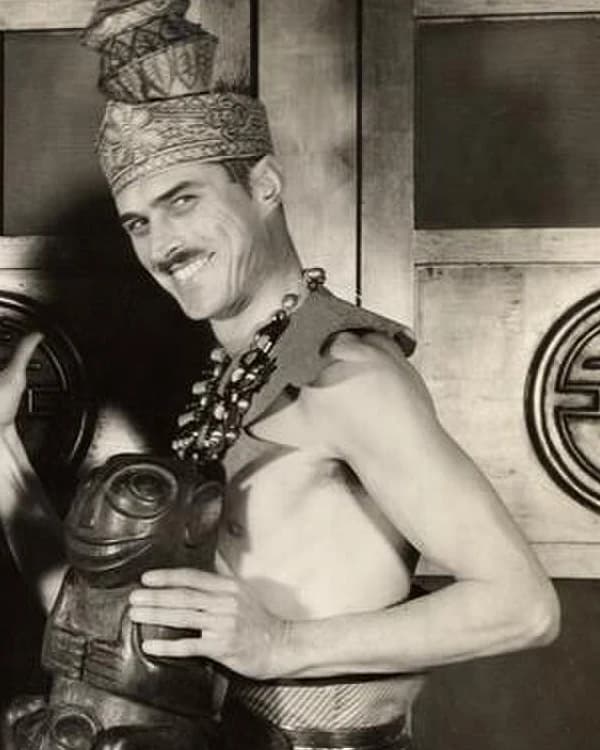
Biography
In 1936 Victor Arnautoff covered the walls of George Washington High School in San Francisco with thirteen frescoes, titled “Life of Washington”. In some panels slaves and working people stand at the centre rather than the president himself; in another, a dead Native American lies at the feet of the colonists. People have argued about these walls since at least 1968, and in 2019 the school board voted to paint them over.
He was born on 11 November 1896 (30 October, Old Style) in the village of Uspenyevka in the Taurida Governorate, the son of a priest, Mikhail Arnautov, who taught at the Mariinsky Girls’ Gymnasium in Mariupol. His youth was spent in Mariupol: the Alexander Boys’ Gymnasium, and drawing lessons from a local painter (Vasily Tarasov is named). The war cancelled his plans to study painting. Arnautoff entered the Yelizavetgrad Cavalry School, was commissioned as an ensign in the 5th Lithuanian Uhlan Regiment on 1 October 1915, became a cornet in 1916 and a lieutenant on 1 January 1917. He received the Cross of St George, 4th class, with laurel branch. In early 1918 he was demobilised and settled in Simbirsk, from where he was mobilised again, this time into Kolchak’s army, and retreated with it to Siberia and the Far East.
In 1920 Arnautoff ended up in Harbin. He painted boxes and icons and studied at the Lotos studio under Mikhail Kichigin and Alexander Bernardazzi, former teachers at the Yekaterinburg art school. In 1923–1925 he served as a cavalry instructor at the stud farm of the army of Marshal Zhang Zuolin in Mukden. There he married Lydia Blonsky; they had sons.
In November 1925 he arrived in San Francisco on a student visa and enrolled at the California School of Fine Arts, where he studied with the sculptor Edgar Walter and with Gertrude Partington Albright; Ralph Stackpole is also named among his teachers. He was awarded a scholarship as the best student of his year. When his visa expired, he took his family to Mexico. On Stackpole’s recommendation, in 1929 Arnautoff became an assistant to Diego Rivera. He recalled that at first he ground pigments and carried water, and that he was not allowed to paint details for some time. He took part in the murals of the National Palace (among them “Mexico Through the Centuries”), the Ministry of Health and the Palace of Cortés in Cuernavaca. When Rivera left for San Francisco, he put Arnautoff in charge of the Mexican projects for several months. Rivera advised him to move away from the European tradition and learn from Mexican artists. It was then that he painted “A Worker’s Breakfast” (1929) and “Washing Laundry by the Bridge” (1931), now in the Russian Museum, and several of his woodcuts appeared in the magazine Mexican Life in 1929. In Mexico he also met Bernard Zakheim, with whom he later worked on Coit Tower.
In 1931 the family returned to San Francisco, and Arnautoff received a work permit. His first project was a mural on the wall of his own studio, which he opened to the public.
In August 1932 he completed his first commission, murals for the medical clinic in Palo Alto: scenes of modern and primitive medicine and four medallions of Lister, Hippocrates, Pasteur and Röntgen. The unveiling caused controversy, partly because of a doctor shown examining a female patient with bare breasts.
In 1934 he was chosen as one of the artists for the Coit Tower murals and appointed technical director of the project. His panel “City Life” includes a self-portrait and a portrait of his son Michael. The newsstand in it lacks the conservative San Francisco Chronicle but includes left-wing papers; there is also a poster for Chaplin’s “City Lights”. This mural, too, caused controversy. His other work of the 1930s includes “Peacetime Activities of the Army” in the Presidio chapel (1935), George Washington High School, the library of the California School of Fine Arts and murals in five post offices, among them Pacific Grove, Richmond and South San Francisco. Solo exhibitions in San Francisco were held almost every year.
He taught at the California School of Fine Arts, first in summer sessions and from 1936 as a regular instructor, and at Stanford (from 1938 to 1962 by some accounts, from 1939 to 1963 by others). Among his students was Richard Diebenkorn, who regarded him as a mentor. From 1947 he also taught courses, including printmaking, at the California Labor School. From 1938 he was a member of the Communist Party of the USA; in the same year, according to some accounts, his father was shot in the Soviet Union. During the war he headed a society for aid to the Red Army and presented the painting “Stalingrad Sniper” to Stalingrad. In 1955 his lithograph “DIX McSmear”, linking Vice President Richard Nixon with McCarthyism, prompted calls for Stanford to dismiss him. It was used as the cover of The Nation. After he was questioned by a subcommittee of the House Un-American Activities Committee, such calls arose again, but the faculty committee declined to recommend dismissal.
After his wife died in 1961 and he retired, in 1963 he moved to the Soviet Union, took Soviet citizenship and settled in Zhdanov (the name Mariupol then bore). There he made the mosaic panel “The Conquest of Space” on the communications building (1964), mosaics for School No. 54, the panel “From the Scythians to Space” in the airport terminal, and a monument to the victims of fascism (1967). He published an autobiographical sketch, “Life Anew” (Donetsk, 1972), made woodcuts for books and held exhibitions in Zhdanov and Donetsk. He married for the second time, to the art historian Nonna Taleporovskaya, and moved with her to the outskirts of Leningrad.
Arnautoff died on 22 March 1979 in Leningrad. His ashes were divided: part remained in Leningrad, part was buried in Mariupol. His widow gave nineteen of his works to the Russian Museum. In 2021 a California court overturned the school board’s decision to cover up the Washington murals.
Related context
Associations
Works connected through artistic movements, cultural context and period. Priced works available in this market appear first.








Profile notes
Profile and sources
Image
Artist image
Unknown Unknown; Wikimedia Commons; Public domain.
