
19.06.1889–06.10.1953
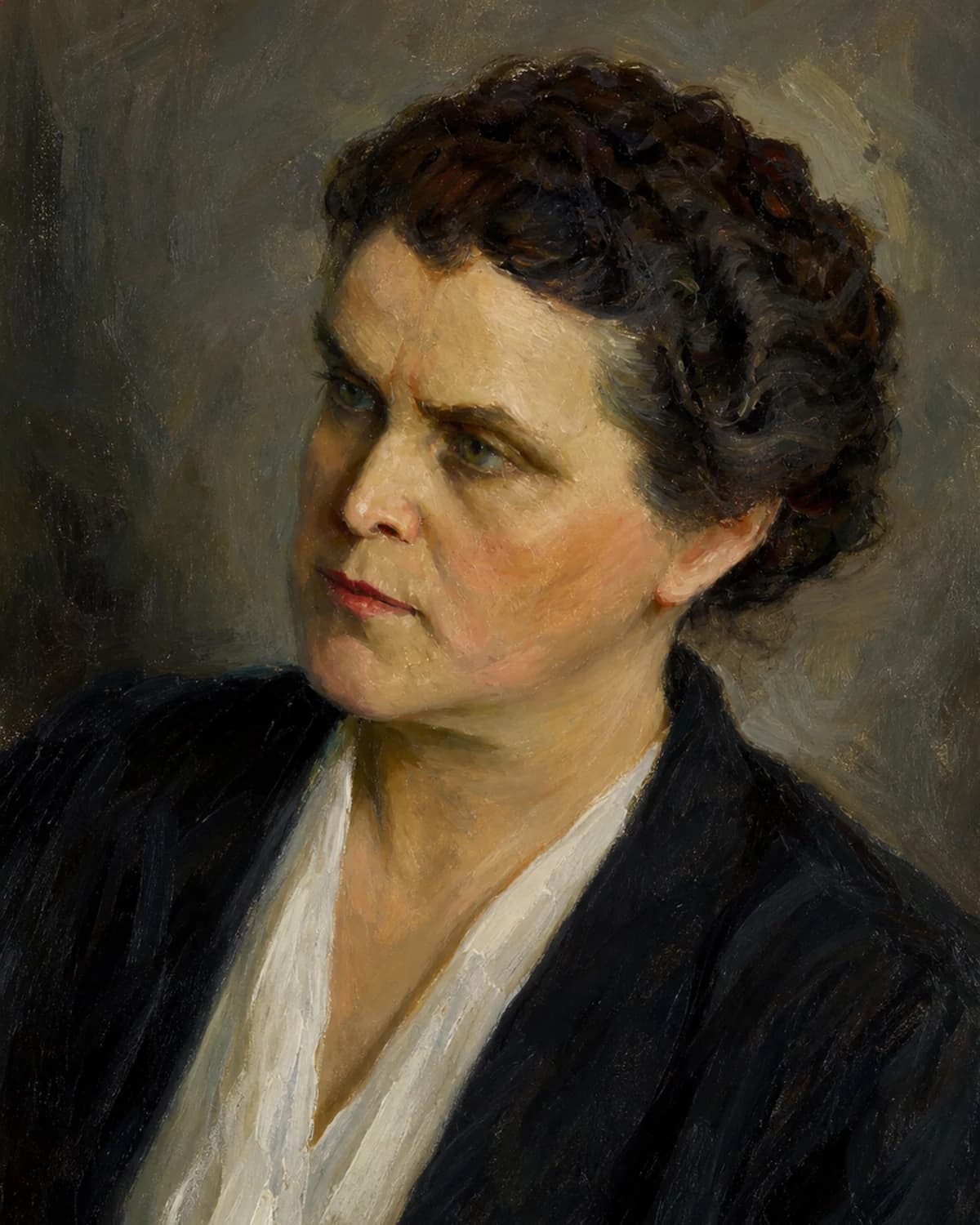
Vera Mukhina
Vera Mukhina (1889–1953) studied in Paris under Bourdelle, started out alongside the Cubists and Aleksandra Ekster, and became famous for “Worker and Kolkhoz Woman”, the 24-metre group on top of the Soviet pavilion at the 1937 World’s Fair. She made monuments and portraits, clothes together with Nadezhda Lamanova, and sculpture in glass; she won the Stalin Prize five times.
Biography
In Paris in 1937 two steel figures stood on top of Boris Iofan’s Soviet pavilion. Mukhina had counted on the sun lighting them from the front so that the metal would shine; a long scarf, brought into the composition, was meant to add a sense of flight, and for all their massiveness the worker and the kolkhoz woman seemed to be flying. The group was 24 metres high. The French press called it “the greatest work of sculpture of the twentieth century”, and Pablo Picasso wrote of “the Soviet giants against the lilac Parisian sky”.
In 1939 the monument was reassembled in Moscow, by the north entrance to the agricultural exhibition, but it was set on a low pedestal and with its back to the sun. “The statue is crawling along the ground,” Mukhina said.
She was born on 19 June (1 July) 1889 in Riga, into a merchant family; her father, Ignaty Kuzmich Mukhin, was a businessman and philanthropist, and the family house on what is now Vilhelma Purvīša Street still stands. From 1892 to 1904 Vera lived in Feodosia, where her father had taken her out of concern for her health, and there she had her first lessons in drawing and painting. In 1904 her father died. Vera and her elder sister Maria were taken in by relatives in Kursk, where she finished the gymnasium with distinction. Later the sisters moved to Moscow and settled on Prechistensky Boulevard. Mukhina studied painting in the studios of Konstantin Yuon, Ivan Dudin and Ilya Mashkov.
In 1912–1914 she lived in Paris and studied at the Académie Colarossi and the Académie de la Grande Chaumière, where Antoine Bourdelle became her teacher, and then travelled around Italy to look at Renaissance sculpture and painting. She returned to Moscow in the summer of 1914, a few weeks before the war, took a nursing course and went to work in a military hospital. There she met a young doctor, Alexei Zamkov; they married in 1918.
After the revolution sculptors received commissions under Lenin’s plan for monumental propaganda. Mukhina designed a monument to the educator Nikolai Novikov; Narkompros approved it, but the clay model cracked from the cold in the unheated studio, and the monument never appeared. Then came the sketches “Liberated Labour” and “Revolution” (1919) and designs for monuments to Zagorsky (1921) and to Sverdlov, known as “The Flame of Revolution” (1923). She was still making Cubist pieces in 1922. In 1923, together with Aleksandra Ekster, she designed the pavilion of the newspaper Izvestia at the First All-Russian Agricultural and Handicraft-Industrial Exhibition in Moscow.
The most unexpected chapter of her life, to my mind, is fashion. At the 1925 exhibition in Paris Mukhina and the couturière Nadezhda Lamanova won the Grand Prix for a collection of elegant women’s dresses made from the cheapest fabrics: broadcloth, calico, canvas, flannelette. The hats were of bast matting, the belts were decorated with dyed peas, the buttons were turned from wood, and the dresses carried a “cockerel pattern” of Mukhina’s own invention.
In 1927–1930 she taught at Vkhutein. Her “Peasant Woman” won first prize at the 1927 exhibition for the tenth anniversary of the October Revolution; later the sculpture was bought by the museum in Trieste, and after the Second World War it passed to the Vatican Museums. Then came “Worker and Kolkhoz Woman”, which brought Mukhina the first of her five Stalin Prizes, and sculptures for Shchusev’s Moskvoretsky Bridge (1938–1939). Of the six groups planned, only one, “Bread”, was carried out in her lifetime; the rest, among them “Fertility”, “Sea” and “Earth”, were recreated from her sketches after her death.
From October 1941 to April 1942 Mukhina worked in evacuation in Kamensk-Uralsky. During the war and after it she modelled portraits: of the colonels I. L. Khizhnyak and B. A. Yusupov, the ballerina Galina Ulanova, the surgeon Nikolai Burdenko, the academician A. N. Krylov. Together with the chemist N. N. Kachalov, an expert on optical and art glass, she took up glass sculpture, and in 1947 she showed his portrait, cast in matt blue glass, at the Russian Museum. In 1945 she was invited to Riga as an expert to decide the fate of the Freedom Monument, which was about to be demolished; against the opinion of the party functionaries, Mukhina spoke in its defence, and the monument survived. She made two monuments to Maxim Gorky, at the Belorussky Station in Moscow and in the city of Gorky, as well as tombstones in the Novodevichy Cemetery. From 1943 she was a People’s Artist of the USSR, from 1947 a full member of the USSR Academy of Arts and a member of its presidium.
Vera Mukhina died in Moscow on 6 October 1953 and is buried in the Novodevichy Cemetery. Her monument to Tchaikovsky was unveiled in the courtyard of the Conservatory on Bolshaya Nikitskaya Street in 1954.
Related context
Associations
Works connected through artistic movements, cultural context and period. Priced works available in this market appear first.








Profile notes
Profile and sources
Image
Artist image
На основе открытого изображения: Mikhail Nesterov; Wikimedia Commons; Public domain.
