
02.11.1893–26.09.1937
Vera Ermolaeva
Vera Ermolaeva (1893–1937) started out in Petrograd’s Futurist circles, helped Malevich create UNOVIS in Vitebsk and in 1921 became head of the art institute there. Back in Petrograd she ran the colour laboratory at GINKhUK and later illustrated children’s books by Kharms, Vvedensky and Schwartz. She was arrested in December 1934 and shot near Karaganda in 1937.
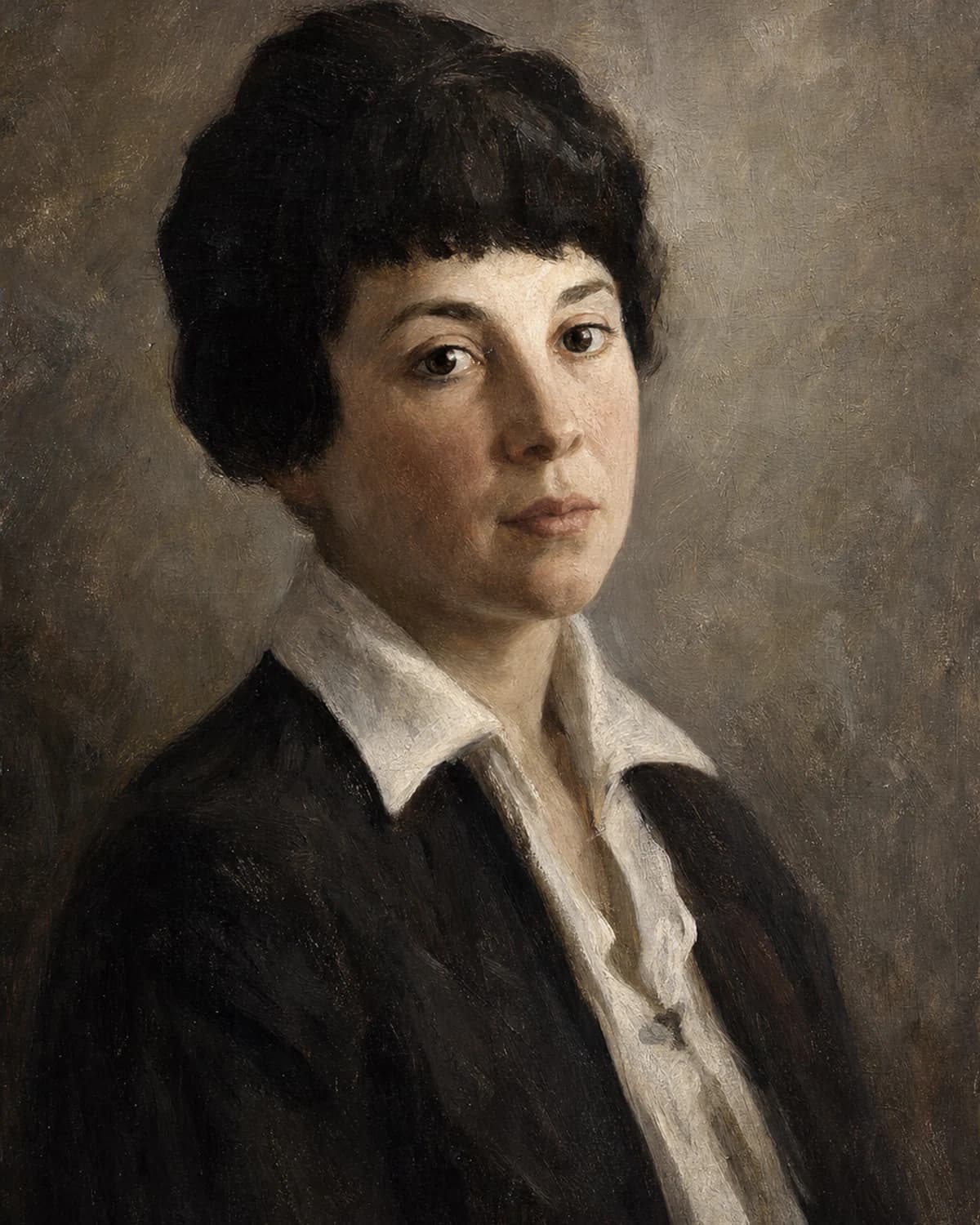
Biography
On 26 January 1919 the journal Iskusstvo kommuny (Art of the Commune) printed Vera Ermolaeva’s article “Petersburg Shop Signs”. She wrote about the painted shop signboards she saw in the streets every day, and she gave her own collection of such signs to the Petrograd City Museum, where she was then working. Icons, lubki and signboards had interested her for a long time, and, I think, without that interest her picture books are hard to understand.
She was born on 2 November 1893 in the village of Klyuchi in Petrovsk district, Saratov Governorate. Her father, Mikhail Sergeyevich Ermolaev, a landowner, chaired the district zemstvo board and published a liberal journal, Zhizn (Life); her mother, Anna Vladimirovna, was born Baroness Ungern-Unkovskaya. As a child Vera fell from a horse, and her legs were paralysed. From then on she could walk only on crutches. Medical treatment was one of the reasons the family spent long periods abroad, and the girl went to school in Paris and Lausanne. In 1904 the Ermolaevs returned to Russia; a year later her father sold the estate, and the family settled in St Petersburg. Mikhail Sergeyevich died on 17 (30) October 1911.
She finished Princess Obolenskaya’s gymnasium in 1910 (other sources say 1911) and entered Mikhail Bernshtein’s studio. There she took up Cubism and Futurism and met Tatlin, Mikhail Le-Dantyu, Nikolai Lapshin and Ilia Zdanevich. In 1914 she went to Paris to look at the new painting, but the outbreak of war forced her to return. In 1915–1916 she and Lapshin belonged to the Futurist circle “Bloodless Murder”, which put out a journal of the same name. In 1917 she graduated from the Archaeological Institute, and at the same time she was a member of the groups “Freedom to Art” and “Art and Revolution”.
In 1918 she became one of the founders of the artel Segodnya (Today). It produced lubki and picture books in tiny print runs, made almost entirely by hand: the illustrations were cut in linoleum and usually coloured with a brush, and in some books the text itself was cut in linoleum too. Ermolaeva designed “Little Mice” and “The Rooster” by Natan Vengrov and “Pioneers” by Walt Whitman. Scholars later saw in these books the first attempt to construct a children’s book as a single artistic organism.
In April 1919 the Fine Arts Department of Narkompros sent her to teach at the People’s Art School in Vitebsk. In November of that year she invited Kazimir Malevich to join her there, and under his influence her own painting became non-objective. Together with Malevich and his students Ermolaeva created UNOVIS (Affirmers of the New Art), a society that called itself a research laboratory of artistic form and preached Suprematism; from 1920 to 1922 she was its secretary. After Marc Chagall left, in 1921, she became rector of the school, which had by then been turned into the Vitebsk Practical Art Institute. For the opera “Victory over the Sun” by Mikhail Matyushin and Aleksei Kruchenykh she made set designs in hand-coloured linocut, like the Segodnya books; in 1922 they were shown at the First Russian Art Exhibition in Berlin, and one of them is now in the Museum of Modern Art in New York.
In 1922 she returned to Petrograd and took charge of the colour laboratory at the State Institute of Artistic Culture. When the institute was closed in 1926, her ties with Malevich weakened.
From the mid-1920s Ermolaeva worked for the children’s department of the State Publishing House. She illustrated “Top-Top-Top” by Nikolai Aseev (1925), “Many Beasts” and “Fishermen” by Alexander Vvedensky, “The Train” by Evgeny Schwartz (1929) and Daniil Kharms’s little book “Ivan Ivanych Samovar” (1930), and in 1929–1931 she produced twelve small books of Krylov’s fables. Some books, such as “Little Dogs” and “The Hapless Coachman” (1928), she both wrote and illustrated herself. In the summer of 1928, together with the artist P. V. Velikanova, she travelled along the Barents Sea coast and brought back a series of gouaches; Kharms and Vvedensky saw them and wrote pieces based on them. Among the gouaches of that year are “Seated Woman”, “Three Figures”, “Accordionist” and “Ballerina”, in which the art historian E. Kovtun found the influence of Cubism, above all of Braque.
By the early 1930s she had moved from children’s books to books for adults, epic and philosophical ones: Goethe’s “Reynard the Fox”, Cervantes’s “Don Quixote”, and finally a series of gouaches for Lucretius’s poem “On the Nature of Things”. In the same years came a large painting cycle, “The Village”, with “Peasant Woman with a Sheaf” and “Peasant Woman with a Child”, in which Suprematism can still be felt. The Russian Museum holds her “Three Figures (Golgotha)” (1928) and “Man with a Basket” (1933). In 1929, with Vladimir Sterligov, K. I. Rozhdestvensky, L. A. Yudin, N. M. Suetin and A. A. Leporskaya, she formed a “group of painterly-plastic realism”. On Tuesdays they met at her flat, held exhibitions there and argued about painting. These exhibitions for a narrow circle became the pretext for a denunciation.
On 25 December 1934 Ermolaeva was arrested; in the same days Sterligov, L. S. Galperin, Nina Kogan and Ermolaeva’s pupil M. B. Kazanskaya were also taken. On 29 March 1935 she was sentenced under Articles 58-10 and 58-11 to three years’ imprisonment and sent to the Karaganda corrective labour camp. On 20 September 1937 an NKVD troika passed a second sentence on her. Vera Ermolaeva was shot near Karaganda on 26 September 1937 (other sources give a year later).
She was rehabilitated on 20 September 1989. Her first solo exhibition was held in 1972 at the Leningrad branch of the Union of Artists, a large exhibition followed at the Russian Museum in 2008, and in 2013 a foundation bearing her name was set up in Moscow to support women’s initiatives in contemporary art.
Related context
Associations
Works connected through artistic movements, cultural context and period. Priced works available in this market appear first.








Profile notes
Profile and sources
Image
Artist image
На основе открытого изображения: Unknown author Unknown author; Wikimedia Commons; Public domain.
