
31.12.1872–15.11.1952
Vasyl Krychevsky
Without an academic diploma, Vasyl Krychevsky (1872–1952) built the Poltava provincial zemstvo building, which became the model of Ukrainian architectural Art Nouveau. He designed stage productions and films, among them Dovzhenko’s “Zvenigora”, painted landscapes, taught architecture in Kiev and was one of the founders of the Ukrainian Academy of Arts. He spent his last years in Caracas.
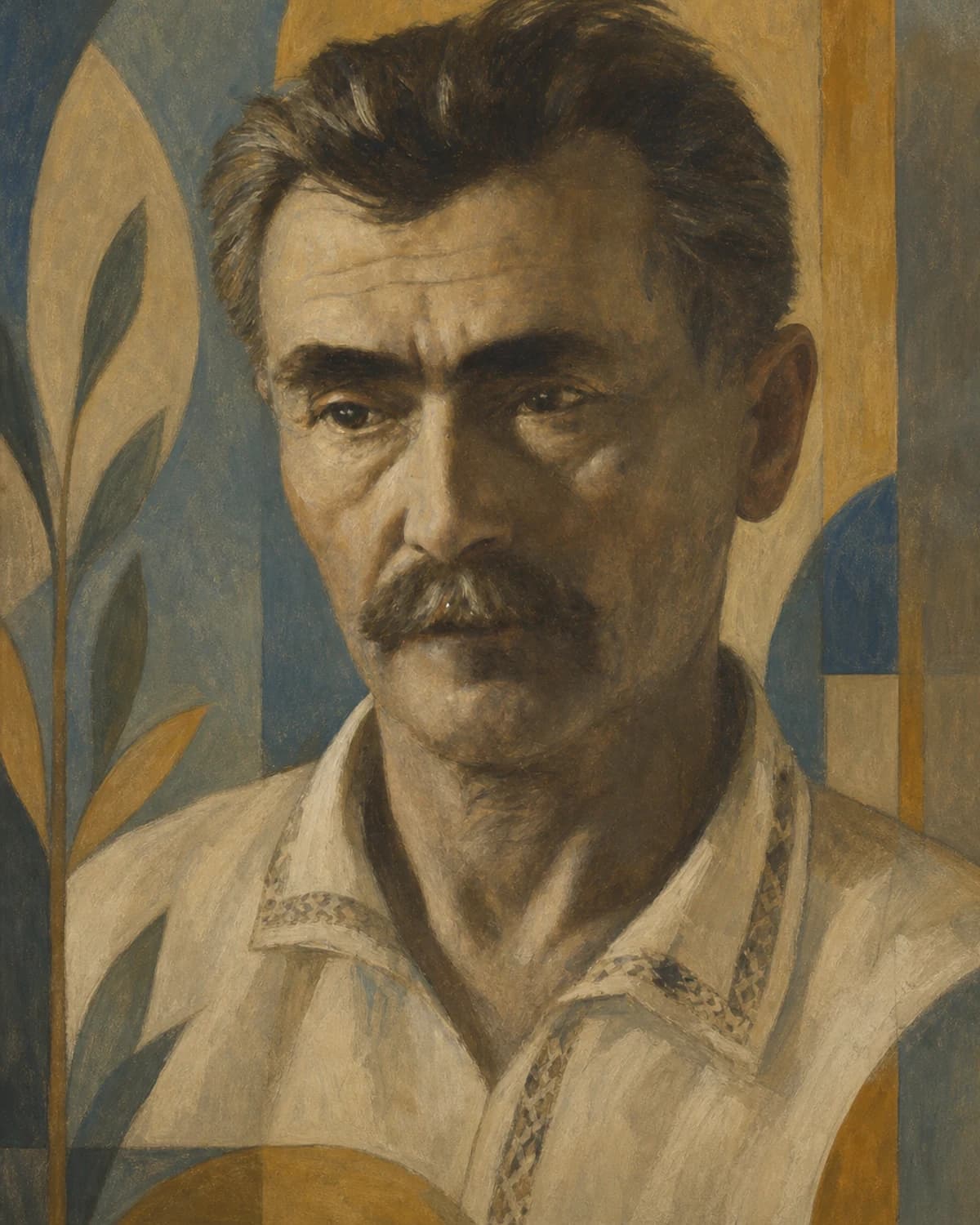
Biography
In 1903 the competition for the building of the Poltava provincial zemstvo was won by a man without an architectural diploma. Vasyl Krychevsky’s design, which took account of the original designs of E. I. Shirshov and M. O. Nikolaev, drew on Ukrainian folk architecture. From 1904 to 1908 Krychevsky himself supervised the construction and decoration, and the building became the first example of the style that would later be called Ukrainian architectural Art Nouveau. Today it houses the Poltava Museum of Local Lore.
He had little schooling, and most of it was in a trade.
He was born on 31 December 1872 (12 January 1873) in the sloboda of Vorozhba, Lebedin uyezd, Kharkov province, the eldest of the eight children of a district zemstvo medical assistant, Hryhoriy Krychevsky. He went to the village school, studied at the two-class school in Verkhnyaya Syrovatka in 1880–1882, then at the Kharkov railway technical school, where he qualified as a draughtsman. From the age of fifteen he worked as an assistant draughtsman in the Kharkov council offices, then for the architects S. I. Zagoskin and A. N. Shpigel, and as chief assistant to the Academician Alexei Beketov. The work he submitted for admission to the St Petersburg Academy of Arts was, according to his biographers, judged equal to the full academic course. In 1902 he took part in the exhibition held with the 12th Archaeological Congress in Kharkov. His brother Fedir Krychevsky also became a well-known painter and teacher.
From 1907 Krychevsky worked in Kiev. The first building in the new style there was I. I. Shchitkovsky’s house on Poltavskaya Street (1907–1908), and in 1908–1909 Mykhailo Hrushevsky’s six-storey apartment building was decorated to his design. He built the complex of the S. F. Hrushevsky town school on Kirillovskaya Street, an apartment building at 28 Streletskaya Street, where he himself lived from the early 1920s, the People’s House in Lokhvitsa and, in 1916, the building of the Poltava zemstvo pottery training and demonstration centre in Opishnya. In 1907–1910 he designed more than fifteen plays and operas, among them Mykhailo Starytsky’s “Bohdan Khmelnytsky” and Smetana’s “The Bartered Bride”, worked with Mykola Sadovsky’s theatre and designed books. For the patron Bohdan Khanenko he made cartoons for carpets on themes from folk art, woven by the Khanenko workshop in Olenivka; Krychevsky directed it and the ceramics school in Mirgorod. All his life he collected Ukrainian folk art and assembled one of the richest collections of its kind; it was kept in Hrushevsky’s house and burned during the artillery bombardment of Kiev in 1918.
In 1917 he was among the founders of the Ukrainian Academy of Arts and taught there as a professor until 1922. In March 1918 the Central Rada approved his designs, among them a coat of arms based on the trident of Volodymyr; at Mykhailo Hrushevsky’s request he also drew seals and banknotes for the Ukrainian People’s Republic.
From 1922 teaching became Krychevsky’s main work. He initiated the Kiev Architectural Institute and headed a department there until 1941; in 1930–1936 he taught at the Kiev Civil Engineering Institute, where he organised the section of drawing and painting, and in 1939 he received the degree of Doctor of Art History. Among his students was Iosif Karakis, who studied the interiors of residential and public buildings and painting technique with him. In 1923–1924 Krychevsky established that Taras Shevchenko had lived in a house in Khreshchatytsky Lane in 1846, and directed its conversion into a museum, from the designs of the rooms to the garden; later, in the 1930s, the Shevchenko memorial museum in Kaniv was built to his design. In 1925–1927 he was the designer of the films “Taras Shevchenko” by Pyotr Chardynin, “Taras Tryasilo”, “Borislav Laughs” and Oleksandr Dovzhenko’s “Zvenigora”, and in the 1930s he designed “Nazar Stodolya” and “The Sorochintsy Fair”. His painting is assigned to a lyrical “Ukrainian Impressionism”: “On the Dnieper” (1900), “The Fair” (1913), “Landscape” (1934). In all he made about three thousand paintings, drawings, ornamental designs and book covers, the latter including the cover of Yuri Yanovsky’s novel “The Master of the Ship” (1928). In 1940 a large solo exhibition of 1,055 of his works was held in Kiev, and that year he received the title of Honoured Art Worker of the Ukrainian SSR.
Krychevsky was in Kiev when the war began, and the city was soon under occupation. In 1943 he left with his family for Lviv and headed the Higher Art Studio there; later the teachers and students moved to the Lemko region, where they painted a church in the village of Labova. After the war he lived in Germany and in Paris with his son Mykola, and at the end of the 1940s he and his wife moved to their daughter Halyna in Caracas. He died there on 15 November 1952. The descriptions available to me say little about his last years.
In 1975 his remains were moved to the Ukrainian cemetery of St Andrew in South Bound Brook, New Jersey. The largest collection of his work abroad is in the Ukrainian Museum in New York, and in 2003 about three hundred works that had remained with his daughter were donated to museums in Kharkiv, Poltava, Lebedyn and Kyiv.
Related context
Associations
Works connected through artistic movements, cultural context and period. Priced works available in this market appear first.








Profile notes
Profile and sources
Image
Artist image
На основе открытого изображения: Unknown author Unknown author; Wikimedia Commons; Public domain.
