
12.01.1848–19.03.1916
Vasily Surikov
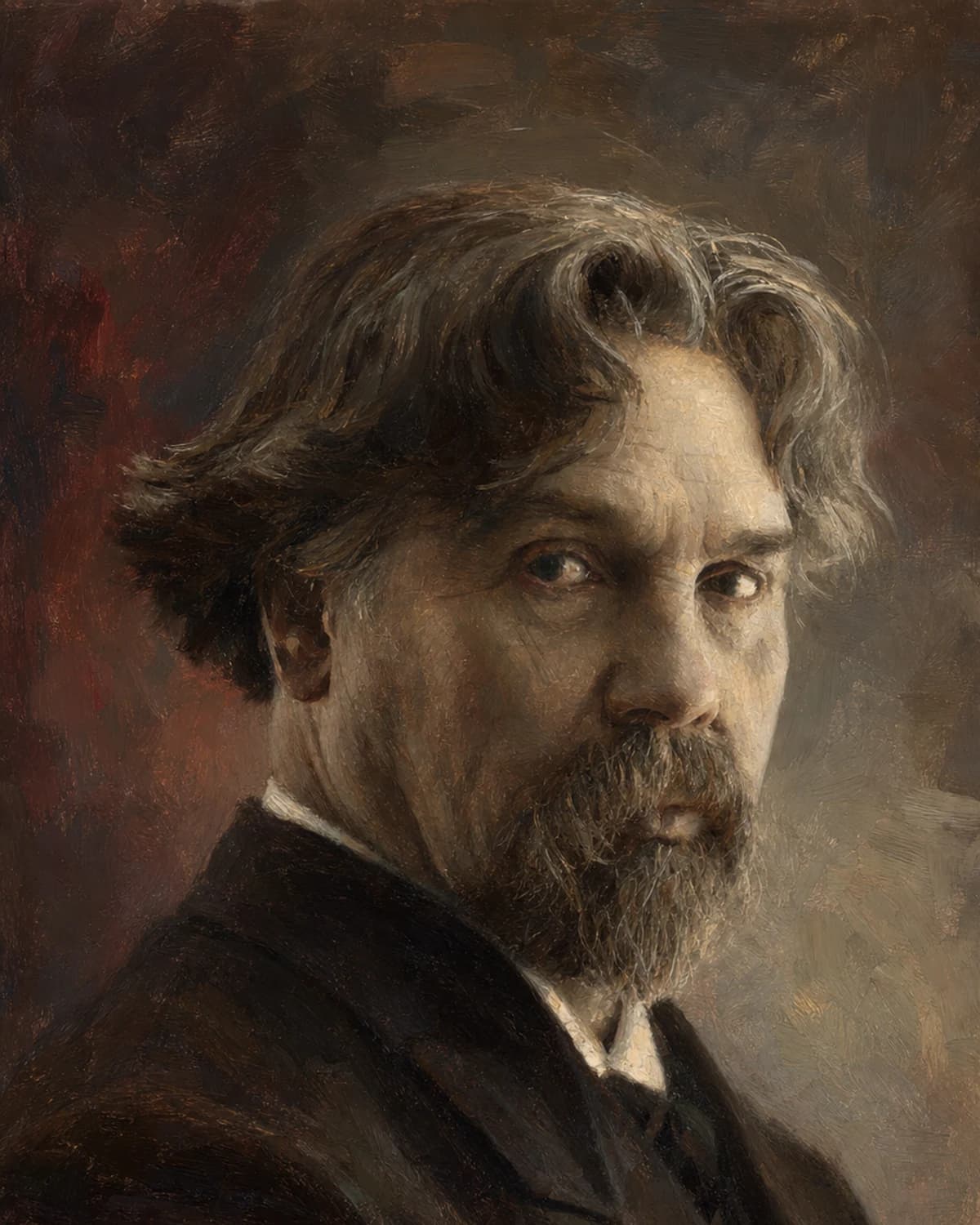
Vasily Surikov (1848–1916), a Siberian from a Cossack family, came to St Petersburg with the wagon train of a Krasnoyarsk gold-mine owner and made his name in Moscow with large history paintings. He often painted the figures of “The Morning of the Streltsy Execution”, “Boyarynya Morozova” and “Suvorov Crossing the Alps” from his Krasnoyarsk relatives and fellow townspeople. He was a Peredvizhnik, a full member of the Academy of Arts and an academician.
Biography
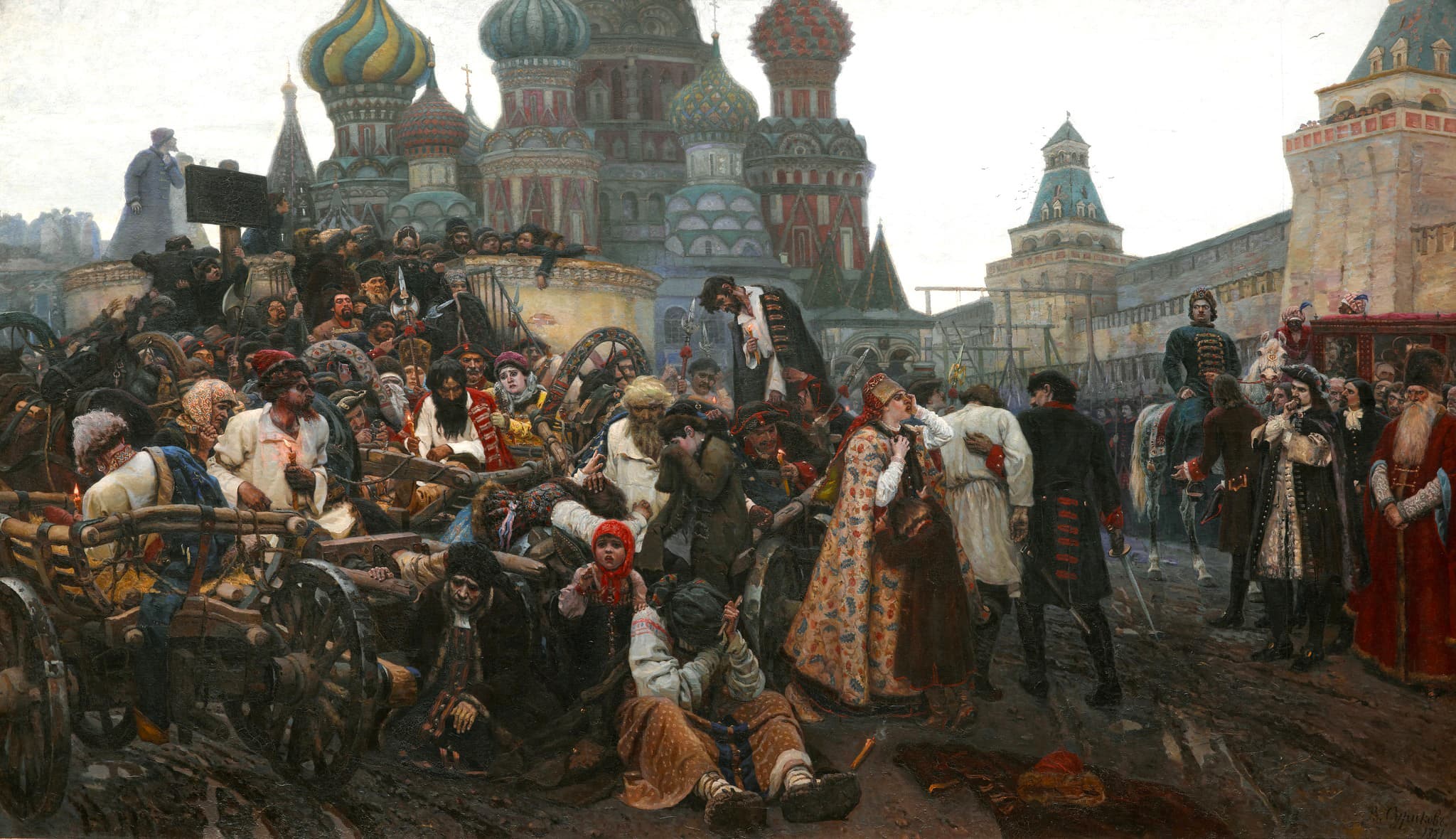
In “The Morning of the Streltsy Execution” a black-bearded strelets stands among the condemned. He was modelled by Stepan Fyodorovich Torgoshin, the husband of Surikov’s aunt, and the aunt herself, Avdotya Vasilyevna, would a few years later become the face of Boyarynya Morozova. To my mind this explains a great deal about Surikov: his Russian seventeenth century is peopled by men and women he knew by name.
He was born on 12 (24) January 1848 in Krasnoyarsk, into a family of the Cossack estate; his grandfather had served as a sotnik in Turukhansk. In 1854 his father, a collegiate registrar, was transferred to the excise office in the village of Sukhoi Buzim, and the boy started at the parish school there. In 1859 his father died. His mother returned to Krasnoyarsk with the children, and the second storey of the house had to be let.
He was taught drawing by Nikolai Grebnev of the district school; his earliest dated work, the watercolour “Rafts on the Yenisei”, belongs to 1862. There was no money for the gymnasium, and the teenager became a copying clerk in the provincial administration. There the Yenisei governor P. N. Zamyatnin saw his drawings and found him a patron: the gold-mine owner P. I. Kuznetsov undertook to pay for his studies at the Academy of Arts.
On 11 December 1868 Surikov set off for St Petersburg with Kuznetsov’s wagon train. The Academy did not take him at once: in the summer of 1869 he studied at the drawing school of the Society for the Encouragement of Artists, in the autumn he became an auditor, and a year later a regular student. He studied under Pavel Chistyakov, won four silver medals and earned the nickname “the Composer” for his attention to the construction of a scene. The competition of 1875 came to nothing: the council judged the works of all four entrants, Surikov’s “Apostle Paul” among them, unworthy of the large gold medal and the scholarship trip abroad. On 4 (16) November 1875 he graduated from the Academy as a class artist of the first degree. He would see Europe only eight years later, on the money from a sold picture.
His first large commission was four frescoes on the Ecumenical Councils for the Cathedral of Christ the Saviour. For their sake he moved to Moscow in 1877 and stayed there for the rest of his life, though he never acquired a home of his own: rented flats, hotels, and Krasnoyarsk for the summer. In January 1878 he married Elizaveta Avgustovna Charais. They had two daughters, Olga and Yelena.
“The Morning of the Streltsy Execution” was painted from 1878 to 1881: the streltsy who had risen in revolt in 1698 are being led to their execution. In 1881 Surikov joined the Association of Travelling Art Exhibitions. In 1883 Pavel Tretyakov bought “Menshikov in Beryozovo”, and the painter at last went abroad, to see the Dresden Gallery and the Louvre. The first sketch for “Boyarynya Morozova” dates from as early as 1881; he took up the canvas in 1884. As a boy he had heard the story of the Old Believer noblewoman from another aunt, Olga Matveyevna Durandina. The laughing man on the left, who looks like a merchant, was painted from Varsonofy Zakourtsev, a former sexton of the Trinity Church at Sukhoi Buzim, and the wanderer with a staff on the right from a settler met on the road. The picture was shown at the 15th Travelling Exhibition in 1887. Academic painters attacked such canvases as a “jumble” of faces and called them “brocade carpets”, while Benois praised them for their kinship with Old Russian painting.
In 1887 he took up portraiture seriously for the first time: he painted his mother and, probably at the same time, “My Brother”. Surikov, incidentally, never accepted portrait commissions.
In April 1888 Elizaveta Avgustovna died.
His younger brother Alexander came from Krasnoyarsk and persuaded him to take his daughters home to Siberia; from the summer of 1889 to the autumn of 1890 the Surikovs lived in Krasnoyarsk. There his brother suggested the subject of “The Capture of Snow Town” (1891, Russian Museum), Surikov’s most cheerful picture. The snow fortress was built in the courtyard of the family house, peasants from the village of Bazaikha stormed it, and Alexander himself stands on the right in a sleigh. At the Paris World’s Fair of 1900 the picture won its author a bronze medal.
Then Siberia again. For “The Conquest of Siberia by Yermak Timofeyevich” (1891–1895) he painted studies on the Ob, spent the summer of 1892 at the gold diggings in Khakassia and wrote from there: “I am painting Tatars. I have painted a fair number. I have found the type for Yermak.” From 1893 he was a full member of the Academy of Arts, from 1895 an academician. “Suvorov Crossing the Alps” was conceived in Krasnoyarsk in October 1895. The first Suvorov was the 82-year-old retired Cossack officer F. F. Spiridonov, and the white horse under the general belonged to G. N. Smirnov, a singing teacher at the gymnasium. In the summer of 1897 he painted studies in Switzerland. He finished the picture for the centenary of the Italian campaign, in 1899, and it was bought by Nicholas II.
“Stepan Razin” went differently. The idea came in 1887, and in the first sketch Razin sailed at the head of a flotilla, with the Persian princess in the centre; the scholar A. Dyomkin believes the artist painted his wife as the princess. In 1900, when Surikov returned to the subject, only one boat was left in the sketches and the princess had gone; Razin sits in heavy thought, apart from the Cossacks. The picture was sold in 1907, but he went on repainting the ataman’s face until 1910. Scholars note the ataman’s likeness to Surikov’s self-portraits of those years, and it seems to me the theory of a hidden self-portrait is convincing. In 1907 he left the Peredvizhniki and joined the Union of Russian Artists.
In 1910 he travelled to Spain with his son-in-law, Pyotr Konchalovsky; that same year a drawing school opened in Krasnoyarsk on his initiative. Among those who sat for “The Tsarevna’s Visit to a Convent” (1912) was his granddaughter Natalya Konchalovskaya. In the summer of 1914 he again painted the Yenisei and the streets of Krasnoyarsk. His last work was “The Annunciation”. In 1915 Surikov went to the Crimea for treatment.
He died in Moscow on 6 (19) March 1916. He is buried in the Vagankovo Cemetery, next to his wife.
Artist works
Works by the artist
Works by Vasily Surikov available in this edition of NEOARCA.
Related context
Associations
Works connected through artistic movements, cultural context and period. Priced works available in this market appear first.








Profile notes
Profile and sources
Image
Artist image
На основе открытого изображения: Karl Fischer; Wikimedia Commons; Public domain.
