
12.08.1858–17.12.1890
Vasily Sergeyevich Smirnov
Vasily Smirnov (1858–1890) painted “The Death of Nero”, for which the Academy of Arts gave him the title of academician in 1888 and which Alexander III bought. He spent four years in Italy as an Academy stipendiary and worked at the excavations in Pompeii. He died at thirty-two; his surviving work is small and is held mainly in the Tretyakov Gallery.
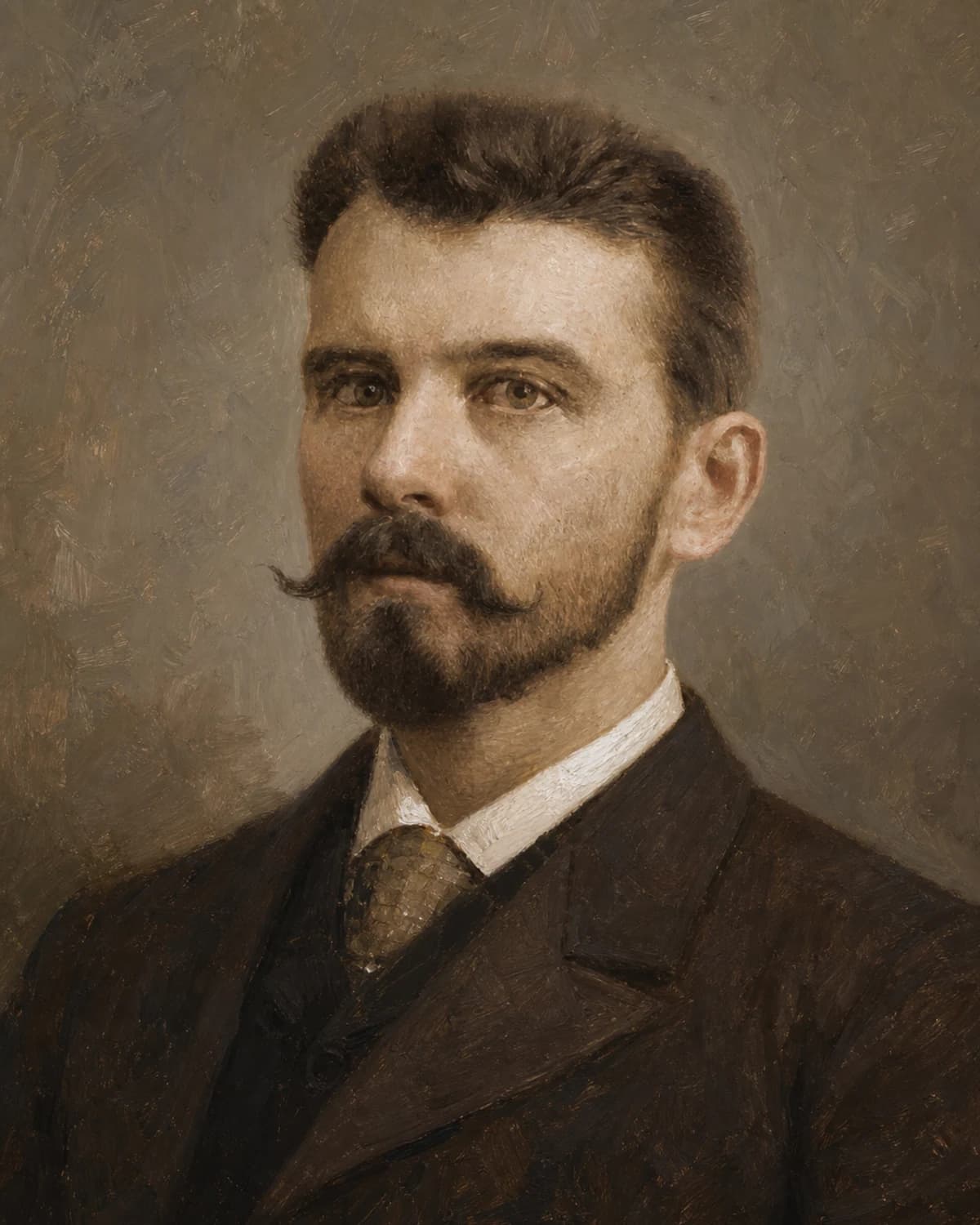
Biography
Vasily Smirnov died in a railway carriage, between the stations of Kubinka and Golitsyno, on 29 December 1890. Gravely ill, he was returning from Italy to the family estate.
He was born on 24 August 1858 (12 August, Old Style) in Moscow, into a noble family. His father, Sergei Semyonovich Smirnov, was a chamberlain at the imperial court and marshal of the nobility of the Klin district, where the family estate lay; the Smirnovs lived in their own house on Prechistenka. Vasily attended the Fifth Classical Gymnasium but did not finish it: in 1875, at seventeen, he entered the Moscow School of Painting, Sculpture and Architecture. His choice of profession was apparently influenced by Vasily Perov, a friend of the family. In Perov’s class Smirnov learned that the subject is what matters most in a picture, and the habit stayed with him for a long time. At the school he won small silver medals for a drawing and a study from life.
In September 1878 he transferred to the Imperial Academy of Arts in Saint Petersburg, studied in the studio of Pyotr Shamshin and attended the classes of Pavel Chistyakov, though he was not among Chistyakov’s closest pupils. His early work has not survived; only in the 1950s did a study, “Peasant with a Staff”, turn up in a private collection. In 1880 he won large silver medals, and in 1882 a small gold medal for the set subject “The Return of the Prodigal Son”. That same year, because of a chronic catarrh of the lungs, he had to take leave. In 1883 he was admitted to the competition for the large gold medal, and for his programme piece “The Holy Prince Michael of Chernigov in the Horde before Batu Khan’s Tent” he won it, together with the title of class artist of the first degree and the right to four years of study abroad at the Academy’s expense. Ilya Repin approved the work.
Smirnov travelled to Italy by way of Vienna, saw Padua, Bologna, Venice and Florence on the way, and by May 1884 had settled in Rome. To escape the heat he went to Turin, and from there to the Paris Salon, where he came to know the work of Meissonier and Munkácsy; he then visited London, the Netherlands, Germany and Bohemia. In the autumn he returned to Italy and shared lodgings with Vasily Savinsky, a pupil of Chistyakov, who guided him through letters. To my mind the influence of this mentorship at a distance on Smirnov has been underrated: he is mentioned constantly in the correspondence between Chistyakov and Savinsky, and the teacher took an interest in his plans too.
In the summer of 1885 he made studies at the excavations in Pompeii. This began his fascination with antiquity. In early 1886 he abandoned the idea of “The Apostles Peter and John at the Tomb of the Lord” on the advice of the academician Valery Jacobi, who had come to Rome to see the work of the Academy’s stipendiaries. For his two-year report Smirnov sent nineteen pieces, mostly studies on classical themes. At that time the plan for a painting about the death of Nero first appears in his letters; it took about two years. His report work for the third year was “The Triumph of Poppaea over Octavia” (1887): Poppaea Sabina, Nero’s second wife, receives as a gift the head of his first wife. Chistyakov remarked that the faces were “painted rather coarsely”. The Academy did not buy the picture; for two years it toured provincial towns with a travelling exhibition, and where it is now is unknown. In the summer of 1887 Smirnov came briefly to Russia, presumably because of his father’s death.
“The Death of Nero” was finished by 1888. On 31 October the Council of the Academy gave Smirnov the title of academician, and at the Academy exhibition of 1889 the canvas received awards and was bought by Alexander III. Critics of the day saw in it an “inordinately enlarged” version of a subject by Alma-Tadema, one that worked on the viewer through its “bloody tragedy”. The scholar Elena Nesterova believes that Smirnov relied more on Renan’s book on the Antichrist than on ancient authors. He gave up the everyday detail customary among his contemporaries and built the picture on foreshortenings and large planes of colour, concentrating on the final moment.
In January 1889 Smirnov received a post as supernumerary associate professor in the Academy’s drawing classes, but in October, because of tuberculosis, he went back to Italy. In 1889 he still made studies at Pompeii, and in his last year he took up “The Morning Procession of a Byzantine Empress to the Tombs of Her Ancestors”; the first study for it dates from 1884. He set the scene in the mausoleum of Galla Placidia and took the subject in part from the mosaics of Ravenna. The picture remained unfinished.
Smirnov was buried in the cemetery of the Novospassky Monastery, beside his father; the necropolis was destroyed under Soviet rule. His brother, who became his executor, sold the unfinished picture to Pavel Tretyakov. At the Academy exhibition of 1891 a solo show of about fifty works was held. Six Pompeii studies entered the Tretyakov Gallery only in 1985. Alexandre Benois called Smirnov “dry” and an epigone, but by the early twenty-first century assessments had changed: Nesterova considers him a talented voice of the age of historicism, one who has yet to be properly appreciated.
Related context
Associations
Works connected through artistic movements, cultural context and period. Priced works available in this market appear first.








Profile notes
Profile and sources
Image
Artist image
На основе открытого изображения: Петр Фёдорович Борель (1829 - 1901); Wikimedia Commons; Public domain.
