
01.06.1844–18.07.1927
Vasily Polenov
Vasily Polenov (1844–1927) painted “Moscow Courtyard” (1878), with which the small-scale, “intimate” landscape began in Russian painting, and the large canvas “Christ and the Sinner”. For more than ten years he taught at the Moscow School of Painting, where Levitan and Korovin were among his pupils. He spent his last decades on Borok, the estate he built on the Oka, which became a museum.
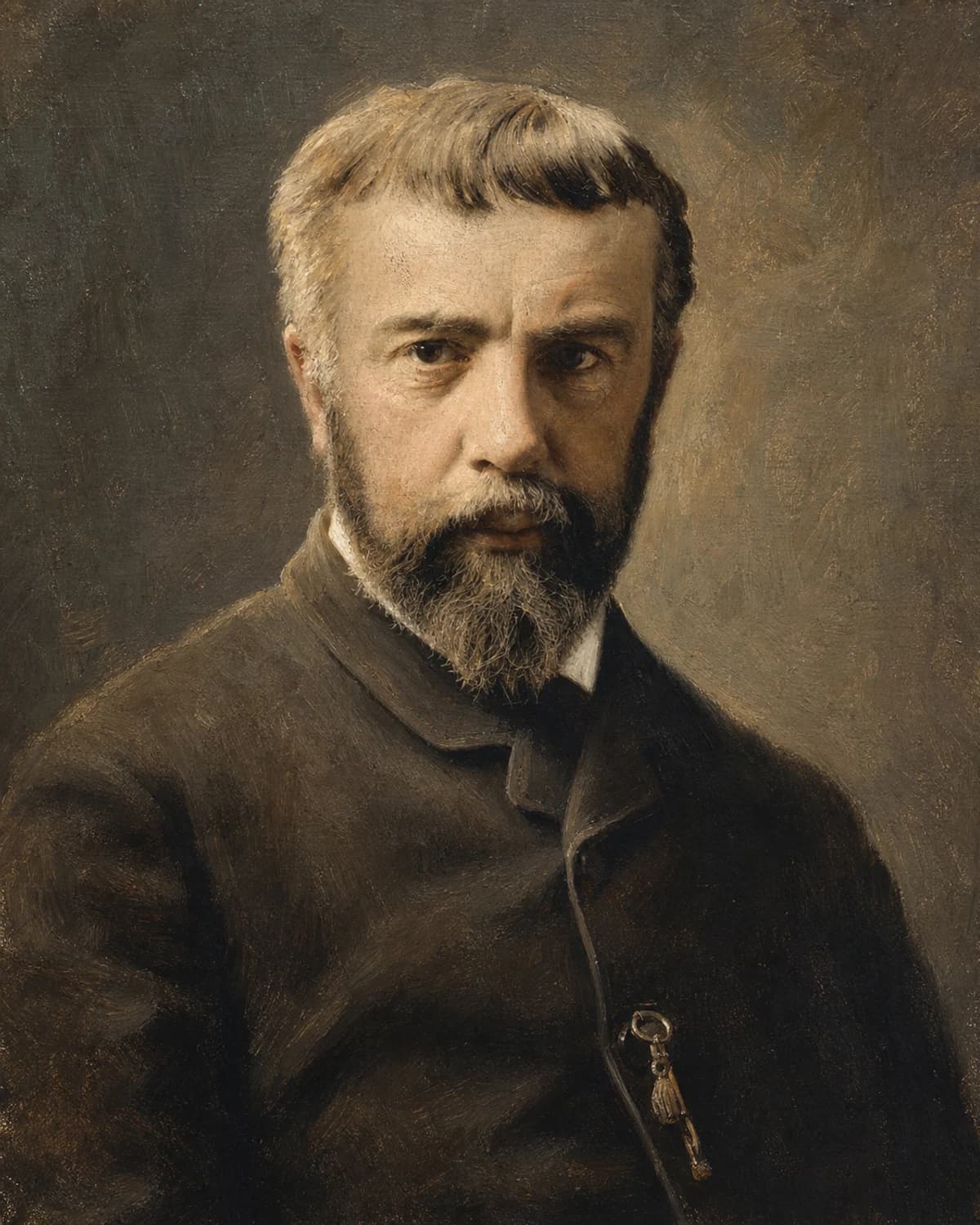
Biography
On 27 October 1904 Polenov wrote to Ivan Tsvetaev from his estate on the Oka that over the summer he had “built himself a studio, but for some reason it turned out to be an abbey”. The window in the new brick building was enormous, the light, in his words, wonderful, and he had dreamed of such a studio all his life. The building was known as the Abbey ever after.
He was born on 20 May (1 June) 1844 in St Petersburg, together with his twin sister Vera, the first children of a large noble family. His father, Dmitry Vasilyevich, was a diplomat, archaeologist and bibliographer; his mother, Maria Alekseevna, née Voeikova, wrote books for children and painted herself. The children spent their summers on the Imochentsy estate in Olonets Governorate and with their grandmother, Vera Nikolaevna Voeikova, at Olshanka in Tambov Governorate. Their grandmother, the daughter of the architect Nikolai Lvov, who had grown up in Derzhavin’s house, told her grandchildren the old epic tales and set them drawing competitions on subjects such as “The Judgement of King Solomon”, awarding the winner a “medal” as at the Academy. In 1856–1861 Vasily and his younger sister Elena, also a future artist, were taught drawing by Pavel Chistyakov, then still a student at the Academy himself. From the very first lessons he required his pupils to look closely at nature.
After gymnasium in Petrozavodsk, Polenov entered the faculty of physics and mathematics at St Petersburg University in 1863, while in the evenings he attended the Academy of Arts. Later he moved to the law faculty, and he completed both courses at the same time, in 1871. In 1869 he received the small gold medal for “Job and His Friends”, and in 1871 the large one for “The Raising of Jairus’ Daughter”, together with Ilya Repin.
His years as a pensioner abroad began in 1872: Vienna, Munich, Venice, Florence, Naples, then a long stay in Paris. There he painted “The Arrest of a Huguenot Woman”, which made him an academician in 1876. In the summer of 1874 he and Repin worked in the open air at Veules-les-Roses in Normandy, and Polenov took up landscape seriously for the first time. On his return he admitted that abroad he had tried every kind of painting and had realised that his field was landscape and scenes of everyday life.
First, though, came war.
In 1876 he volunteered for General Chernyaev’s army in the Serbian–Turkish war, fought in Colonel Andreev’s flying detachment and received the Serbian medal “For Bravery” and the Order of the Cross of Takovo. In 1877, now in the Russo-Turkish War, he was attached to the headquarters of the Ruschuk detachment under the Tsesarevich Alexander Alexandrovich. The drawings he sent to the magazine Pchela are almost all peaceful: views of Belgrade, the valley of the Morava, horsemen at a watering place.
In 1877 Polenov settled in Moscow, and the following year he showed “Moscow Courtyard”, painted from life in a lane off the Arbat, at the Sixth Itinerant Exhibition. It was followed by “Grandmother’s Garden” (1878) and “Overgrown Pond” (1879). A sunny summer courtyard with a church, children and a horse by a shed proved such a novelty that a whole genre, the “intimate landscape”, is traced back to it. To my mind, the secret is that absolutely nothing happens in the picture. Soon he was admitted to the Society of Itinerant Art Exhibitions. He spent long periods at Abramtsevo with Savva Mamontov, whom he had first met in Rome, painted ponds and birch avenues there, drew portraits of his friends and designed productions for the house theatre, and later for the Private Opera. In 1882 he married Natalia Yakunchikova.
From 1882 to 1895 he taught at the Moscow School of Painting, Sculpture and Architecture, where he trained Isaac Levitan, Konstantin Korovin, Ilya Ostroukhov, Abram Arkhipov and Alexander Golovin and was exacting about the quality of their paints and canvases. In 1881–1882, with the expedition of Semyon Abamelek-Lazarev and Adrian Prakhov, he travelled to Constantinople, Palestine, Syria and Egypt and brought back studies for “Christ and the Sinner”. He worked on the picture for several years, partly in Italy, and showed it at the Fifteenth Itinerant Exhibition in 1887; it was bought by Alexander III. A second journey to the East in 1899 provided material for the large cycle “From the Life of Christ”, completed in 1909.
With the money from “Christ and the Sinner”, in 1890 Polenov bought land near the village of Bekhovo on the high bank of the Oka and built a house with studios to his own design, the Borok estate. He conceived it as a “nest of artists” and a future museum open to all. There he put on plays with peasant children, built a people’s theatre, helped the schools, and in 1906 erected the Trinity Church in Bekhovo. He also composed music: an “All-Night Vigil”, a “Liturgy” and the opera “Phantoms of Hellas”, which was performed in 1906 in the Great Hall of the Moscow Conservatory.
In 1905, together with Valentin Serov, he resigned from the Academy of Arts, whose president was Grand Duke Vladimir Alexandrovich, over the Grand Duke’s role in the events of 9 January. Afterwards he devoted himself to the people’s theatre: in 1915 he opened a People’s House in Tarusa, and in Moscow a building to support village and factory theatres was put up to his sketches and at his expense, later named after him. In 1918–1919 he painted “Flood on the Oka” at Borok, and in 1920–1921 he made sixty-five small paintings of a journey round the world for a home light-theatre diorama. In 1924 the Tretyakov Gallery held his first solo exhibition for his eightieth birthday, and in 1926 he was made a People’s Artist of the Republic.
Polenov died on 18 July 1927 at Borok and was buried in the village cemetery at Bekhovo, on the steep bank of the Oka. In accordance with his will, an Olonets cross was placed over his grave. The estate became a museum, and its first director was his son Dmitry.
Related context
Associations
Works connected through artistic movements, cultural context and period. Priced works available in this market appear first.








Profile notes
Profile and sources
Image
Artist image
На основе открытого изображения: Unidentified photographer; Wikimedia Commons; Public domain.
