
21.12.1833–29.05.1882
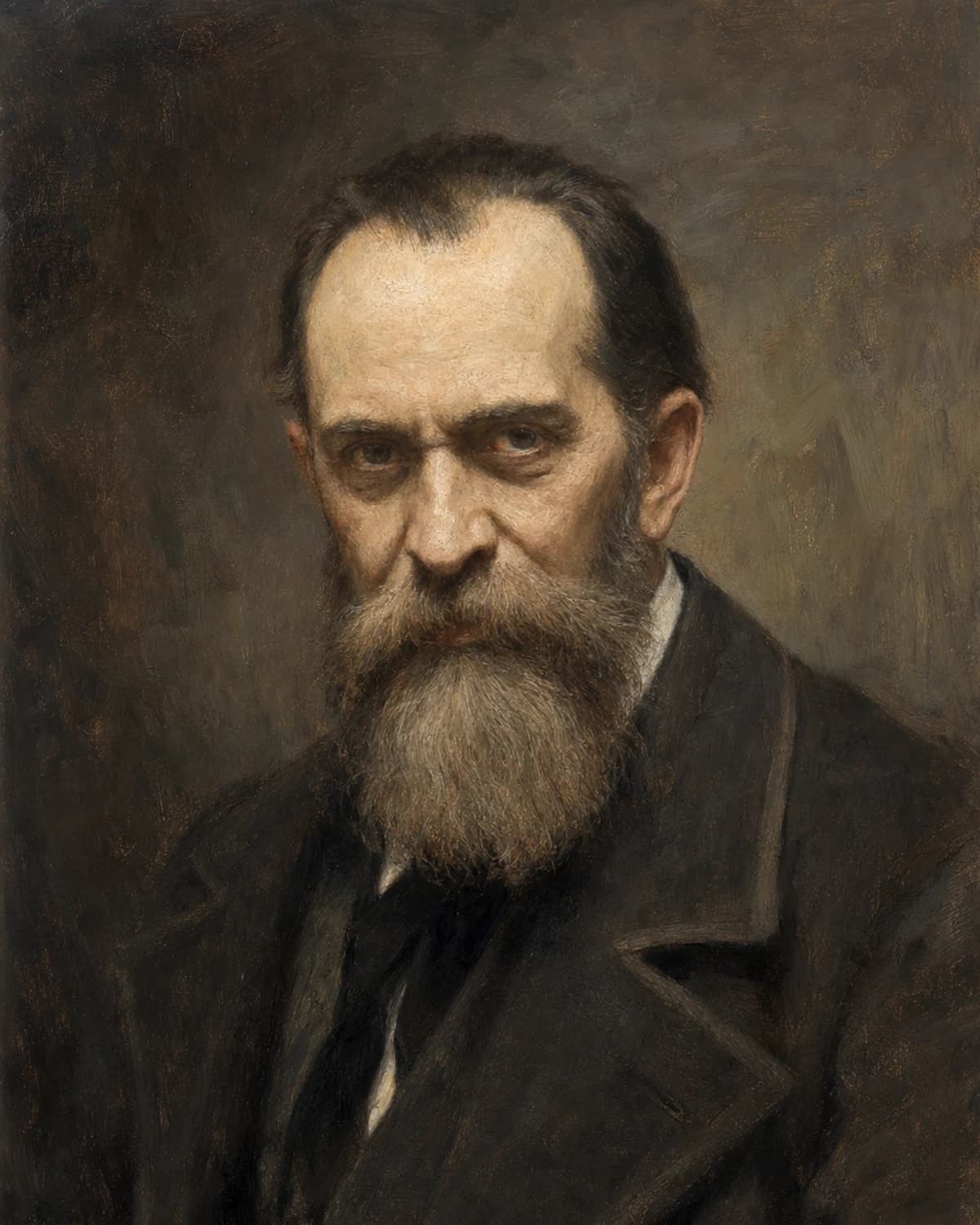
Vasily Perov
Vasily Perov (1833/1834–1882) painted “Easter Procession in the Country”, “Tea Drinking in Mytishchi”, “Troika” and “Seeing Off the Dead”, and later “Hunters at Rest” and the portrait of Dostoevsky. He was among the founders of the Society of Travelling Art Exhibitions (the Peredvizhniki), and from 1871 he taught at the Moscow School of Painting, Sculpture and Architecture, where Mikhail Nesterov was one of his pupils. He also published stories.
Biography
In official papers he was long recorded as Vasiliev, after his godfather’s first name. His real father, the Tobolsk provincial prosecutor Baron Grigory Karlovich Krüdener, married the boy’s mother, Akulina Ivanova, only after he was born, and the son could inherit neither the surname nor the baronial title. The name “Perov” was invented by the man who taught him to read and write, a sexton without a parish: it was his way of praising the pupil for diligence and for how deftly he handled a pen (pero in Russian).
Perov was born in Tobolsk on 21 December 1833 (2 January 1834); the exact day, however, is not known, and different documents give dates from 21 to 23 December.
His father was soon dismissed from the service, and the family spent years on the move: Arkhangelsk, the Krüdener estate near Dorpat, the estates of his half-brothers in Samara Governorate. In 1842 his father became steward of the Yazykov estate at the village of Sablukovo in Arzamas district, and there the boy first watched a hired painter at work. After the district school he studied, with interruptions, at Alexander Stupin’s school in Arzamas in 1846–1849. Stupin let him paint in oils earlier than the others and used to say that “Vasenka will not go to waste”. Perov did not finish the school. His “Crucifixion”, painted in the course of a single Lent for a church near the village of Nikolskoye, has not survived.
In 1852 he came to Moscow and the following year entered the School of Painting and Sculpture. He had nothing to live on and was about to give up his studies when the teacher Yegor Vasiliev took him into his own home. Perov finished under Sergei Zaryanko. For “Arrival of the District Police Officer for an Investigation” (1857) the Academy of Arts awarded him a large silver medal, and Stasov saw in him Fedotov’s heir; it was with this picture that Gavriil Khludov began his collection. In 1860 “The First Rank. The Son of a Sexton Promoted to Collegiate Registrar” won a small gold medal.
The next year was the noisiest. “Sermon in a Village” won a large gold medal and the right to a travelling scholarship abroad, while the Academy rejected “Easter Procession in the Country”: a drunken priest, a procession straggling apart, mud. Pavel Tretyakov bought the canvas, and V. Khudyakov wrote to him that the Synod might ask why he was buying such immoral pictures, and that Perov, instead of going to Italy, might well end up in Solovki. In 1862 came “Tea Drinking in Mytishchi”, in which a corpulent monk at the samovar pays no attention to a lame, blind soldier and the boy who leads him.
In the autumn of 1862 Perov married Elena Sheins, and in December he went abroad on the Academy’s scholarship: Berlin, Dresden, Düsseldorf, Paris. In Paris he painted street people, “The Organ Grinder”, “The Savoyard”, “Parisian Rag-Pickers”, but he seems to have felt a stranger there, and he asked permission to come home before his term was up while keeping his stipend. From 1864 until the end of his life he lived in Moscow.
His best pictures were painted in the next six or seven years. “Seeing Off the Dead” (1865): a peasant sledge with a coffin, a widow, children, a horse, and nobody else on the snowy road; Stasov compared this funeral with Nekrasov’s “Red-Nosed Frost” and found it bleaker still, because in Perov’s picture no one follows the coffin. “Troika” (1866), in which three child apprentices drag a huge barrel of water along a winter street, and “The Arrival of a Governess at a Merchant’s House” earned him the title of Academician; “Troika”, too, was bought by Tretyakov. The figures in these canvases often look straight out at the viewer, and that is more unsettling than any subject. Five of his pictures hung at the 1867 World’s Fair in Paris, and the French critic Thoré-Bürger wrote that he was Russian both in his choice of subjects and in his manner. Then came “The Drowned Woman” (1867), “The Last Tavern at the City Gates” and “Scene at the Railway” (both 1868), and “The Bird-Catcher” (1870), for which, together with “The Wanderer”, he was made a professor. The one in this list closest to me is “The Last Tavern”: an empty evening road, sledges at the door, a woman waiting in one of them, and beyond the gates a fading sunset.
In 1869, together with Grigory Myasoyedov, he gathered the Moscow group of the future Peredvizhniki, was among the founders of the Society and sat on its board for seven years. At its first exhibition in 1871 he showed “Hunters at Rest” and “The Fisherman”. That same year he took the place of the late Zaryanko at the Moscow School of Painting, Sculpture and Architecture; among his pupils was Mikhail Nesterov. In 1871–1872, on Tretyakov’s commission, Perov painted Ostrovsky, Dostoevsky, Turgenev, Maikov, Dahl and Pogodin. Nesterov later recalled the portrait of the merchant Kamynin, “containing almost the whole range of Ostrovsky’s characters”.
In 1872 he married again, this time Elizaveta Druganova. He travelled to the Volga and to Orenburg Governorate for material for “Pugachev’s Judgement” and painted it three times over: his Pugachev was now a dashing Cossack on horseback, now a puny little peasant, now ferocious and mighty. The first version, by general agreement the best, was cut into pieces; the third he finished in 1879 and was again dissatisfied. From 1874 he was seriously ill. In his last years he painted Gospel subjects and “Nikita Pustosvyat. The Dispute on the Faith” (1881), and also wrote stories for the magazine Priroda i Okhota (Nature and Hunting) and for the Khudozhestvenny Zhurnal (Art Journal).
Perov died on 29 May (10 June) 1882 in the small Golitsyn hospital on the Kuzminki estate outside Moscow, before he had reached forty-nine. He was buried in the cemetery of the Danilov Monastery; later his remains were moved to the cemetery of the Donskoy Monastery, but when exactly is not known.
Artist works
Works by the artist
Works by Vasily Perov available in this edition of NEOARCA.
Related context
Associations
Works connected through artistic movements, cultural context and period. Priced works available in this market appear first.








Profile notes
Profile and sources
Image
Artist image
На основе открытого изображения: Ivan Kramskoi; Wikimedia Commons; Public domain.
