
1863–1918
Vasily Pereplyotchikov
Vasily Pereplyotchikov grew up in a Moscow merchant family and first prepared for a commercial career, but after meeting Ivan Shishkin he chose painting. From 1902 he travelled to the Russian North every year, and in 1913 he reached Novaya Zemlya. He exhibited with the Wanderers, Mir Iskusstva and the Union of Russian Artists, of which he was a founder.
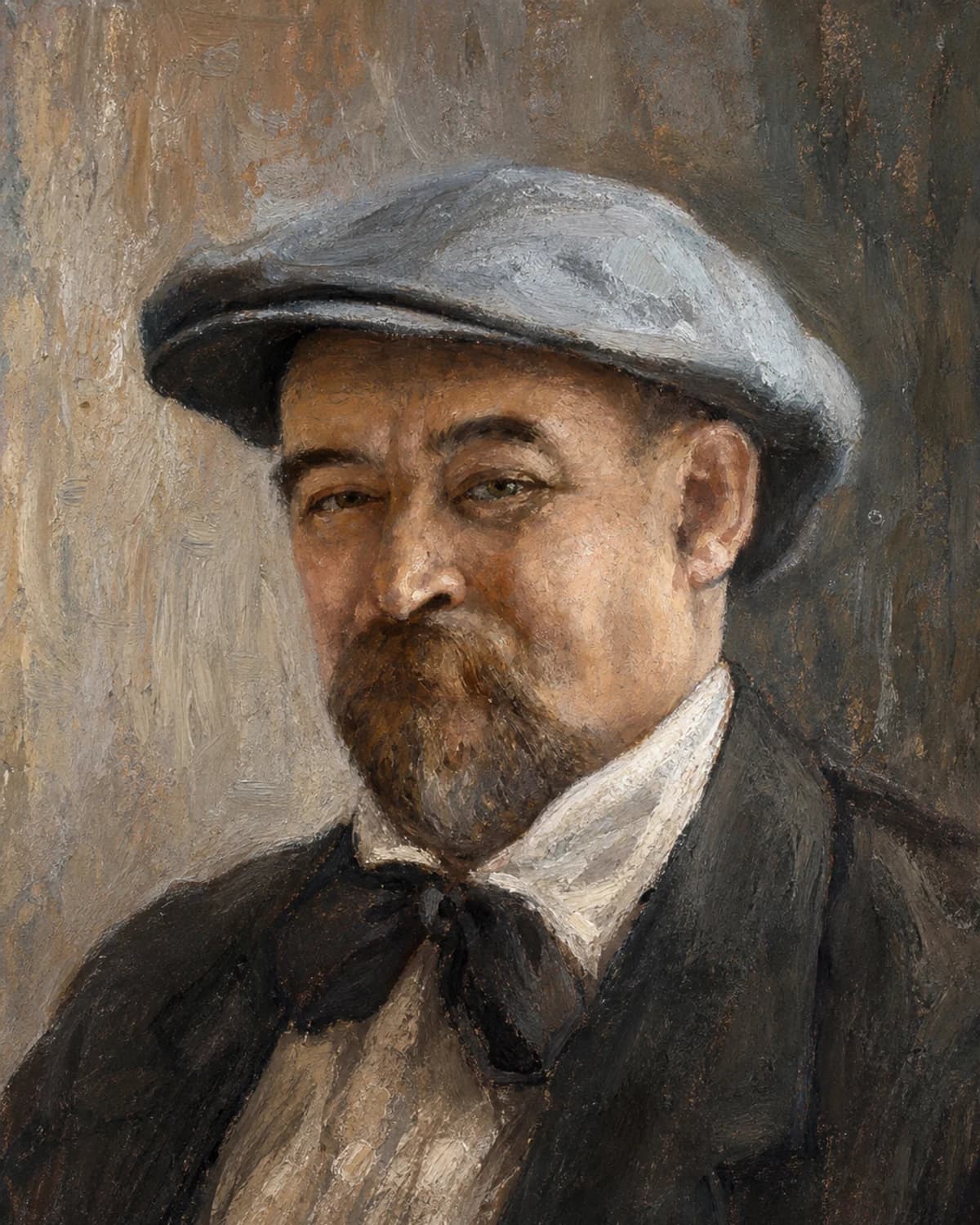
Biography
He printed his address right in the exhibition catalogues: “Opposite the Yauza Gate, Khludov Lane, my own house.” That is how Vasily Pereplyotchikov, a student who never had to think about earning a living, signed his early exhibited works.
He was born on 30 October 1863 (18 October, Old Style) in Moscow, into the family of Vasily Mikhailovich Pereplyotchikov, an honorary citizen of Moscow and candidate of commerce, and his wife Ekaterina Alekseevna. He received his early education at the Practical Academy of Commercial Sciences, and studied painting and drawing privately with Alexander Kiselyov. In 1872 he entered the Moscow School of Painting, Sculpture and Architecture as an auditor and became a pupil of Vasily Polenov. At first he studied architecture, but his acquaintance with Ivan Shishkin settled the matter: he took up painting.
From 1880 his work was shown at exhibitions of the school. In the 1880s he went on sketching trips to Savvinskaya Sloboda near Zvenigorod with Isaac Levitan and Sergei Korovin, and to Plyos and the Volga with Sergei Vinogradov. Together with colleagues who were keen on drawing, he began to publish the “Periodical Publication of Drawings of Russian Artists”. The first album, of 1886, included Sergei Ivanov, Korovin, Levitan, Viktor Simov and Alexei Stepanov; Pereplyotchikov showed a lithograph, “The Kama at Pyany Bor”. In the late 1880s and early 1890s he taught at the School of Fine Arts of the architect Anatoly Gunst, where Levitan and Leonid Pasternak also taught.
In 1891 an album of his landscape drawings in pen, charcoal and pencil was published. They show that he had studied Shishkin attentively. A year later, together with Kiselyov, Nikolai Clodt, Pasternak, Stepanov and Shishkin himself, he worked on the design of the Moscow magazine of fine arts and literature “Artist” and made drawings for a literary miscellany.
From 1893 to 1901 Pereplyotchikov took part in the exhibitions of the Wanderers (Peredvizhniki, the association of artists who organised travelling exhibitions); in 1893 and 1899 he exhibited with the Moscow Association of Artists, and in 1894, 1896 and 1897 with the Society of Russian Watercolourists. In 1899–1903 he showed work at the exhibitions of Mir Iskusstva (“World of Art”), and in 1901–1903 at those of the “36 Artists”. From 1884, with interruptions, he exhibited at the Moscow Society of Art Lovers; he became a member in 1893 and served as its secretary. In 1903 he was one of the founders of the Union of Russian Artists, exhibited with it regularly until 1918 and sat on its committee. He was also among the founders of the society “Free Aesthetics” (1907–1908) and of the group “Izograf” (1917–1918). He belonged to the Northern Circle of Fine Art Lovers.
The turning point in his manner seems to have come in 1902. That year he travelled to Arkhangelsk with Vinogradov, and from then on painted mostly Northern subjects. He is reported to have gone there every year until 1914, often to places that were hard to reach; he visited the Arkhangelsk and Vologda provinces, and in 1913 the archipelago of Novaya Zemlya. In 1904, by some accounts under the influence of Igor Grabar, he experimented with painting in dots. How far this went, I cannot say from the data available.
His Northern works survive in museums: in the Tretyakov Gallery, “Market in Arkhangelsk” (1902) and “The Village of Porog” (1911); in the Russian Museum, “The Village of Krivoye on the Northern Dvina” (1912); in the Plyos Museum-Reserve, “Northern Village” (Ust-Pinega, 1908). The Tretyakov Gallery also has “In the Forest in Winter” (1895), “Early Spring” (1896) and “The Bird Cherry in Bloom” (1915). His paintings are also kept in museums in Vladimir, Voronezh, Rostov, Barnaul, Irkutsk, Stavropol, Ulyanovsk and other cities.
Pereplyotchikov died in Moscow on 23 July 1918. He was buried at the Novo-Alekseyevsky Monastery; the grave, together with the whole necropolis of the monastery, was destroyed under Soviet rule.
Related context
Associations
Works connected through artistic movements, cultural context and period. Priced works available in this market appear first.








Profile notes
Profile and sources
Image
Artist image
На основе открытого изображения: Sergey Malyutin; Wikimedia Commons; Public domain.
