
1826–14.07.1871
Vasily Khudyakov
Vasily Khudyakov was born a serf in a village in Simbirsk Governorate, and in 1851 the Academy of Arts made him an academician for his portrait of its rector for architecture. His “Skirmish with Finnish Smugglers” became in 1856 the first Russian painting bought by Pavel Tretyakov. He worked in Italy for four years and was a professor of the Academy from 1860.
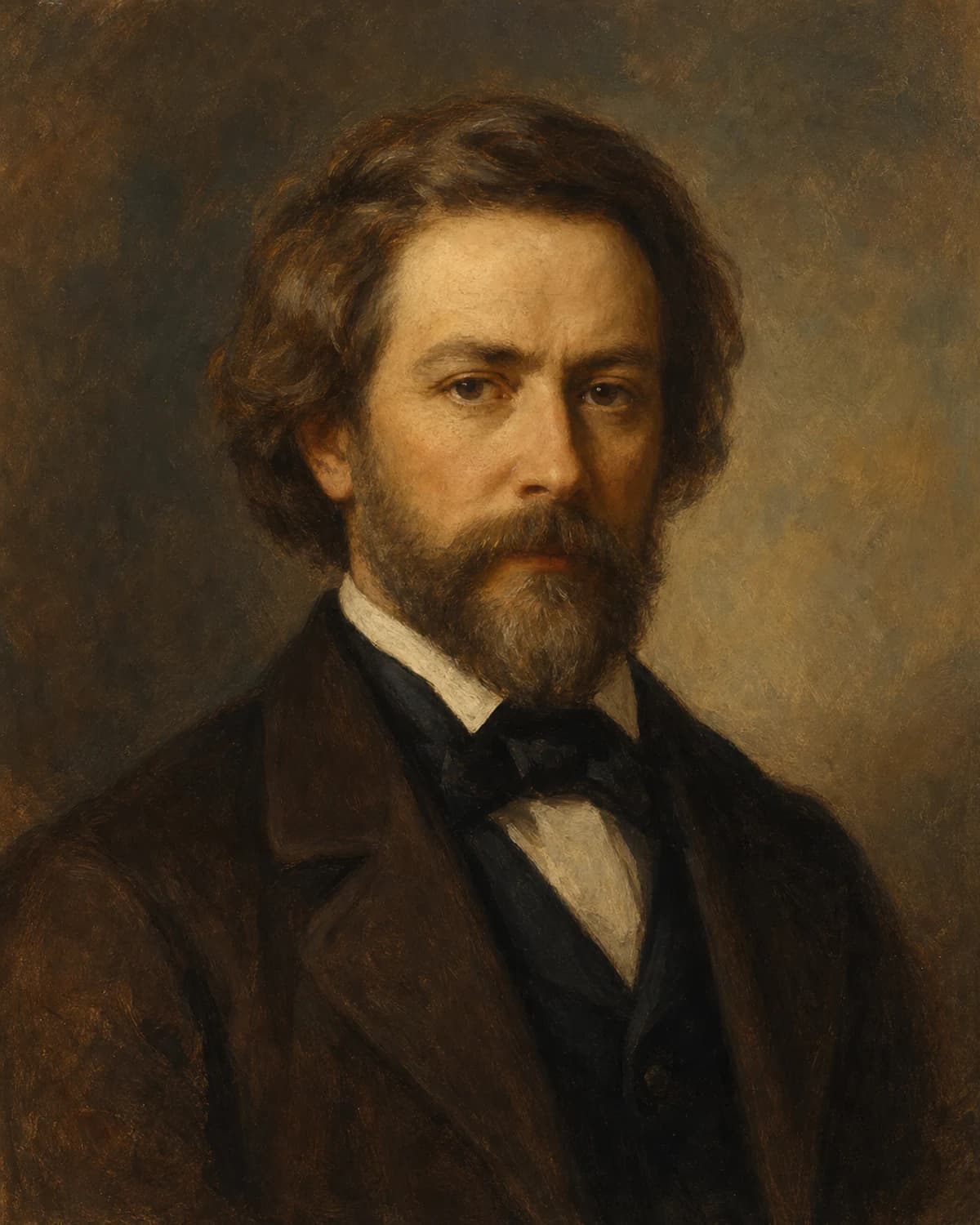
Biography
The first painting in Pavel Tretyakov’s collection was bought in 1856, and it was painted by a former serf from Simbirsk Governorate. It is called “Skirmish with Finnish Smugglers”; today it is more often known as “Finnish Smugglers”.
Khudyakov was born on 5 January 1826 (24 December 1825, Old Style) in the village of Akshuat, also called Shuvaty, in Korsun District of Simbirsk Governorate, into a family of serfs belonging to Senator Ivan Polivanov. The year of his birth is given differently: by some accounts 1826, by others 24 December 1825 by the old calendar. How he came to Moscow I have not been able to establish: the articles I read contain no documents about a purchase of freedom or a release. He began his studies at the Stroganov School of Technical Drawing, and after a year and a half moved to the Moscow School of Painting and Sculpture. His closest teacher was Professor Fyodor Zavyalov, who took him on as an assistant for the painted decoration of the Holy Vestibule of the Kremlin Palace. Works sent from the school to the Imperial Academy of Arts were awarded a large silver medal, and in 1847 Khudyakov received the title of artist, with the right to a rank of the fourteenth class, the lowest in the civil service. In 1848 he moved to Saint Petersburg and enrolled at the Academy as an auditing student. But almost at once he took the certificate of Free Artist, to which the medal entitled him. The price was real: he could no longer compete for the large gold medal, and it was that medal which opened the way to a trip abroad at the Academy’s expense.
In Saint Petersburg he painted mostly portraits and icons on private commission. In 1851 he was named a candidate for academician, and in the same year, for his portrait of Avraam Melnikov, the Academy’s rector for architecture, he was recognised as an academician. The portrait hung in the Academy’s conference hall, after the revolution belonged to the Russian Museum, and is now again in the museum of the Academy of Arts.
Then came icons for the church of the Tula Cadet Corps and other churches, as well as history paintings. “Persecution of Christians in the East” was bought by Emperor Nicholas I to give to King Otto of Greece. “The Battle of Kulikovo” was bought by the Moscow collector Khludov. Tretyakov took “Finnish Smugglers” in 1856; by one account it is the first painting in the history of the collection, by another one of the first two, together with a work by Nikolai Schilder. It is now in the Tretyakov Gallery, and to my mind it shows well that in the mid-1850s patrons looked to the young academician for a subject and sound painting, not a loud name.
In 1857 Khudyakov left for Italy and for four years lived mainly in Rome and Naples. By other accounts the itinerary also included Paris, and the trip began in 1856; I found no confirmation of this and keep to the version with 1857. From there in 1860 the Moscow Society of Art Lovers summoned him to teach at the School of Painting and Sculpture. In the same year the Academy awarded him the title of professor for a Roman scene, “The Game of Bowls”, painted on commission for Count Grigory Kushelev-Bezborodko.
He stayed in Moscow only briefly. Back in Saint Petersburg, he exhibited at the Academy’s shows until the end of his life: “Herodias with Her Daughter Awaiting the Head of Saint John the Baptist” (1861), “The Secret Visit” (1862), “Candiots Awaiting the Arrival of the Steamer Arkadion” (1867), “The Captive Queen Syuyumbike Leaving Kazan” (1870). Criticism of his day called him an excellent draughtsman and colourist, a little florid, able to render light and the relief of forms, but not especially inventive. His late pictures are judged there to be weaker than the Italian ones and those of the first years after his return. Museums hold oil studies and two watercolours, “Russian Artists at the Carnival in Rome” and “A Sermon in an Italian Church”; in the Tretyakov Gallery, besides the smugglers, there are “At the Tomb” and “Study at Olevano, near Rome”.
Khudyakov died in Saint Petersburg on 26 July 1871.
Related context
Associations
Works connected through artistic movements, cultural context and period. Priced works available in this market appear first.








Profile notes
Profile and sources
Image
Artist image
На основе открытого изображения: Engelberthumperdink; Wikimedia Commons; CC BY-SA 4.0.
