
06.01.1897–03.06.1922
Vasily Chekrygin
Vasily Chekrygin (1897–1922) entered the Moscow School of Painting, Sculpture and Architecture at thirteen, and at twenty-three began the graphic cycles “The Execution”, “The Insane” and “The Resurrection of the Dead”. He illustrated Vladimir Mayakovsky’s poems, was among those who created the Makovets group, and wrote about art under the influence of the philosopher Nikolai Fyodorov. He was killed by a train at Mamontovka station at twenty-five.
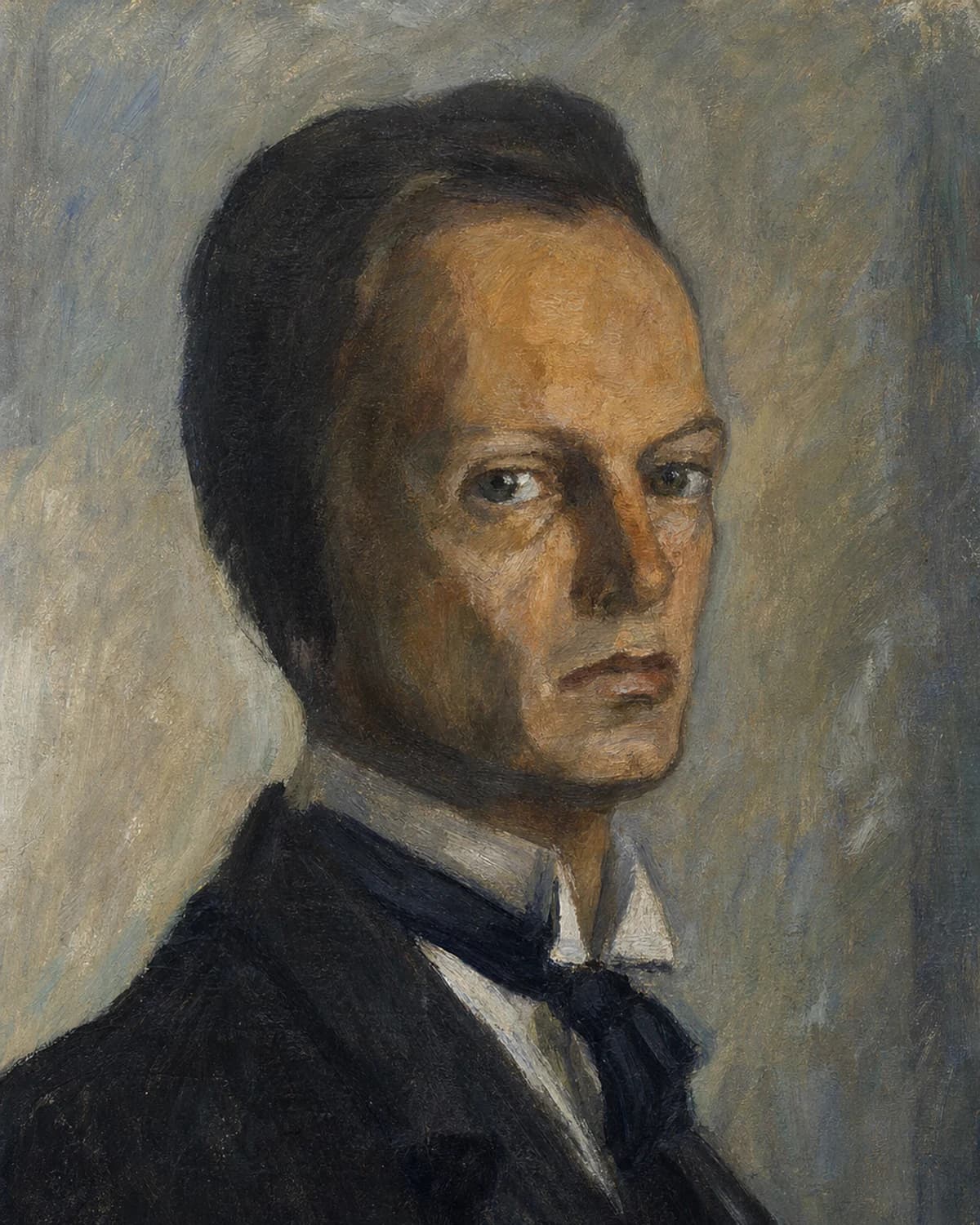
Biography
Chekrygin’s first solo exhibition opened in 1956, thirty-four years after his death. Eight years later the Mayakovsky Museum showed 130 of his works, in 1969 there was a large exhibition at the Pushkin Museum of Fine Arts, and in 2022 another at the Tretyakov Gallery. In his lifetime he did not have time to be recognised.
He was born on 18 January 1897 (6 January, Old Style) in Zhizdra, in Kaluga Province, but spent his childhood in Kiev. He studied at the icon-painting school of the Kiev Pechersk Lavra, the great monastery of the city, and at a municipal school with a six-year course, and worked as an assistant retoucher in a photographic studio. Klement Redko, who knew him from the Lavra workshop, remembered that in summer Chekrygin came back to Kiev and worked every day in a cramped room of a poor apartment, where he lived with his mother, brothers and sister. The main subject of his canvases then was a horseman with a long lance pointed at a serpent, that is, Saint George. At thirteen he entered the Moscow School of Painting, Sculpture and Architecture. Around 1913 he met Mayakovsky, David Burliuk and Lev Zhegin, the son of the architect Fyodor Shekhtel. He and Zhegin became so close that Chekrygin lived for long periods in Shekhtel’s house. Together with Zhegin he made the lithographed illustrations for Mayakovsky’s first book, “I!”, which came out in an edition of 300 copies. In the winter of 1913–1914 he showed several innovative works at the school’s jubilee exhibition; a scandal followed, his scholarship was withdrawn for a year, and he had to leave his studies. He took part in the exhibition “No. 4”, organised by Mikhail Larionov, and travelled across Europe with Zhegin: Vienna, Munich, Paris, Hendaye, San Sebastián.
On his return he illustrated Mayakovsky’s wartime ditties and “Persian Tales” for the Nekrasov publishing house. At the end of 1915 he joined the army as a volunteer and fought near Dvinsk in a machine-gun brigade.
After the revolution his life became as varied as that of many artists of the time. In 1918 he joined the Commission for the Protection of Artistic Treasures, then served in the army again, this time at a higher school of military camouflage. Pavel Kuznetsov found him a place at the Children’s Theatre of Henrietta Pascar, then he worked in the poster section of IZO, the fine arts department of Narkompros (the People’s Commissariat for Education), and lectured at the State Free Art and Technical Studios. In July 1920 he married Vera Berenstam-Kotova. These were also the years in which he became a theorist. He built his views on the theory of form of Vladimir Favorsky and on the “philosophy of the common task” of Nikolai Fyodorov, who dreamed of the resurrection of the ancestors. Chekrygin took part in founding the Makovets group and in writing the manifesto of the union of artists and poets “Art–Life”, which was printed in 1921 in “Makovets”. His best-known text, “On the Cathedral of the Resurrecting Museum” (1921), is dedicated to the memory of Fyodorov. To my mind, it matters more for understanding the drawings than any letters or memoirs, because “The Resurrection of the Dead” was conceived as an almost literal embodiment of this idea.
There were several graphic cycles in the early 1920s: “The Execution” (1920), “The Insane” (1921), “Famine in the Volga Region” (1922) and “The Resurrection of the Dead” (1921–1922). He worked on the last until his death.
On 3 June 1922 Chekrygin was hit by a train at Mamontovka station and died at once, in his wife’s arms. He was twenty-five. He was buried on 6 June near the village of Akulovo, in the Bogolyubsky cemetery; the grave was identified only on 5 May 2021.
His two younger brothers, the poets Pyotr and Nikolai Chekrygin, were arrested on 1 November 1924 in a case concerning a “Russian fascist organisation”. They were shot on 30 March 1925, together with Alexei Ganin, a close friend of Sergei Yesenin.
Related context
Associations
Works connected through artistic movements, cultural context and period. Priced works available in this market appear first.








Profile notes
Profile and sources
Image
Artist image
На основе открытого изображения: Vasily Chekrygin; Wikimedia Commons; Public domain.
