
22.10.1894–20.05.1958
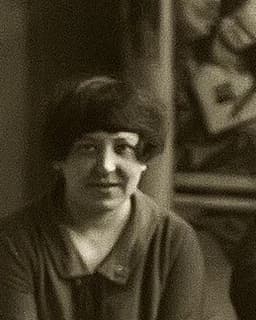
Varvara Stepanova
Varvara Stepanova (1894–1958), the wife and collaborator of Alexander Rodchenko, founded the first Working Group of Constructivists with him and Aleksei Gan in 1921. She designed fabrics for the First Calico-Printing Factory, invented work and sports clothing, designed “The Death of Tarelkin” for Meyerhold and for many years was art editor of magazines. She also signed her work with the pseudonym Varst.
Biography
In 1924 Varvara Stepanova produced more than a hundred and fifty fabric designs for the First Calico-Printing Factory near Moscow. She used one or two dyes, and few shapes as well: a triangle, a circle, a square, a line. But she laid them over one another so that the flat cotton print began to look many-layered. She worked at the factory for little more than a year, together with Lyubov Popova.
She was born on 22 October (3 November) 1894 in Kovno, today’s Kaunas. The sources disagree about her family: according to some, her father was a civil servant; according to others, she was of peasant origin. In 1910–1913 Stepanova studied at the Kazan Art School, left without finishing and went to Moscow. At about that time she met Alexander Rodchenko, and from then on they worked together. In 1915–1917 she studied in Konstantin Yuon’s studio. Her first exhibition, “Decorative Artists for the Benefit of the Wounded”, at the Lemercier Gallery in Moscow in 1915, showed two designs for decorative panels.
After the revolution everything moved fast. In 1918–1920 she took part in the State Exhibitions, among them the Tenth, “Non-Objective Creativity and Suprematism” (1919); in 1919–1922 she worked on the art board of the People’s Commissariat for Education, and from 1920 she collaborated with the Institute of Artistic Culture. In 1919 she illustrated Aleksei Kruchenykh’s book “Gly-Gly”. In 1921, at the exhibition “5 × 5 = 25”, she declared that composition is a contemplative approach, while technology and industry set art the task of construction as an active process; the museum, she said, was turning into an archive. The same year, together with Rodchenko and Aleksei Gan, she founded the Working Group of Constructivists, which gave up easel art for graphic design, posters, photography and propaganda.
I think clothing interested her more than anything else.
In 1922 she designed “The Death of Tarelkin” for Meyerhold: costumes of dark blue and grey cloth turned the actors’ bodies into a moving composition of lines and geometric shapes. She went on to divide clothing into “prozodezhda”, working clothes, with a separate “spetsodezhda” for each profession, in which seams, pockets and buttons were all thought through, and “sportodezhda”, with large forms and contrasting colours so that spectators could tell the teams apart at once. She designed the team emblems too. Almost none of this went into production: there was not enough money for mass manufacture. From 1920 to 1925 Stepanova taught at the art studio of the Krupskaya Academy of Communist Education, and in 1924–1925 at VKhUTEMAS, where she taught textile design. In 1924, as part of the literacy campaign, she staged a “Book Evening”, a performance in which characters from pre-revolutionary and new literature fought one another. In 1925, with Rodchenko, she designed the panels on the Mosselprom building, and in 1926 she worked on the film “The Break”.
The following years were spent on magazines. Stepanova was art editor of “Kinofot” (1922), “LEF” and “Novy LEF” (1923–1927), then of “Sovetskoye Kino”, “Sovremennaya Arkhitektura”, “Smena” and “Kniga i Revolyutsiya” (1926–1932); in 1933–1934 she worked at Partizdat, the Party publishing house, and in 1945–1946 at the magazine “Sovetskaya Zhenshchina”. She was a member of the Union of Contemporary Architects. With Rodchenko she made photo albums, for example a 1938 album about the Papanin polar expedition.
Rodchenko died in December 1956. Stepanova outlived him by a year and a half: she died on 20 May 1958 in Moscow, and they were buried together in the New Donskoy Cemetery. Moscow has a street named after Varvara Stepanova, and in 2021 her work was shown at the Centre Pompidou in the exhibition “Women in Abstraction”.
Related context
Associations
Works connected through artistic movements, cultural context and period. Priced works available in this market appear first.








Profile notes
Profile and sources
Image
Artist image
Unknown author Unknown author; Wikimedia Commons; Public domain.
