
07.01.1865–22.11.1911
Valentin Serov
Valentin Serov (1865–1911), the son of the composers Alexander and Valentina Serov, studied under Repin from the age of nine and became the foremost portraitist of his generation, from “Girl with Peaches” to Nicholas II, Yermolova and Ida Rubinstein. For twelve years he taught at the Moscow School of Painting, Sculpture and Architecture; his pupils included Petrov-Vodkin, Saryan and Yuon.
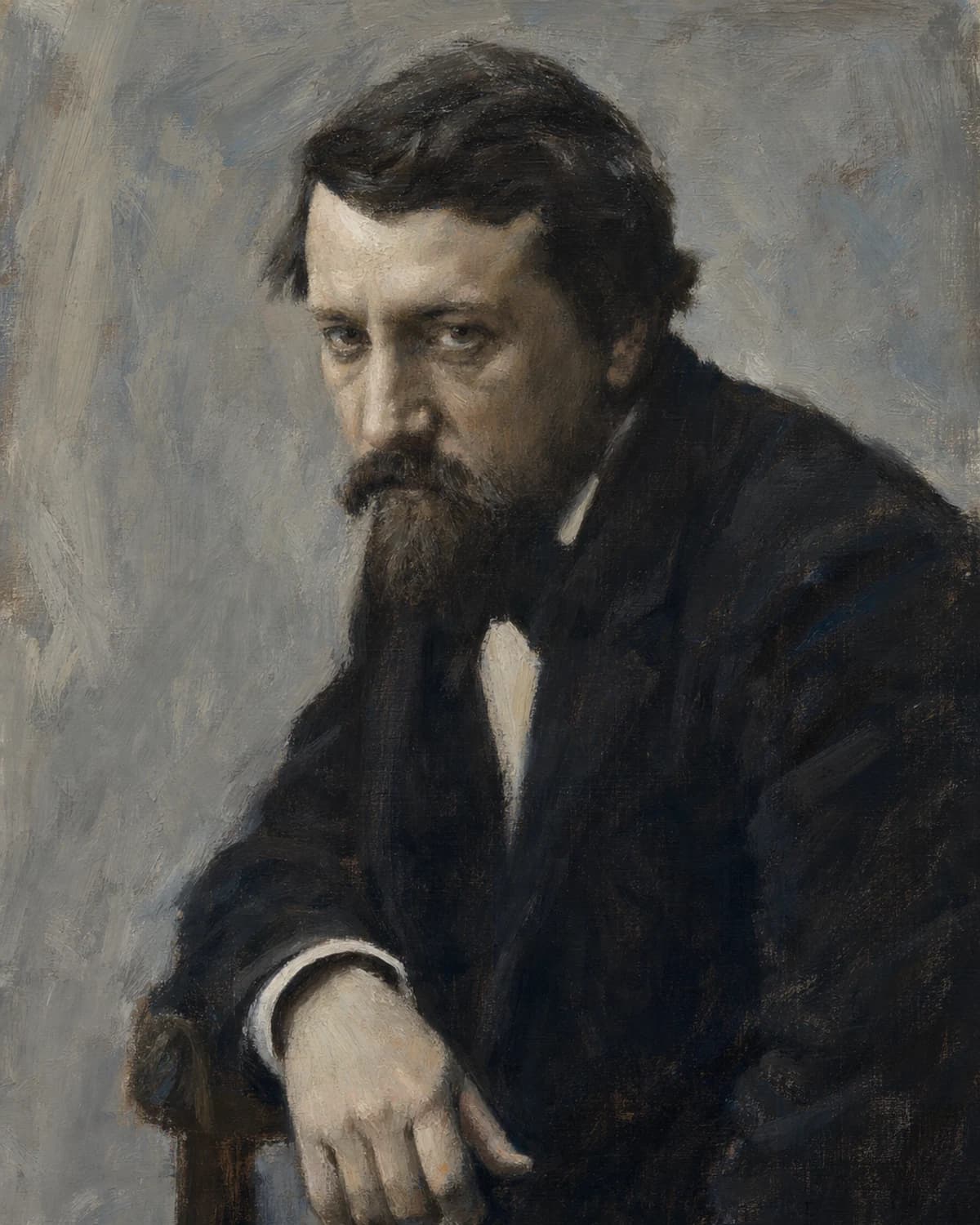
Biography
In the spring of 1887 Serov received a thousand roubles for the ceiling painting “Phoebus Radiant”, done for the Seleznevs, landowners near Tula, and at once left for Italy with friends. On his return he stayed with the Mamontovs at Abramtsevo from August to October and painted their daughter Vera at the table. That is how “Girl with Peaches” came about. In December 1888 the “portrait of V. M.” won the only portrait prize, two hundred roubles, at a competition of the Moscow Society of Art Lovers.
The following summer, at Domotkanovo, he painted his cousin Maria Simonovich under a tree, in patches of sunlight. Pavel Tretyakov bought “Girl Illuminated by the Sun”. Both pictures are now in the Tretyakov Gallery. To my mind their fresh, breathing light is all the more interesting because Serov, by all appearances, did not yet know the work of the French Impressionists.
He was born on 7 (19) January 1865 in St Petersburg. His father, Alexander Nikolayevich Serov, was a composer and critic; his mother, Valentina Semyonovna, née Bergman, also wrote music. In 1871 his father died, his mother went to study in Munich, and the six-year-old boy was placed for a time in N. N. Drutskaya-Sokolinskaya’s commune on her estate of Nikolskoye in Smolensk province. It was there that his drawing was first noticed. In 1873 in Munich the German graphic artist Karl Köpping gave him lessons, and from October 1874 in Paris he studied with Ilya Repin. Repin recalled that the boy threw himself into his work so fiercely that his teacher sometimes had to stop him.
His childhood was a nomadic one. Abramtsevo, Kiev, the Akhtyrka farmstead in Kharkov province, where his mother lived with Vasily Nemchinov; in Kiev, Nikolai Murashko’s drawing school; in Moscow, Repin again and expulsion from the progymnasium for poor marks. In the summer of 1879 at Abramtsevo came his first known pencil portraits: of Savva Mamontov, Tatyana Mamontova and Repin himself. In 1880 he and Repin travelled through the Crimea and Ukraine, to the places of the Zaporozhian Sich, and in the autumn Serov became an auditor at the Academy of Arts while also attending Pavel Chistyakov’s private studio. In 1882 he was made a regular student. He did win medals, but in September 1886 he took back his papers and left for Moscow; later he admitted that at the Academy he had valued only Chistyakov’s opinion. A year earlier, in the Munich Pinakothek, he had copied Velázquez’s “Portrait of a Young Spaniard”, and that copy too is in the Tretyakov Gallery.
On 29 January 1889 he married Olga Trubnikova, a ward of the Simonovich family; Repin was a witness. That autumn relations with his teacher soured for a while: Serov had not finished the portrait of Sofia Dragomirova he was painting in Repin’s studio, and Repin touched up the costume and accessories with his own brush. He left the face alone, but Serov answered him with a sharp letter.
In 1890 Serov exhibited with the Peredvizhniki for the first time, showing the portrait of his father, and Stasov spoke well of it. Then came the portraits now familiar from school textbooks: Konstantin Korovin (1891), Isaac Levitan (1893), Nikolai Leskov, commissioned by Tretyakov (1894). Together with Korovin he won a competition held by the Kharkov nobility for a picture, “Alexander III and His Family”, for the church near Borki station; he had to start on the imperial family from photographs. In 1894 he was admitted to the Association of Travelling Art Exhibitions, and that same year, after the picture was delivered, he and Korovin spent two months travelling in the Russian North. In the summer of 1899, on the balcony of a dacha at Terijoki, he painted “Children”, his sons Sasha and Yura.
Serov did not want to teach. In 1894 he wrote to Chistyakov: “Teaching in general I do not like.” Three years later, in 1897, he nevertheless took on the life class at the Moscow School of Painting, Sculpture and Architecture and taught there until 1909. His pupils included Pavel Kuznetsov, Nikolai Sapunov, Martiros Saryan, Kuzma Petrov-Vodkin, Nikolai Ulyanov and Konstantin Yuon. In 1898 Serov became an academician, and from 1899 he took part in the World of Art exhibitions.
At the turn of the century he painted the court: Grand Duke Pavel Alexandrovich (for this portrait he was given the Grand Medal of Honour at the Paris World’s Fair of 1900) and Nicholas II himself. The 1900 portrait of the emperor had a strange fate: in October 1917 soldiers carried it out of the Winter Palace and pierced its eyes with bayonets, and art students persuaded them to give up the canvas and handed it over to Neradovsky. Serov himself had stopped working for the court by the end of 1901, after Empress Alexandra Fyodorovna interfered in one of the sittings. In 1900 he left the Peredvizhniki. In 1905, after Bloody Sunday, he also resigned from the Academy of Arts, whose president was Grand Duke Vladimir Alexandrovich, and painted “Soldiers, Brave Lads…”. The same year produced the full-length Maria Yermolova.
In 1907 he travelled through Greece with Léon Bakst. In 1909 he left the School, in protest at its refusal to reinstate Anna Golubkina. His last years were bound up with Diaghilev’s circle and with antiquity: Tamara Karsavina, Mikhail Fokine, the poster with the dancing Anna Pavlova, Ida Rubinstein (1910), “The Rape of Europa” with its sculptural version, the sketch for the curtain of the ballet “Scheherazade” (1911).
Serov died in Moscow on 22 November (5 December) 1911. He was buried in the Donskoy Cemetery, and in 1939 his remains were moved to Novodevichy.
Related context
Associations
Works connected through artistic movements, cultural context and period. Priced works available in this market appear first.








Profile notes
Profile and sources
Image
Artist image
На основе открытого изображения: Karl Fischer; Wikimedia Commons; Public domain.
