
06.03.1851–15.04.1901
Václav Brožík
Born into a poor family in Železný Hamr near Třemošná, Václav Brožík began as a lithographer and porcelain painter and ended as a Paris academician and a professor in Prague. His “Master Jan Hus at the Council of Constance” (1883) hangs in the Old Town Hall in Prague. His painting of Columbus before Queen Isabella appeared on a United States postage stamp in 1893.
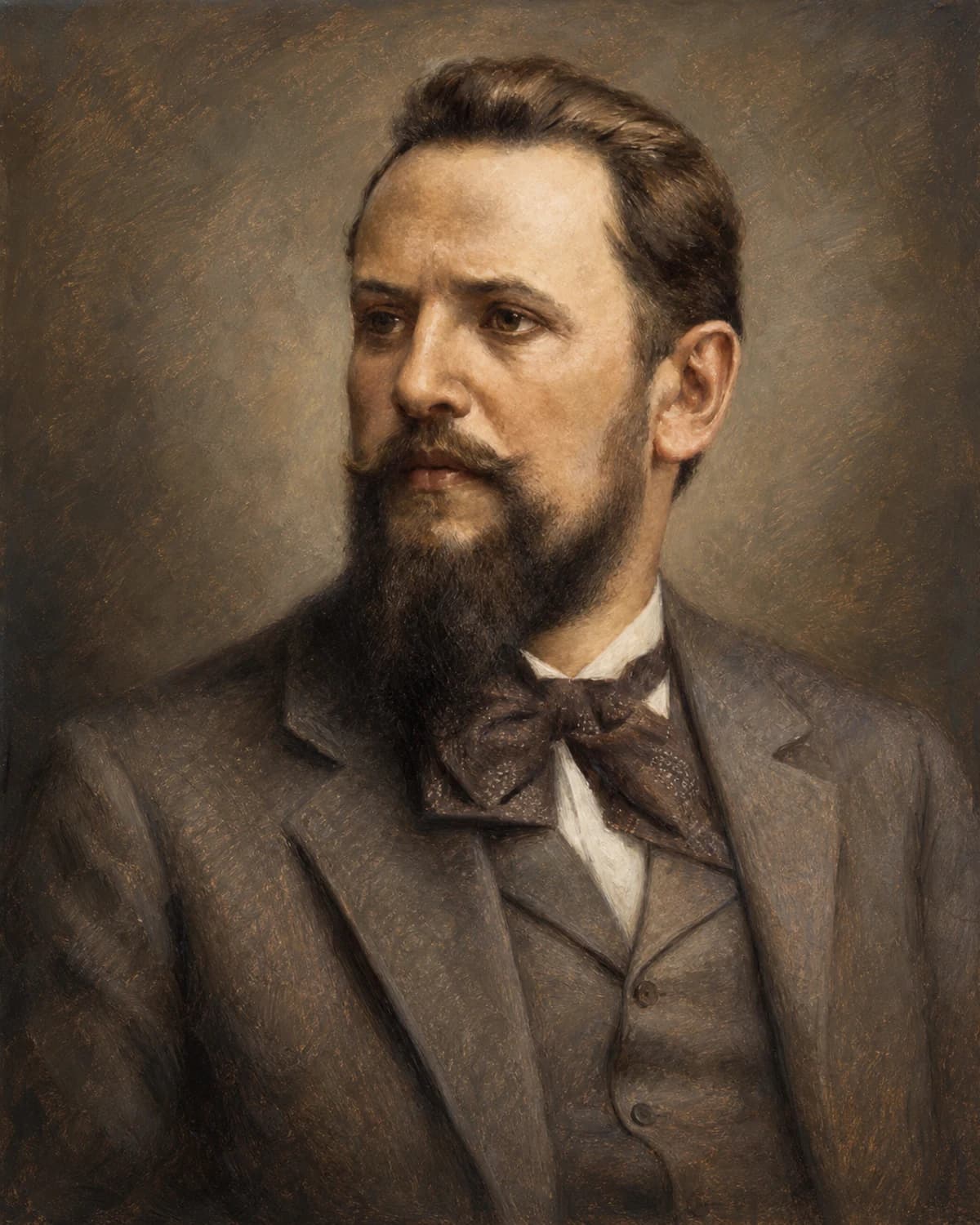
Biography
Brožík was born on 6 March 1851 in Železný Hamr near Třemošná, in Bohemia, into a poor family; his father, by one account, was a metal turner, by another a hammer master at the local ironworks. The boy was apprenticed to lithography and porcelain painting, and in Prague he worked at the porcelain factory in Smíchov.
After that, he was carried along by other people’s help. In 1868 a local landowner paid for him to study at the Academy of Fine Arts in Prague, where he worked under Emil Lauffer and exhibited a painting for the first time. Later came Dresden (from 1871) and Munich (from 1873), where he came under the influence of Karl Piloty and his historical painting. His first historical subjects from the Czech past date from the early 1870s: “Eva of Lobkowicz Visiting Her Father in Prison” (1871) and “The Wedding Procession of Queen Kunhuta” (1872). From 1876 he lived in Paris, reportedly without speaking French. There he studied under Léon Bonnat and soon worked in a studio of his own. His painting of the wedding embassy of King Ladislaus to the court of Charles VII earned him a gold medal for foreign artists at the Salon of 1878. In 1879 he travelled to the Netherlands to study the Old Flemish and Dutch masters, and in November of that year he married Hermina Sedelmeyer, daughter of the wealthy Parisian art dealer Charles Sedelmeyer. His father-in-law introduced him to high society and, it seems, suggested subjects; Brožík soon had many commissions for portraits of women in fashionable dress.
His chief work, “Master Jan Hus Condemned at the Council of Constance”, is dated 1883; the canvas measures about four by six and a half metres. Around the same time he painted “The Ballad Singer” (1882) and “Motherly Happiness” (1883), a scene in a middle-class drawing room. In 1885 came “Columbus at the Spanish Court”, the very subject that eight years later appeared on the American stamp.
There were also village scenes and landscape studies from nature, in which, scholars say, he came close to Impressionism. To my mind, this Brožík, painting geese and women on the hay, is more interesting today than the official one.
Honours came one after another. He received the Legion of Honour in 1883 and became an officer of the order in 1890; in 1886 he received the Austrian Order of Franz Joseph; in 1890 he was appointed a member of the Czech Academy of Sciences and Arts. In the 1890s he became a member of the Académie des Beaux-Arts in Paris. In those same years he divided his time between Paris and Prague. In 1891 he was called as a professor to the Academy of Fine Arts in Prague, where the following year he became rector; by other accounts, he began teaching there in 1893. He was commissioned to paint a large canvas for the fiftieth anniversary of the reign of Franz Joseph I: “Tu felix Austria nube” (1896), showing the betrothal in 1515 of the children of King Vladislaus II Jagiellon to the grandsons of Emperor Maximilian I, about four by seven metres; it is now in the Belvedere in Vienna. For it, in 1897, Brožík was raised to the Austrian nobility with the predicate “von Valrose”. His late works include “The Election of George of Poděbrady as King of Bohemia” (1898) for the Old Town Hall and “Emperor Ferdinand I Receiving Artists at Prague Castle” (1899).
From 1894 his health declined, but he worked ever more doggedly. Brožík died in Paris on 15 April 1901, by some accounts the day before, 14 April, and was buried in Montmartre Cemetery. After his death his painting was thought old-fashioned, and interest returned only with a large retrospective at the National Gallery in Prague in 2003.
Related context
Associations
Works connected through artistic movements, cultural context and period. Priced works available in this market appear first.








Profile notes
Profile and sources
Image
Artist image
На основе открытого изображения: Jan Vilímek; Wikimedia Commons; Public domain.
