
1501–1625
Ustad Mansur
Ustad Mansur drew for the emperor Jahangir whatever was brought to court: a turkey cock from Goa in 1612, a Barbary falcon from Shah Abbas in 1619, a zebra in 1621, the birds of Kashmir and more than a hundred Kashmiri flowers. Jahangir gave him the title Nadir al-Asr, “unequalled of the age”. He is credited with one of the few colour pictures of the dodo made from a living bird; the sheet is kept in St Petersburg.
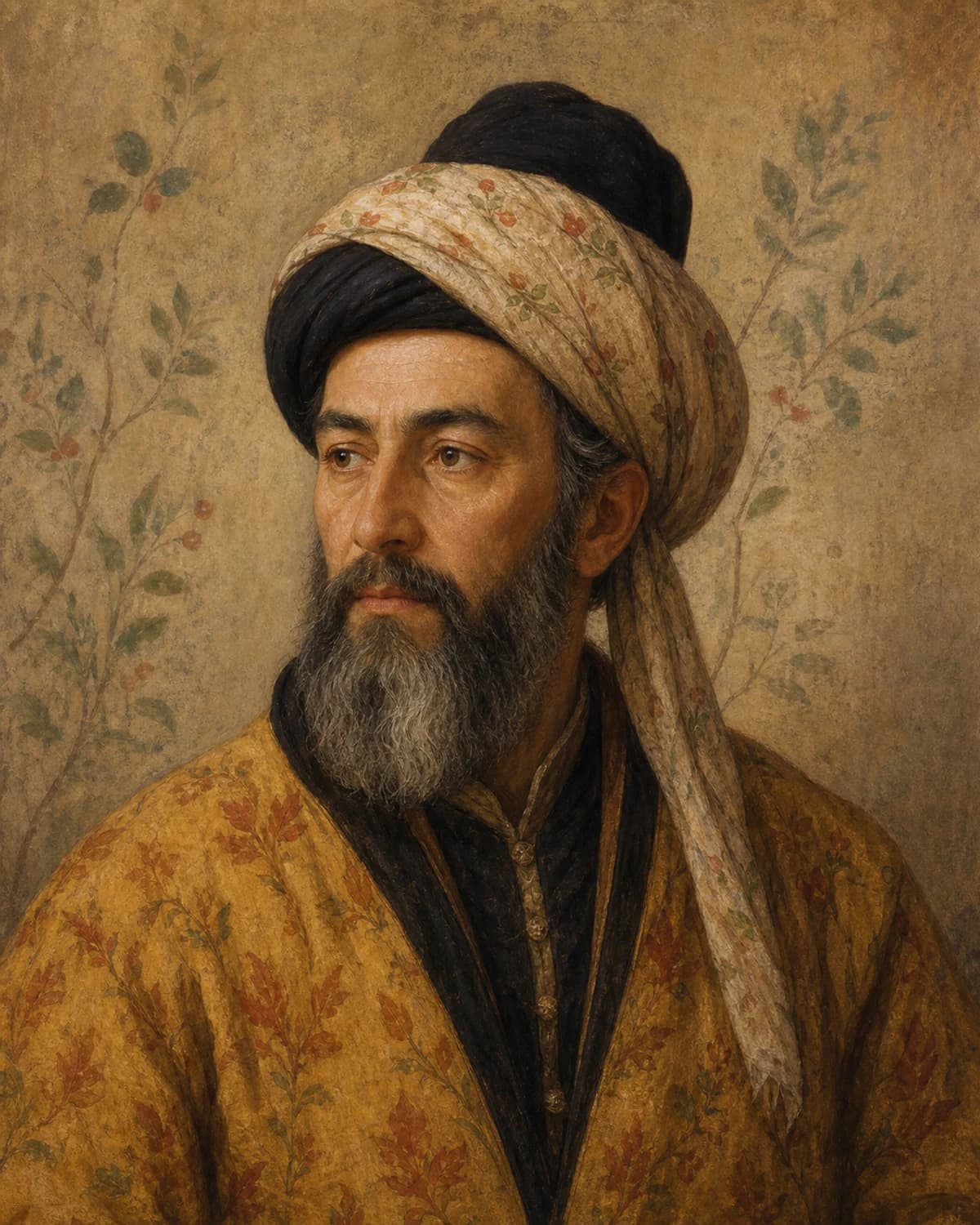
Biography
In 1620, in Kashmir, Jahangir saw on a mountain stream a bird that dived and stayed a long time under water, surfacing somewhere else. He ordered two or three to be caught, to check whether their feet were webbed; one died at once, the other lived a day, and the feet turned out not to be a duck’s. “I ordered Nadir al-Asr Ustad Mansur to draw its likeness,” the emperor wrote in his memoirs. It was a dipper.
When Mansur was born is not known. In early miniatures his name carries the suffix “naqqash”, painter or carver: he seems to have come from a family of craftsman-artists. His first works are shares in the folios of the “Baburnama” of 1590–1595, where he was an assistant colouring other men’s drawings; the folio “Babur meeting his sister” in the National Museum in Delhi is also attributed to him. In the “Akbarnama” he too, by all appearances, was only a colourist, and Abu’l-Fazl does not name him among the court painters. But Akbar required the name of every master to be written in the margin, and in the British Museum copy of the “Akbarnama” of 1604 his name on several folios is already prefixed with “ustad”, master. The “Veena Player” (c. 1595) and, with Manohar, the portrait of Jahangir at his accession of about 1605 are assigned to the same years. He worked alongside Basawan, Miskina and Nanha; his early fantasy birds, assembled from flowers and insects, are in the manner of his senior colleagues Miskina and Ikhlas.
Under Jahangir Mansur became what he is remembered as: a draughtsman of beasts, birds and flowers. The emperor, himself a passionate observer of nature, took him on his travels and had him draw everything rare. In 1612 a turkey cock was brought to court from Goa, and Mansur painted it; in 1619 Shah Abbas sent a Barbary falcon, Jahangir admired its plumage, and when the bird died he ordered a portrait made of it. In Kashmir in 1620 Mansur painted no fewer than a hundred flowers, among them a red tulip whose species botanists identify in different ways. In 1621 the emperor was given a zebra, and its picture is thought to be, possibly, Mansur’s last miniature. For these works Jahangir gave him the title Nadir al-Asr, “unequalled of the age”; he considered two men exceptional, Mansur and Abu’l Hasan. Mansur also painted portraits, for instance of the musician Naubat Khan, who had served Akbar before him. In his sheets a single bird or animal fills the composition, standing or feeding, with grasses and insects around it and a floral border at the edge. Most of the works are unsigned, and in the seventeenth to nineteenth centuries they were copied and faked, at times with his signature, for export to Europe, so that the authenticity of each sheet has to be decided on quality: in the chameleon, for example, by the feet with their toes fused into two groups and the line of white scales on the belly.
For zoologists two sheets matter most. The Siberian crane in the Indian Museum in Kolkata was painted a century and a half before Pallas described the species in 1773: one can see the wrinkles of the bare skin, the legs, a small feather stuck to a claw. Ernest Havell, principal of the art school in Calcutta, showed this sheet to Abanindranath Tagore, who, having examined the detail through a lens, gave up oil for gouache on paper. The dodo, brought, it is thought, by way of Goa and Surat, is painted without a signature; the sheet was found in St Petersburg, in the collection of the Institute of Oriental Studies, in 1958, caused a sensation at the XII ornithological congress in Helsinki, and remains one of the few colour pictures of the extinct bird made from a living model. It is attributed to Mansur or to someone in his circle, and I would not argue with that cautious wording.
He died after 1621; some sources give 1624, others hold that his work ended with Jahangir’s reign in 1627. Signed sheets are kept in Kolkata, Delhi, Jaipur and Mumbai. A crater on Mercury is named after him.
Related context
Associations
Works connected through artistic movements, cultural context and period. Priced works available in this market appear first.
Profile notes
Profile and sources
Image
Artist image
На основе открытого изображения: Sailko; Wikimedia Commons; CC BY 3.0.
