
23.04.1875–27.08.1949
Uemura Shōen
Uemura Shōen (1875–1949), born Uemura Tsune in Kyoto, painted women all her life: beauties in the spirit of ukiyo-e, heroines of the Noh theatre, working women of the war years. In 1941 she became the first woman admitted to the Imperial Art Academy, in 1948 the first to receive the Order of Culture, and her “Jo-no-mai” (1936) became the first painting by a Japanese woman to be listed as an Important Cultural Property.
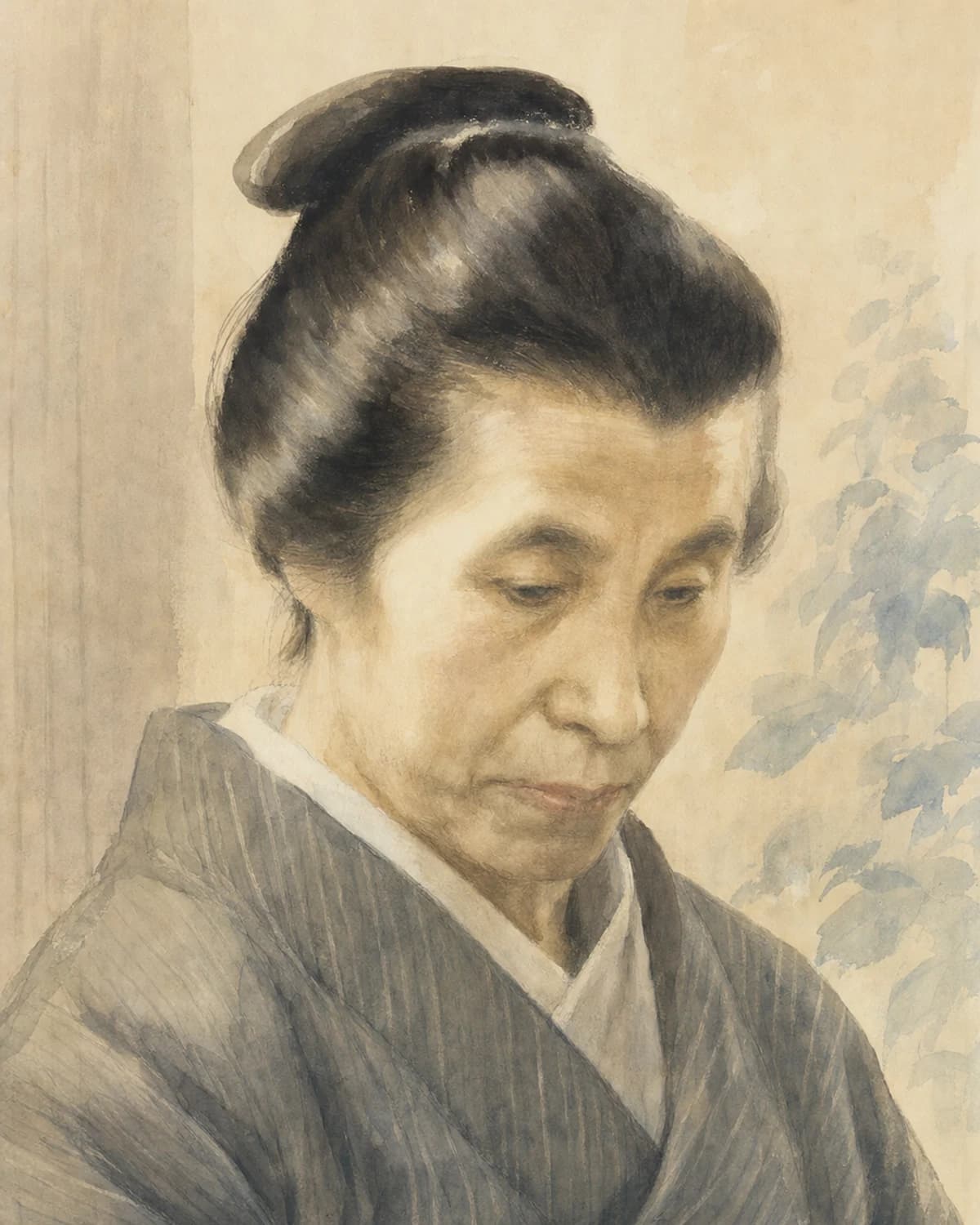
Biography
In the 1936 painting “Jo-no-mai” there is a single figure against an empty ground: a woman in an orange kimono whose pattern dissolves into clouds towards the hem, caught in the dance that opens a Noh play. The model is believed to have been the artist’s daughter-in-law. The work later became the first painting by a Japanese woman to be entered on the country’s list of Important Cultural Properties.
The artist was sixty-one. She had only now begun to paint large pictures.
She was born on 23 April 1875 in Kyoto, in the Shimogyō district, the second daughter of a tea merchant who had died two months before her birth; her real name was Uemura Tsune. It was a household of women: her mother, her aunts, a tea shop with a refined clientele, and her mother taught her the tea ceremony from childhood. At twelve she was drawing figures, at fifteen she was already exhibiting and winning prizes, and her model was the prints of Hokusai. Her mother supported her decision to become a painter, a rare thing in the Kyoto of those years. At the Kyoto Prefectural Painting School she studied under Suzuki Shōnen, a landscape painter in the Chinese manner, who in recognition gave her the first character of his own pseudonym, “Shō”, and let her draw figures in his private studio, although under the school’s curriculum figure work was allowed only in the senior years. There too she learned the manner of the Kanō and Sesshū schools. In 1894 she moved on to Kōno Bairei and, after his death, to Takeuchi Seihō. Her first local award came for a work at the Kyoto Exhibition of New and Old Art in 1898, her first national one for a painting at the exhibition of the Japan Fine Arts Academy in 1900. Her early success is tied to “The Beauty of Four Seasons”: the picture was bought by Prince Arthur, Duke of Connaught, son of Queen Victoria, during his visit to Japan, and the young painter’s name became known. For the Chicago World’s Fair of 1893 she painted a second version and received an award for it. From 1907 she painted mainly for the government-sponsored Bunten exhibitions.
Her women do more than pose. In “Women Walking Against a Snowstorm” (1911) a beauty walks into the wind and does not bend. In 1918 she exhibited “Flame”: the living spirit of a jealous woman, the figure of Lady Rokujō from “The Tale of Genji” and the Noh play “Aoi no Ue”, with a glance at the eighteenth-century “Beauty” by Soga Shōhaku. She herself called the picture the flame of a middle-aged woman’s jealousy. Until then critics had reproached her with “faceless dolls”; after “Flame” the reproach fell away. The picture appeared in the year Suzuki Shōnen died, and for several years the artist stopped exhibiting. She returned in 1924 with “Yōkihi”, a portrait of the Chinese consort Yang Guifei, at the fourth exhibition of the Imperial Academy; the painting is now in the Shōhaku Art Museum in Nara.
In the 1930s, when she was in her late fifties and sixties, her largest works appeared: “Spring and Autumn” (1930), “Jo-no-mai” (1936) and “Soshi-arai Komachi” (1937), the last after the Noh play about the poet Ono no Komachi. In the Noh theatre all the roles, including the female ones, were played by men, whereas she set the poses from live female models. The composition in these works is one and the same: a large figure in the centre, emptiness around it, the light planes of the clothing calculated to stand out from the unfilled ground. European oil painting was coming into fashion, but Shōen kept to mineral pigments and Japanese subjects.
In 1941 she was invited, the first woman, to join the Imperial Art Academy; in 1944 the Imperial Household appointed her a court painter. In the war years she painted working women at their daily tasks: “Twilight” and “Clear Day” (1941), “Late Autumn” (1943). The government used these images in its propaganda, and at its invitation the elderly artist travelled to the war zone in China. In February 1945 she was evacuated from Kyoto to the outskirts of Nara.
In 1948 she became the first woman to receive the Order of Culture. Uemura Shōen died on 27 August 1949 near Nara, where she had lived since the evacuation. Of her beauties she said that she had never once painted a picture on the assumption that it would pass as long as the woman in it was good-looking; she wanted there to be not a grain of the vulgar in her work. Her son Uemura Shōkō also became a painter. “Jo-no-mai” appeared on a Japanese postage stamp in 1965, “Mother and Child” in 1980, and in 2000 a stamp was issued in honour of the artist herself.
Related context
Associations
Works connected through artistic movements, cultural context and period. Priced works available in this market appear first.








Profile notes
Profile and sources
Image
Artist image
На основе открытого изображения: Ihei Kimura; Wikimedia Commons; Public domain.
