
27.11.1886–29.01.1968
Tsuguharu Foujita
Tsuguharu Foujita (1886–1968) came to Paris from Tokyo in 1913, and in the 1920s he became famous in Montparnasse for nudes whose skin is barely touched with colour, for cats and for self-portraits in round glasses. During the war he became Japan's leading war artist; afterwards he left for France for good, became a Catholic under the name Léonard and painted his own chapel in Reims.
Biography
On 1 October 1966 the Bishop of Reims consecrated a small chapel in the Romanesque manner, built beside the cellars of the Mumm champagne house. The artist had made the model himself, and he also learned the technique of fresco and painted the entire interior: the life of Christ, the Virgin, visions of the Apocalypse. Tsuguharu Foujita was seventy-nine, and the chapel turned out to be his last work.
He was born on 27 November 1886 in Tokyo, in the Ushigome district, the son of an army doctor, Tsuguakira Fujita, who rose to the rank of general. When the boy was two, the family moved to Kumamoto on Kyushu, and after his mother's early death they returned to Tokyo. In 1900 one of his watercolours was shown in the Japanese pavilion of the Exposition Universelle in Paris among the work of schoolchildren. He began learning French at school and dreamed of France, but his father, after consulting his friend the writer Mori Ōgai, persuaded his son to study at home first. In 1905 Foujita entered the Tokyo School of Fine Arts, joining Seiki Kuroda, who taught Western-style oil painting. The teacher was not pleased with him: the dark diploma “Self-Portrait” of 1910, so the story goes, he showed to the class as an example of how not to paint. In 1911 Foujita married Tomiko Tokita.
In 1913 his father agreed to send him money for three years on condition that his son then came home. On 5 August Foujita stepped off the ship at Marseille and settled in Montparnasse. He began signing his name in the French manner, Foujita, worked on his French and, unlike most of his compatriots, painted less in oil than in watercolour. In Picasso's studio he saw paintings by Henri Rousseau; he made friends with Modigliani and Soutine and copied Raphael and Leonardo in the Louvre. When the First World War broke out, almost all the Japanese artists went home; Foujita stayed, worked as a Red Cross volunteer, and no longer received money from his father. In 1916 he spent several months in London, separated from Tomiko and wrote to his father that he no longer needed help and was staying in Europe.
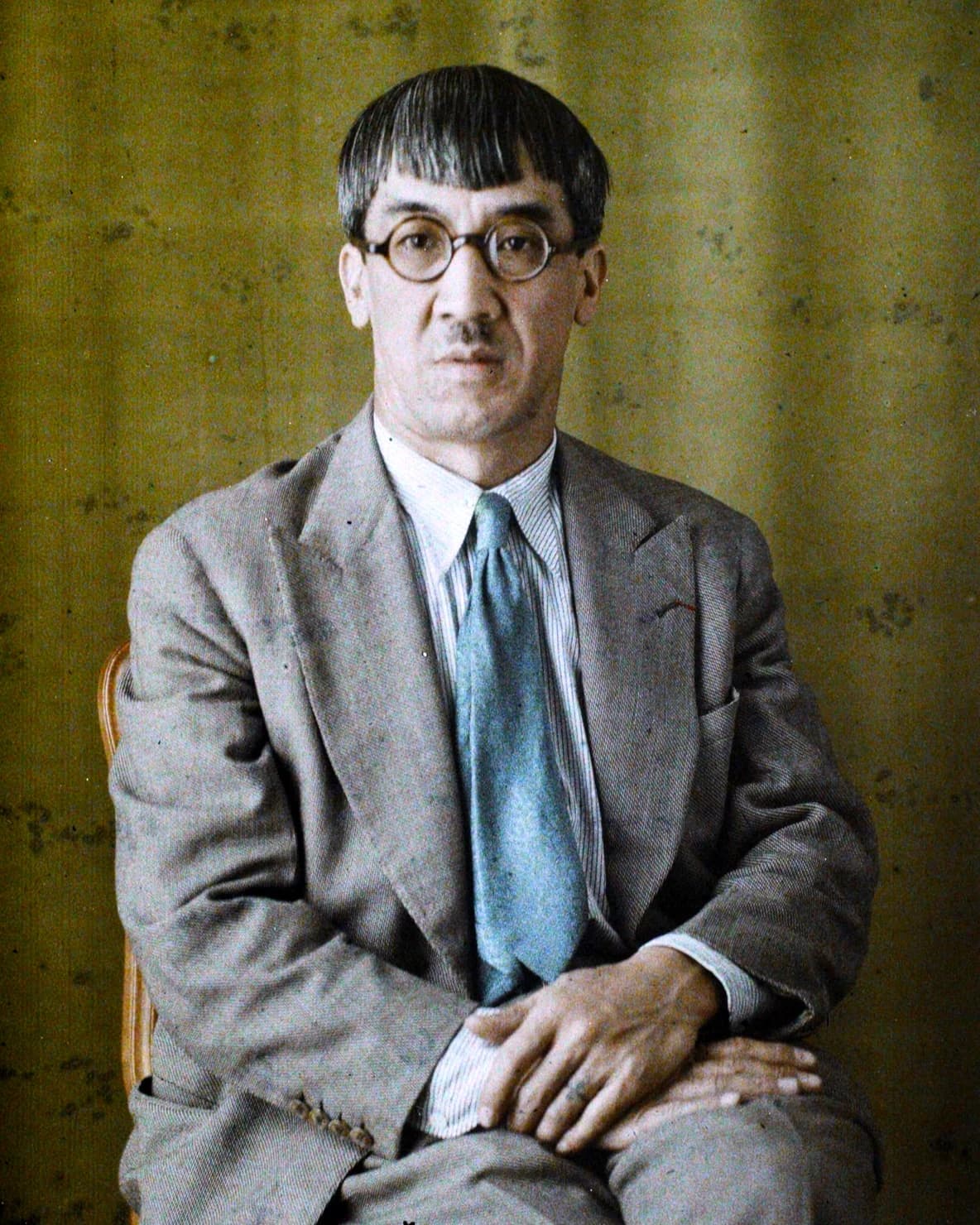
In March 1917, at the Café de la Rotonde, he met Fernande Barrey, who had sat for Modigliani, and thirteen days later they were married. Fernande showed his drawings to the dealer Georges Chéron, who bought everything he saw and gave him his first solo exhibition at his gallery: a hundred and ten watercolours. People knew him by his fringe, round glasses and little moustache, and he painted nudes, cats, children, self-portraits and interiors with still lifes. “Reclining Nude with Toile de Jouy”, for which Kiki de Montparnasse posed, was a huge success at the Salon d'Automne of 1922. He said the aim of his nudes was to convey the quality of the most beautiful material there is, human skin.
I think his whole Parisian fame rests on that phrase. Like Suzuki Harunobu and Kitagawa Utamaro in their prints, he left the skin almost uncoloured, and the body on the canvas reads as a single fine line.
Then his life began to go off course. In 1922 he met Lucie Badoud, whom he called Youki, Japanese for “snow”; in 1924 he divorced Fernande; in 1929 he married Youki and took her to Japan, where the public flocked to his exhibition while the critics called him an imitator of the West. By 1931 Youki had left him for their friend the poet Robert Desnos, tax debts had driven Foujita into bankruptcy, and he left for South America with a former dancer, Madeleine Lequeux. There were Rio de Janeiro, five months in Buenos Aires with a successful exhibition, Bolivia, Peru and Cuba, half a year in Mexico from November 1932, where he was struck by Diego Rivera's monumental murals, and then California. At the end of 1933 he returned to Japan. Madeleine died in 1936; soon Kimiyo Horiuchi appeared at his side, later to be his last wife. In Akita he painted a panel on the seasons measuring 3.65 by 20.5 metres, in 174 hours, so it is said. Japanese critics found his geishas, sumo wrestlers and fishermen old-fashioned, Japan seen through the eyes of a foreigner.
In 1938 the navy took him on as a war artist. In 1939 Foujita briefly returned to Paris, and in May 1940, after the German invasion of Belgium, he went back. Throughout the war he painted huge battle canvases commissioned by the army, and in 1943 he became vice-chairman of the Army Art Association. “Battle of Nomonhan” (1941) measures one and a half metres by four and a half; “Last Stand at Attu” (1943) shows Japanese soldiers who died in the Aleutian Islands without surrendering, and viewers wept and prayed in front of it. After the defeat, the Japan Art Association in 1946 counted him among the artists responsible for the war, although his name did not appear on the list of war criminals published in 1947. In Japan he is argued about to this day.
In March 1949 he left for New York and taught at the Brooklyn Museum Art School, but there too his colleagues staged protests at his exhibition. In January 1950 Foujita and Kimiyo moved to France, and he announced that he would never leave again. In 1951 he designed the costumes for “Madama Butterfly” at La Scala; in 1955 he and his wife took French citizenship, renouncing their Japanese nationality; in 1957 he was made an officer of the Legion of Honour. On 14 October 1959 the couple were baptised in Reims Cathedral, with René Lalou, the head of the Mumm house, as Foujita's godfather. The artist took the name Léonard, in memory of Leonardo da Vinci's “Last Supper”, and from then on painted almost nothing but religious subjects. Lalou provided the land and the money for the chapel.
A few months after it opened Foujita fell seriously ill. He died in Zurich on 29 January 1968. He was buried in Reims; Kimiyo later moved his remains to Villiers-le-Bâcle near Paris, and in 2003 the coffin was returned to the chapel, beneath the flagstones, to the place he had intended for himself.
Related context
Associations
Works connected through artistic movements, cultural context and period. Priced works available in this market appear first.








Profile notes
Profile and sources
Image
Artist image
Georges Chevalier; Wikimedia Commons; CC BY 4.0.
