
23.10.1617–25.09.1691
Tosa Mitsuoki
Tosa Mitsuoki (1617–1691) won back for the Tosa school the post of head of the court painting office in Kyoto, which his family had lost in 1569. Into the old yamato-e manner he brought detailed painting from life, picked up from the rival Kano school and from Chinese masters of the Song and Yuan dynasties. His quails became a model for later generations of the school.
Biography
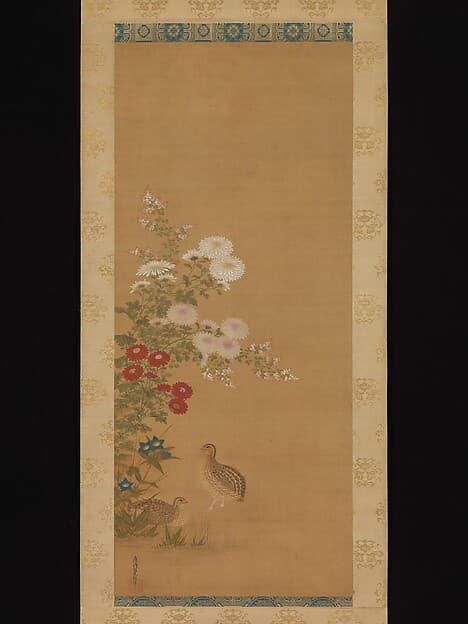
In 1801 Hashimoto Tsuneakira, an expert on court custom, recorded a story in his “Notes by the Plum Window”: a cat had pounced on a quail painted by Tosa Mitsuoki. Similar tales were told of many painters, and this one cannot be checked. The bird, though, is well chosen. Mitsuoki painted quails constantly, returning again and again to the scroll “Quails” by the Southern Song court painter Li Anzhong (now in the Nezu Museum and listed as a National Treasure), and rendering the feathers in the minute, detailed manner he had taken over from his father.
He was born in Sakai, in Izumi Province, on the 23rd day of the tenth month of the third year of Genna, that is, 21 November 1617 by the Gregorian calendar. His father was Tosa Mitsunori, head of the school.
For centuries the Tosa school had supplied the court with its edokoro azukari, the head of the court painting office. In 1569 Tosa Mitsumoto was killed in battle, the post passed out of the family, and the school itself settled for almost half a century in the merchant city of Sakai, where Mitsunori painted for the townspeople. In 1634 the eighteen-year-old Mitsuoki moved to Kyoto with his father; Mitsunori began painting ceremonial fans for the court and died in 1638. The decisive year was 1654. Mitsuoki, then thirty-eight, received the junior fifth rank and the court title of shōgen of the Left Guard, and apparently at the same time regained the post of edokoro azukari for the family, eighty-five years after it had been lost. That same year, together with Sumiyoshi Jokei, his father’s pupil, he painted sliding partitions and cedar doors in the imperial palace then being rebuilt. Emperor Go-Mizunoo favoured him: Mitsuoki was allowed to call his house the court workshop and to stamp his works with a seal reading “Painting Academy by Imperial Licence”. All this earned him the name of restorer of the house of Tosa.
The school’s old manner was not enough for him. He learned from his rivals of the Kano school, studied Song and Yuan painting, gave ink a larger role in his work and carried precise drawing from life into the soft yamato-e style. New subjects appeared that Tosa painters had not tackled before: scenes of city life, grasses and trees. Many works in a wide range of formats survive. There is a pair of handscrolls illustrating poems of the twelve months (about 1664–1668, Tokyo National Museum), a portrait of Hōjō Ujinaga (1670, Detroit Institute of Arts), and a scroll of 1675 that stages only section 137 of “Essays in Idleness” in four scenes. For the Hiden-in temple in Kyoto he painted thirty-four wall and partition surfaces in 1688. A pair of six-panel screens with flowering cherry and autumn maples, with slips of paper bearing poems pasted onto them, is in the Art Institute of Chicago.
In 1681 he handed the post on to his son Mitsunari, took the tonsure under the name Jōshō, adopted the art name Shunkaken and received the clerical rank of hokkyō, and in 1685 the higher rank of hōgen.
A year before his death Mitsuoki wrote down the “Great Instruction on the Rules of Painting of Our Country”. In the preface he explains that he committed to paper the family secrets, until then passed on by word of mouth, for fear that they would be retold wrongly, and he strictly forbids showing the book to outsiders. Inside are the six laws of painting, the three grades of skill and the twelve prohibitions familiar from Chinese treatises, and alongside them purely practical advice on brushes and pigments. He put the difference of his school this way: “The painting of a foreign land is like prose, the painting of our land is like poetry.” I find it curious that here he roundly abuses the Kano school while himself insisting, without hesitation, on working from model copies, just as the Kano painters did.
His last years went into large scrolls. In 1685–1691 he worked on three scrolls of the history of the Kitano Tenmangū shrine, and around 1690, commissioned by the regent Konoe Motohiro, he reconstructed from burnt fragments three scrolls of the history of the Ōdera temple for the Aguchi Shrine in Sakai; the Sakai City Museum holds careful ink preparatory drawings for them. Both works are now designated Important Cultural Properties. His heirs painted so close to his manner that many eighteenth-century works of the school are still doubtfully attributed to him, and in the nineteenth century Tanaka Totsugen and Reizei Tamechika deliberately repeated his compositions.
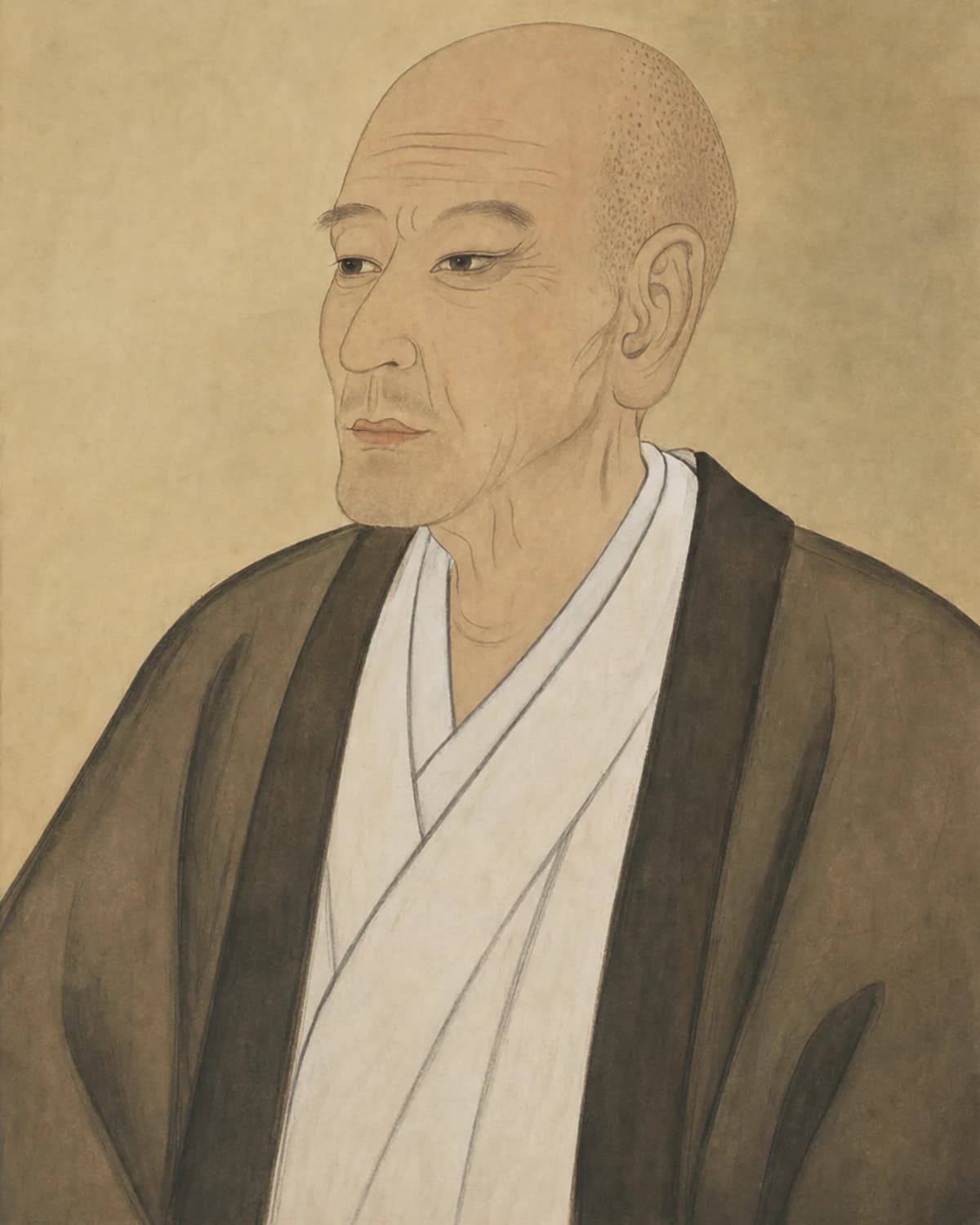
Mitsuoki died in Kyoto on the 25th day of the ninth month of the fourth year of Genroku, 14 November 1691, and was buried at the Chion-ji temple. His portrait, painted by his son Mitsunari, is in the Kyoto National Museum; it was said that in looks he resembled his grandfather, Tosa Mitsuyoshi.
Artist works
Works by the artist
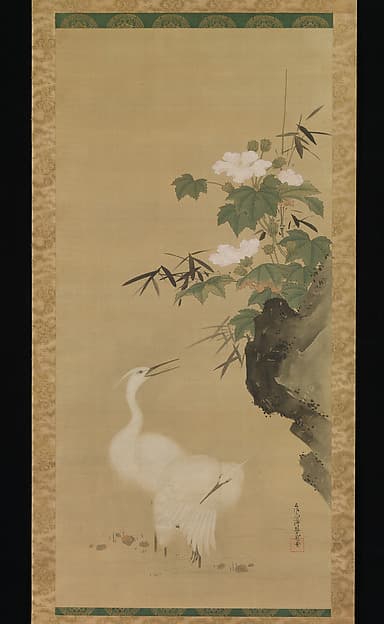
Works by Tosa Mitsuoki available in this edition of NEOARCA.
Related context
Associations
Works connected through artistic movements, cultural context and period. Priced works available in this market appear first.
Profile notes
Profile and sources
Image
Artist image
На основе открытого изображения: Tosa Mitsunari; Wikimedia Commons; Public domain.
