
25.04.1922–26.11.2018
Tomás Maldonado
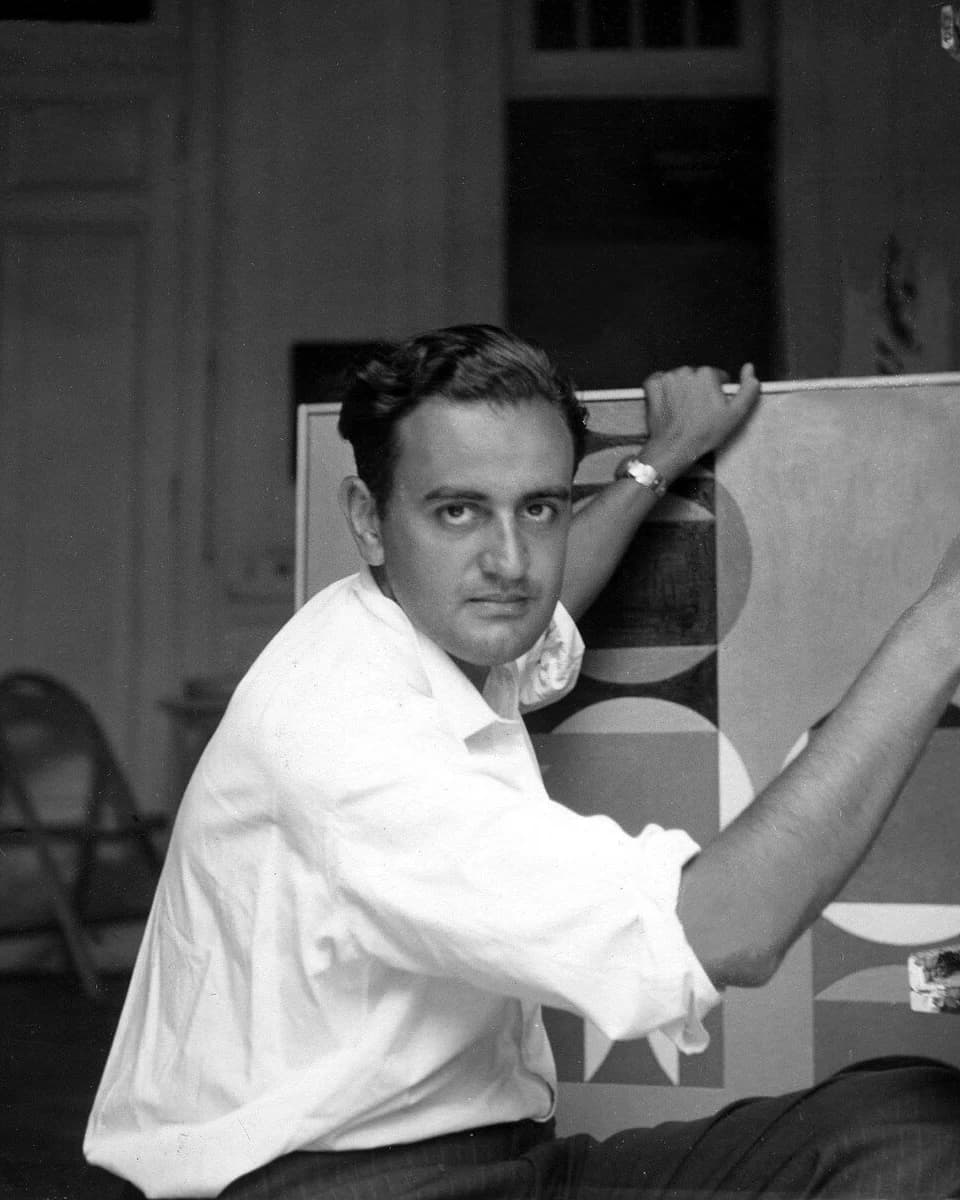
Tomás Maldonado (1922–2018), an Argentine painter of concrete art, left for Ulm in 1954, where after Max Bill’s departure he headed the Hochschule für Gestaltung and built the “Ulm model”: design as planning grounded in science rather than in art. Later he edited Casabella, taught in Bologna and Milan and received the Compasso d’Oro in 1995.
Biography
In 1969 the sixth congress of the International Council of Societies of Industrial Design in London adopted a definition of the profession that Tomás Maldonado had proposed back in 1961 at the second congress in Venice: design works out the formal qualities of an industrial product, and these are above all its structural and functional relationships rather than its outward appearance. Styling, he added, is accidental; form arises together with the product.
By then he had been gone from Ulm for two years and was himself the president of that council.
Maldonado was born on 25 April 1922 in Buenos Aires, the son of the scientist Tomás Maldonado Ortiz and Margaret Bailey, a native of Scotland. In 1942 he graduated from the Prilidiano Pueyrredón National School of Fine Arts, in 1944 he drew illustrations for poems by his relative Edgar Bayley in the magazine Arturo, and in 1945 he became one of the founders of the Asociación Arte Concreto-Invención; the following year the group issued the “Inventionist Manifesto”, in which the beauty of the real world was set against the illusions of both figurative and abstract painting. He was reading the Soviet Constructivists closely at the time. In 1948 he travelled to Italy and Switzerland and met Max Bill; at the same meeting were Otl Aicher and Inge Scholl, who had come from Ulm to recruit Bill for a new school on the Bauhaus model. On his return Maldonado published, in 1949, the article “Industrial Design and Its Social Significance”, and in 1951, with Alfredo Hlito, he founded the magazine Nueva Visión, devoted to art, architecture, design and typography, and ran it until 1957; the magazine spread across Latin America.
In August 1954 he moved to West Germany and joined the staff of the Hochschule für Gestaltung in Ulm, which Bill directed. The school declared itself the heir of the Bauhaus, but already in 1955 Maldonado published in Nueva Visión an article on the social tasks of training designers, and the disagreements with the rector grew; Aicher, Gugelot and Zeischegg took Maldonado’s side. In 1956 Bill gave up the rectorship, in 1957 he left Ulm, and Maldonado took charge of the school. His thesis was simple: design is not art, aesthetics is only one factor beside technology, production and economics, and tailoring a thing to the buyer does not count as design. Higher mathematics, ergonomics, heuristics and social psychology entered the curriculum; the school published the journal Ulm in three languages, and the students designed the corporate identity of Braun, sewing machines for Pfaff and the keyboard of the Olivetti Elea 9003 computer. Under his direction, with Gui Bonsiepe and Rudolf Scharfenberg, a system of electronic equipment for operating theatres, “Tipo-1”, was designed in 1962–1963, a series of excavators in 1964 and electronic calculators in 1966; with Bonsiepe he also made sign systems and, in 1964–1967, a system of codes for Olivetti and the La Rinascente department store. In 1965 he gave the Lethaby lectures at the Royal College of Art in London, in 1966 he spoke at the Aspen conference and became a Council of the Humanities fellow at Princeton, and in 1967–1970 he held a chair at Princeton’s School of Architecture. In 1967 an internal crisis began at Ulm and Maldonado left; that same year he was elected president of the International Council of Societies of Industrial Design for two years. To my mind the quarrel with Bill was a quarrel between two painters over whether one may stop being a painter.
After his presidency he settled in Italy: from 1971 he taught in the faculty of philosophy at the University of Bologna, in 1976–1984 he was professor of environmental design there, and then he moved to the Politecnico di Milano, where in 1994 he took part in opening the department of industrial design. From 1977 to 1981 he edited the journal Casabella. He wrote a great deal: “Max Bill” (1955), “Ulm, Science and Design” (1964), “La speranza progettuale” (1970), “Industrial Design Reconsidered” (1976), “Critica della ragione informatica” (1998); in the essay “The Heterodox” he named it the task of the intellectual to awaken the collective conscience, and in 2007, at Bonsiepe’s initiative, the collection “Digital World and Design” came out.
In 1995 he received the Compasso d’Oro, in 1998 the Italian state prize for contributions to science and culture, and in 2012 a special mention of the Konex Award at home. Tomás Maldonado died on 26 November 2018 in Milan, at ninety-six.
Profile notes
Profile and sources
Image
Artist image
Unknown photographer Unknown photographer; Wikimedia Commons; Public domain.
