
09.03.1856–14.09.1931
Tom Roberts
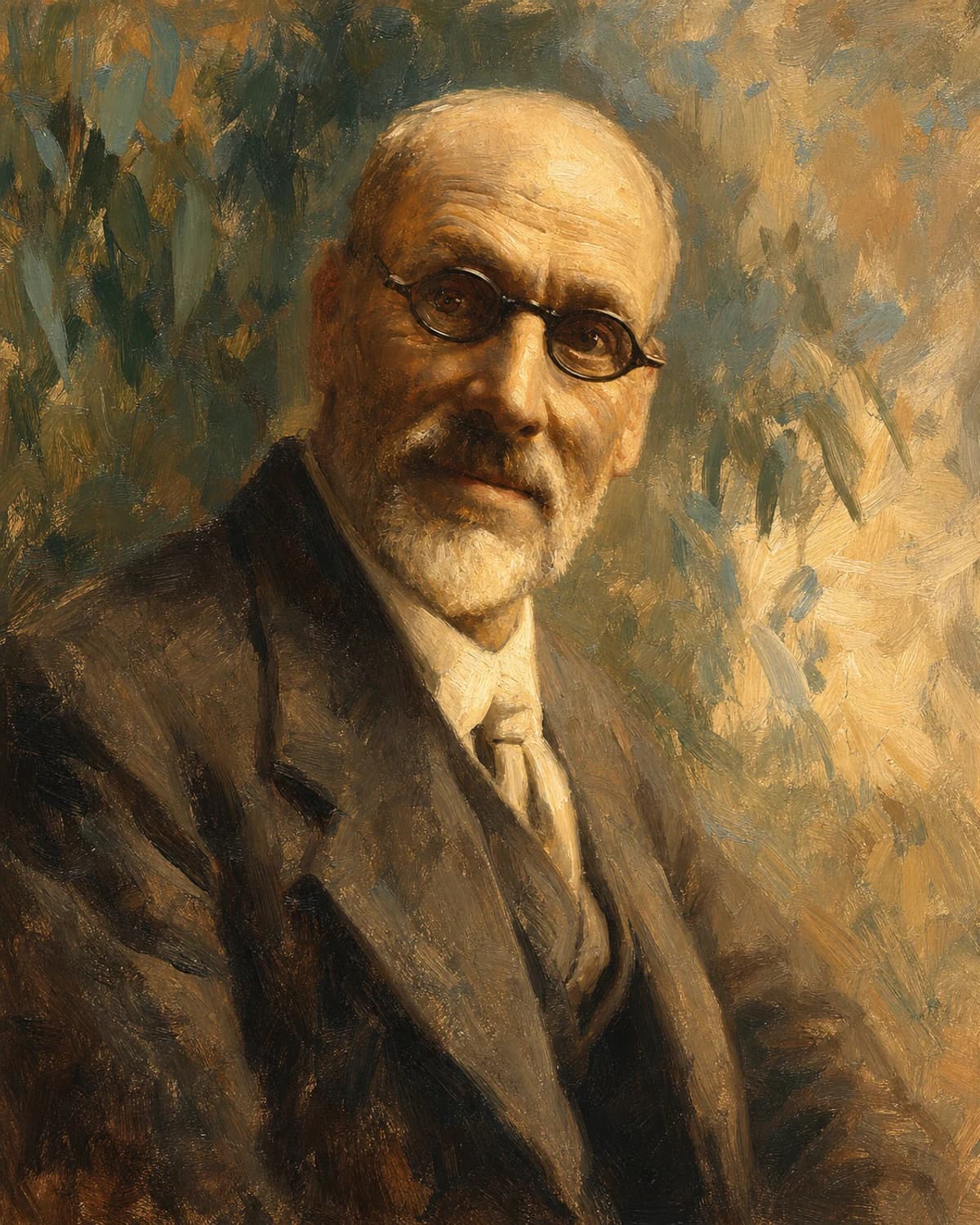
Tom Roberts (1856–1931) came to Melbourne as a boy from Dorchester in England, and by the end of the 1880s he was regarded as the leader of the Heidelberg School, Australia's first plein-air movement. He set up artists' camps near Melbourne and Sydney, painted “Shearing the Rams” and “A Break Away!”, earned his living from commissioned portraits and, on commission, produced “The Big Picture”, showing the first sitting of the Australian Parliament.
Biography
In August 1889 an exhibition opened at Buxton's Rooms in Melbourne in which almost everything had been painted in oil on the wooden lids of cigar boxes. The lids were supplied by Louis Abrahams, the manager of a cigar firm, and their size, nine inches by five, gave the show its name: “9 by 5”. The organisers, Tom Roberts, Arthur Streeton and Charles Conder, called their quick sketches “impressions” and themselves impressionists. Roberts showed more works than anyone else, sixty-three.
The critics decided that impressionism was a passing fad. Today the history of the Heidelberg School is dated from this exhibition.
Roberts was thirty-three at the time. He was born in Dorchester, in Dorset, the son of a journalist, Richard Roberts, and Matilda, née Evans. There is some confusion over his birthday: his birth certificate gives 8 March 1856, while his tombstone is carved with 9 March. He went to the grammar school in Dorchester. When his father died, his mother took the children to Australia in 1869 to join relatives, and the family settled in Collingwood, a suburb of Melbourne.
Money was short. As a boy Tom helped his mother sew bags to order, in the 1870s he worked as a photographer's assistant, and he learned to draw at evening classes with the Swiss landscape painter Louis Buvelot. From 1874 he attended Thomas Clark's evening drawing classes at the National Gallery of Victoria school; in 1877–1879 he studied at the gallery's School of Painting, and in 1878 he attended anatomy lectures at the Melbourne Hospital and the university. It was there that he made friends with Frederick McCubbin. In 1880 Roberts was admitted to the Victorian Academy of Arts. His mother, meanwhile, had remarried; he did not get on with his stepfather, and in 1881 he left for London, where he spent three years at the Royal Academy Schools. In 1883 he travelled through Spain with the Australian artist John Russell and the future politician William Maloney; the Spanish painters Laureano Barrau and Ramon Casas explained to him how to paint in the open air and what impressionism was. In London and Paris he studied the work of Jules Bastien-Lepage and Whistler. In 1885 Roberts returned to Australia stocked with everything that then counted as the latest thing in art.
That same summer, at the turn of 1885 and 1886, he set up the first artists' camp with McCubbin and Abrahams at Box Hill, on the outskirts of Melbourne. The station there had opened not long before, and the bush could be reached by train. They painted rural life, the bush, light and heat from nature; in 1886 came “Wood Splitters”. The next summer the camp moved to the seaside at Mentone, and on the beach they met the young Arthur Streeton, who was also painting from nature. Roberts taught him impressionist techniques, and for a long time Streeton was his pupil and friend. From 1888 Roberts rented a studio in Grosvenor Chambers on Collins Street, the first building in Melbourne put up specifically as artists' studios; the architects consulted him on how to arrange the light. There he became one of the most fashionable portraitists in the city. At the bohemian Buonarotti Club he went about in an opera cape lined with red satin and a collapsible top hat.
His tenacity earned him the nickname “Bulldog”.
In 1888 in Sydney he made friends with Conder; they painted Coogee Beach together, and in October Conder followed him to Melbourne. In the summer of 1888–1889 the two of them joined Streeton at his camp at Heidelberg, which later gave its name to the whole movement, and it was there that the cigar-lid exhibition was prepared. Roberts was older than the others, more tenacious and more influential, and he was regarded as the group's unofficial leader. On leaving for Europe in 1890, Conder wrote to him that if there was any school at all in Melbourne, it was entirely his doing.
That same year a severe economic depression hit Melbourne, and Roberts and Streeton moved to Sydney. They lived in camps on the shores of Sydney Harbour, Curlew Camp among them, and travelled into the interior of New South Wales, while Roberts grew close to the nationalist writers around the weekly “The Bulletin”. He had long urged his companions to paint the national life of Australia. He began “Shearing the Rams” (1890) at the sheep station of Brocklesby in southern New South Wales and finished it in Melbourne: shearers in the shed, and the wool that was then Australia's chief export. Some critics refused to count such a subject as high art, others at once demanded that a public gallery buy the picture; it is now in the National Gallery of Victoria. Then came “A Break Away!” (1891), in which a drover gallops to head off sheep that have broken away from the flock, “The Golden Fleece” (1894), another shearing scene, and “Bailed Up” (1895).
To my mind, his fame as a national painter obscures what he actually lived on: the money came from portraits, not from shearers. He was also the first to campaign for Australia to have its own National Portrait Gallery. In 1903 he completed the commissioned “Big Picture”, the first sitting of the Parliament of Australia in the Exhibition Building in Melbourne. The enormous canvas became the best-known image of that day; it now hangs in Parliament House in Canberra.
In 1896 Roberts married the thirty-six-year-old Elizabeth (Lillie) Williamson, and they had a son, Caleb. Lillie was skilled at making picture frames, and in 1903–1914, when he himself painted little, the family seems to have lived mainly on her earnings. Roberts spent the First World War in England, helping at a hospital; in December 1919 he returned and built a house at Kallista, near Melbourne. Lillie died in January 1928, and in August he married Jean Boyes.
Tom Roberts died at Kallista on 14 September 1931. His ashes were buried in the churchyard at Illawarra near Longford, in Tasmania, one of the places where he liked to paint.
Related context
Associations
Works connected through artistic movements, cultural context and period. Priced works available in this market appear first.








Profile notes
Profile and sources
Image
Artist image
На основе открытого изображения: Unknown author Unknown author; Wikimedia Commons; Public domain.
