
05.07.1853–20.06.1919
Tivadar Csontváry Kosztka
Tivadar Csontváry Kosztka came to painting at about forty, after leaving the pharmacy, following a vision that, by his own account, promised him a fame greater than Raphael’s. He travelled through Dalmatia, Italy, Greece, North Africa and the Middle East, painted enormous canvases, among them “The Lonely Cedar”, and exhibited in Paris in 1907. At home he was thought a crank, and not one painting sold in his lifetime.
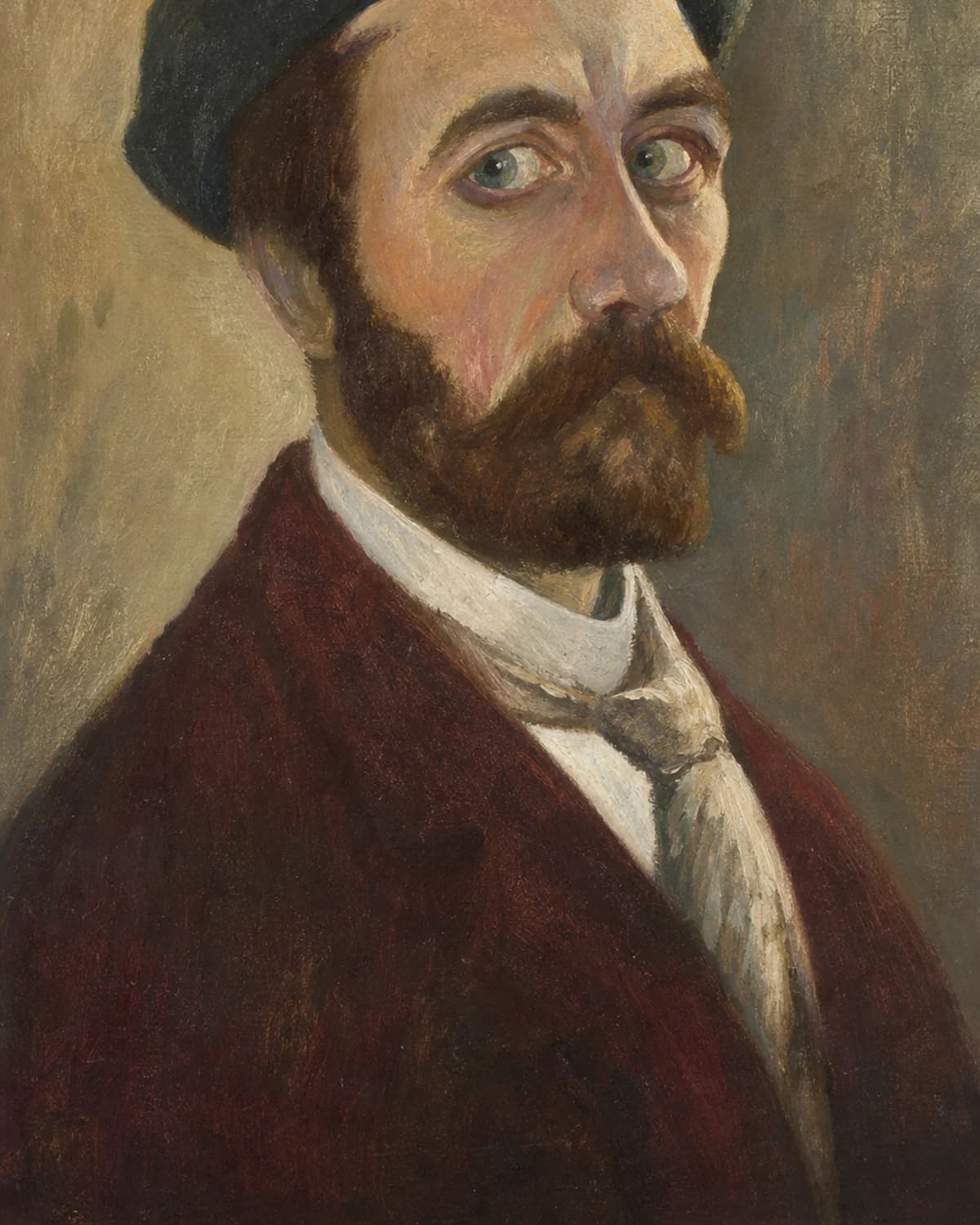
Biography
Csontváry himself told the story of how it all began: on the hot afternoon of 13 October 1880 he heard a voice promising that he would become the greatest painter in the world, greater than Raphael. He was twenty-seven and working as a pharmacist. Some sources place the vision in 1881, and I have no documents apart from the painter’s own notes.
He was born on 5 July 1853 in Kisszeben (now Sabinov, Slovakia), then in the Kingdom of Hungary, and at birth was named Mihály Tivadar Kosztka. His father, László Kosztka, was a physician and pharmacist; his ancestors on the paternal side were Poles who had settled in Hungary. At home they spoke Slovak mixed with German, but Csontváry wrote mostly in Hungarian and took his Hungarian roots very seriously. In 1865 the family moved to the village of Stredné (today in the Zakarpattia region of Ukraine), and he was sent to a commercial school in Uzhhorod. He became a pharmacist, like his father.
After the vision he did not give up his post at once. First he travelled around Europe and visited the galleries of the Vatican, then he returned to Hungary and stood behind a pharmacy counter again: the journeys had to be paid for somehow. In 1883, in Paris, he met Mihály Munkácsy, regarded as the foremost Hungarian painter of his time. He began to draw and paint in the mid-1890s, that is, closer to forty, and was largely self-taught.
From 1890 his journeys became regular. He visited Paris, Dalmatia, Italy and Greece, North Africa and the Middle East: present-day Lebanon, Israel, Egypt and Syria. What he brought back were canvases rather than sketches, often several metres wide and high. In 1900 he changed his surname from Kosztka to the pseudonym Csontváry.
His major works were painted between 1903 and 1909. Among them are “The Lonely Cedar”, “Pilgrimage to the Cedars in Lebanon”, “Ruins of the Greek Theatre at Taormina”, “The Great Tarpatak Waterfall”, “Mary’s Well in Nazareth” (1908) and “Riding on the Seashore” (1909). More than a hundred paintings are attributed to him.
In 1907 his works were shown in Paris, and then in other cities of Western Europe. Western critics largely recognised his talent. In Hungary the pictures met with no response. He acquired a reputation as a madman: he ate no meat, did not drink or smoke, was a pacifist, lived as an ascetic, and in conversation liked to fall into a prophetic tone. The same traits show in his writings: a pamphlet, “Energy and Art, the Errors of Civilised Man”, reflections on exceptional talent, and a religious philosophy in “The Positivum”. He called himself a “sunway” painter, a term he coined. In his lifetime he sold not one painting, and failure, it seems, sapped his strength.
By style he is hard to assign to one school. Art historians find in his painting traces of Post-Impressionism, Symbolism and Expressionism, but he learned without a school and belonged to no movement.
Csontváry died on 20 June 1919 in Budapest. After his death his heirs wanted to sell about forty canvases to be used as cart tarpaulins. They were saved by the architect Gedeon Gerlóczy, who was looking for a studio, came across the rolled-up pictures and bought them. For some fifty years they lay in his apartment. Csontváry’s collection is now held in the museum named after him in Pécs and in the Hungarian National Gallery in Budapest. In 1980 Zoltán Huszárik made a film about him.
Related context
Associations
Works connected through artistic movements, cultural context and period. Priced works available in this market appear first.








Profile notes
Profile and sources
Image
Artist image
На основе открытого изображения: Tivadar Csontváry Kosztka; Wikimedia Commons; Public domain.
