
1488–27.08.1576
Titian
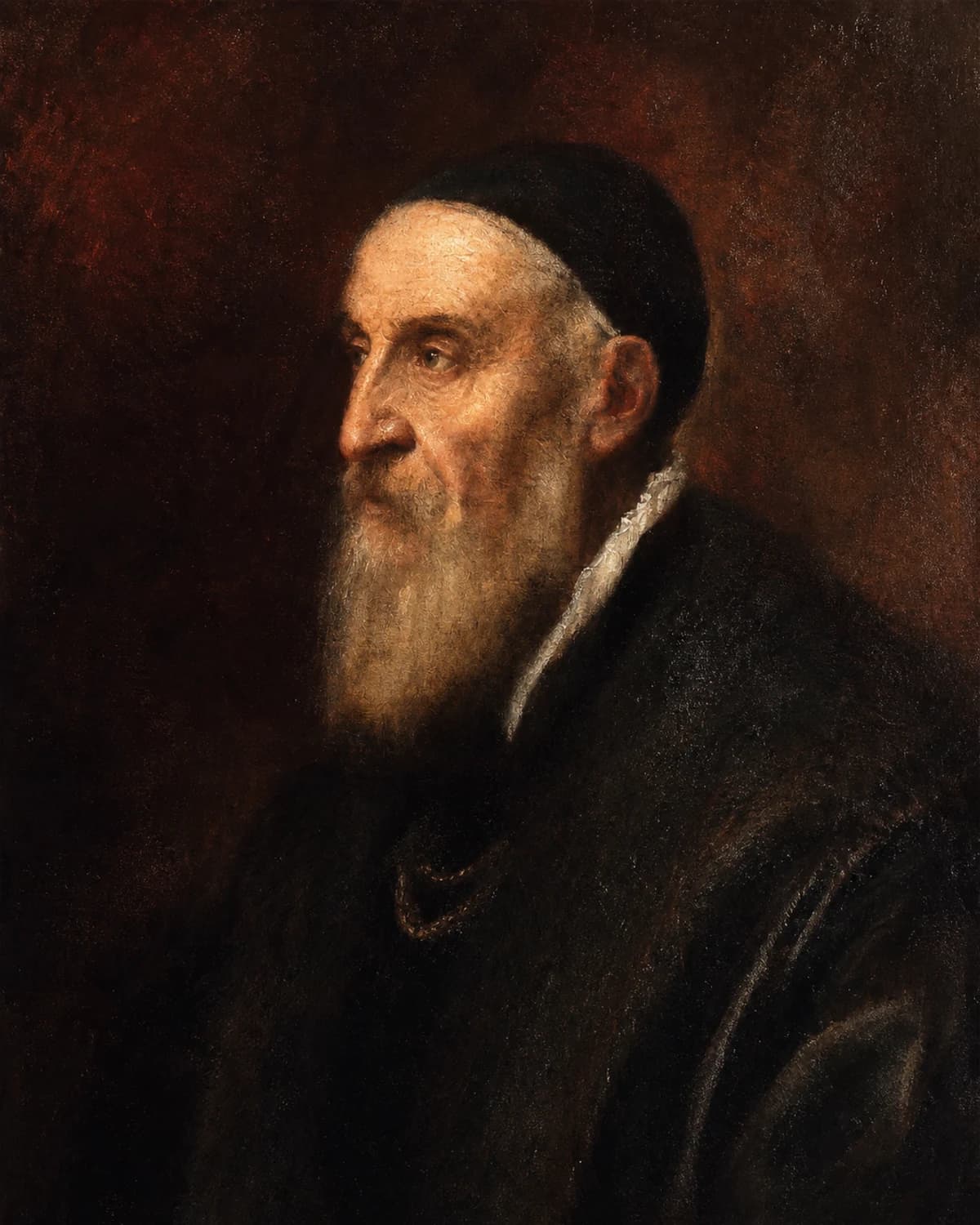
Titian Vecellio of Pieve di Cadore remained the first painter of Venice for some sixty years and worked for Charles V, Philip II, Pope Paul III and the dukes of Ferrara and Urbino. His “Assunta” has stood above the high altar of the Frari church since the late 1510s, and for Philip II he painted a cycle of mythologies after Ovid that he himself called “poesie”.
Biography
In a letter to Philip II written in extreme old age, Titian informed the king that he had been born in 1474. Nobody believes him: his contemporaries gave various years, from 1473 to the early 1480s, as late as the twentieth century it was still happily repeated that he lived to ninety-nine, and present-day scholars agree on 1488–1490. It seems to me entirely in character: a painter who worked for emperors left the simplest date of his own life unclear.
He came from Pieve di Cadore, a mountain town in the Venetian dominions. His father, Gregorio Vecellio, had been a soldier and had ties to the Venetian Arsenal, but mostly he traded in timber and managed mines in Cadore. According to Lodovico Dolce, who knew the painter personally, the boy was sent at about the age of nine, together with his brother Francesco, to an uncle in Venice. Dolce counted four teachers: Sebastiano Zuccato, from a family of craftsmen who worked for St Mark's Basilica, Gentile Bellini, his younger brother Giovanni and, finally, Giorgione. Vasari tells it differently, and there are no documents for either version.
With Giorgione things get more tangled. In 1508–1509 the two painted the facades of the Fondaco dei Tedeschi, the house of the German merchants: Giorgione got the facade over the Grand Canal, Titian the one facing the street, and many judged the younger man's work the stronger. Of the frescoes, only fragments have survived the damp Venetian air. After Giorgione's death in 1510 Titian finished his uncompleted canvases, among them the Dresden “Sleeping Venus”, and art historians have argued ever since about where one painter ends and the other begins. In the twentieth century a good many attributions passed from Giorgione to Titian, and almost none went back.
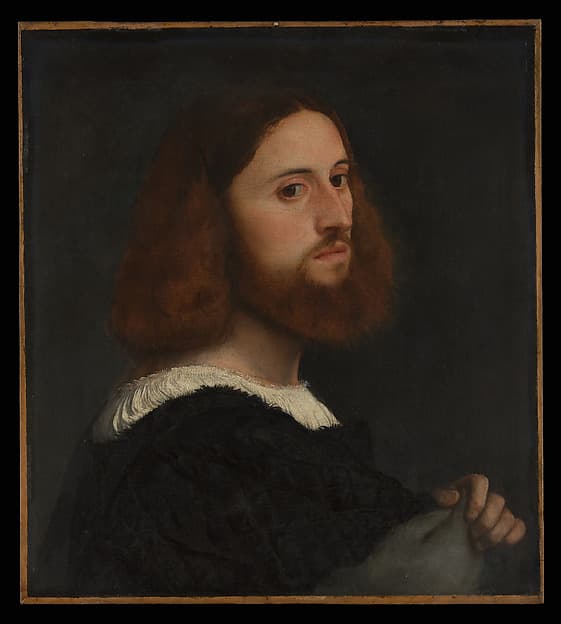
Around 1509 he painted the portrait of a man with a quilted sleeve, now thought to be Gerolamo Barbarigo. A hundred and thirty years later Rembrandt saw it at an auction, sketched it and built his own self-portrait on the same scheme.
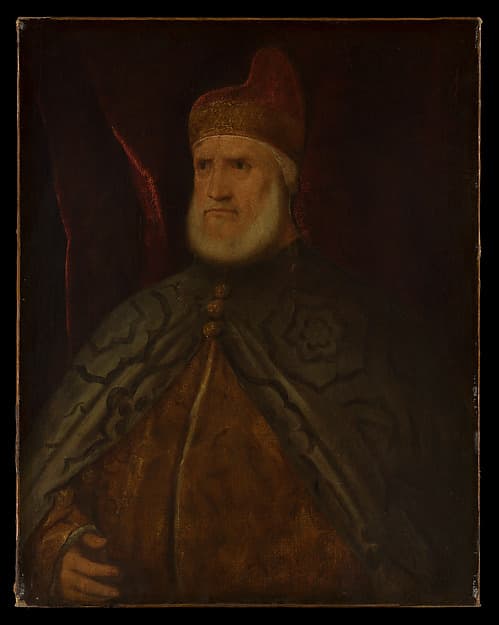
In 1511 Titian went to Padua for several months and painted frescoes of the miracles of St Anthony in the Scuola del Santo. On 31 May 1513 he offered the Council of Ten a large battle scene for the Doge's Palace and asked in return for a lucrative post at the Fondaco dei Tedeschi. He finished the picture only in 1538, under threat of having to return the money he had received, and in 1577 it burned in a fire at the palace. After Giovanni Bellini's death in November 1516 Titian took his place as first painter of the Republic, whose duties included, among other things, painting the portraits of new doges.
The next fifteen years produced his best-known altarpieces and mythologies. “Sacred and Profane Love” (1514) was commissioned by Niccolò Aurelio, a member of that same Council of Ten. The “Assunta” for the high altar of the Franciscan church of Santa Maria Gloriosa dei Frari was painted in 1516–1518; it is his largest picture on a single panel, and it is still in its place. Below, the apostles crowd together, above them Mary rises into the sky, at the top God the Father waits, and the three tiers are bound into one upward movement. For the alabaster chamber of Alfonso d'Este in Ferrara he painted “Bacchus and Ariadne” (1520–1523): Bacchus leaps down towards Ariadne from a chariot drawn by two cheetahs, Theseus's ship is sailing away in the distance, and in the upper left corner of the sky burn the stars of her future crown. In 1526 a second picture of his appeared in the Frari, the “Pesaro Madonna”.
In 1527 Pietro Aretino arrived in Venice, and with the sculptor Jacopo Sansovino they formed a company that the townspeople nicknamed the “triumvirate”. Through Aretino came commissions from Federico Gonzaga in Mantua, and through Gonzaga the acquaintance with Charles V. In Bologna in 1533 the emperor made Titian a Count Palatine and a Knight of the Golden Spur. The gold chain he received then he later painted on his own self-portrait of the 1550s. At home these were hard years. In 1525 he married Cecilia, the mother of his sons Pomponio and Orazio, and in 1530 she died. A year later Titian moved the children to a new house in Biri Grande, on the northern edge of the city, with a garden for drying canvases and direct access to the lagoon.
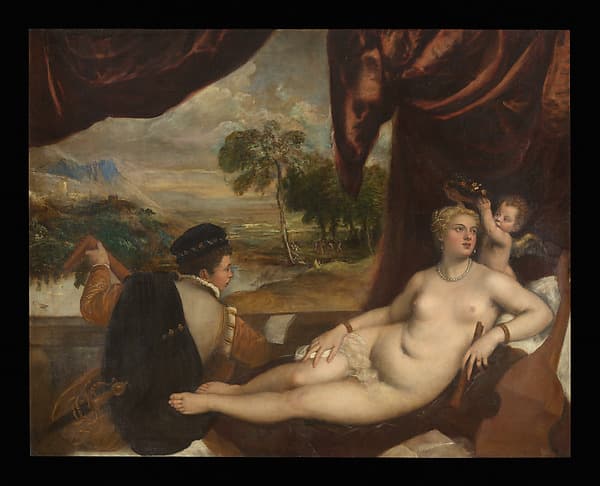
In 1542 Cardinal Alessandro Farnese saw the “Venus of Urbino” and at once wanted a similar nude for himself; this is how the first “Danaë” (1544–1546) came about. In 1545–1546 Titian lived in Rome, painted Paul III, received Roman citizenship and met Michelangelo, who liked the “Danaë” less than one might have wished: he found it lacking in drawing. Titian turned down the lucrative post of keeper of the papal seal that was offered to him.
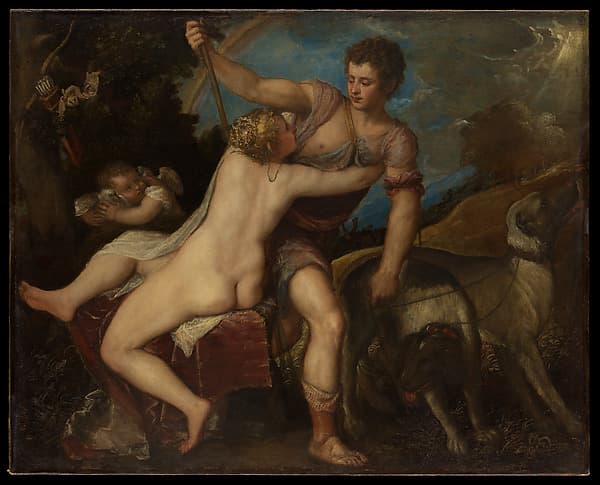
In 1548, at the imperial diet in Augsburg, he painted an equestrian portrait of Charles V commemorating the victory at Mühlberg. After that Philip II became his chief patron. For him the “poesie” after Ovid were painted: “Danaë” (sent in 1553), “Venus and Adonis” (1554), “Diana and Actaeon” and “Diana and Callisto” (1559), “The Rape of Europa” (1562). By then the workshop was turning out replicas of his compositions almost on a production line. According to his pupil Palma il Giovane, whose account Marco Boschini published in 1674, Titian could keep a canvas he had begun turned to the wall for months, and he rubbed in the final layers with his fingers.
His last painting was the “Pietà” for his own tomb in the Frari: a huge canvas stitched together from seven pieces, with a small tablet on which Titian and Orazio pray before a vision. The friars soon returned it to the master. Titian died in Venice on 27 August 1576 and was buried in the Frari by the altar of the Crucifix. Palma il Giovane finished the “Pietà”, leaving on it an inscription saying that he had reverently completed what Titian had begun; since 1814 it has been in the Gallerie dell'Accademia.
In 1843 Emperor Ferdinand I commissioned a marble monument over his grave. Luigi Zandomeneghi began the work, and his sons completed it in 1852. The monument stands in the nave opposite the “Pesaro Madonna”.
Artist works
Works by the artist
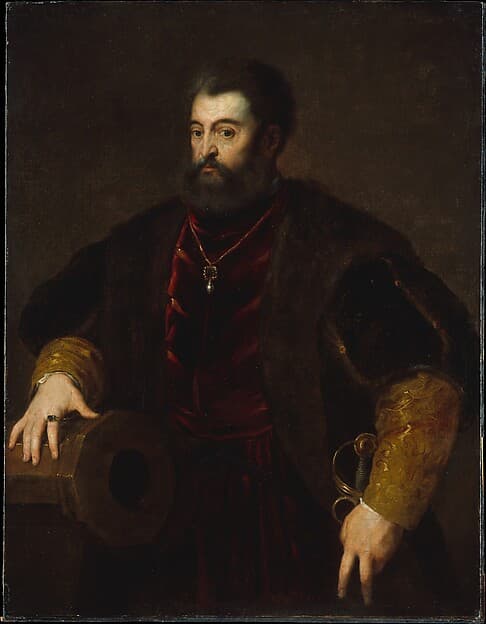
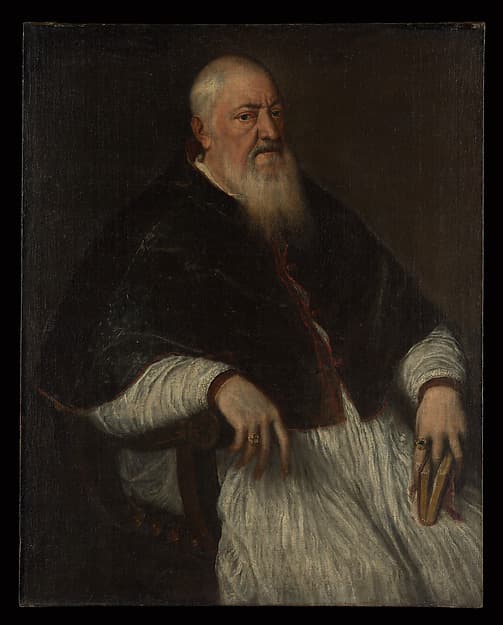
Works by Titian available in this edition of NEOARCA.
Related context
Associations
Works connected through artistic movements, cultural context and period. Priced works available in this market appear first.
Profile notes
Profile and sources
Image
Artist image
На основе открытого изображения: Titian; Wikimedia Commons; Public domain.
