
31.01.1885–17.07.1942
Tinus de Jongh
Tinus de Jongh (1885–1942) was self-taught: his parents forbade him to become an artist, and he began as a decorator in Amsterdam. One of his early canvases was bought by the Stedelijk Museum, and in 1921 he moved to South Africa and settled in Cape Town. There his sober Dutch palette grew brighter, and his landscapes with farmhouses and his etchings sold in the hundreds.
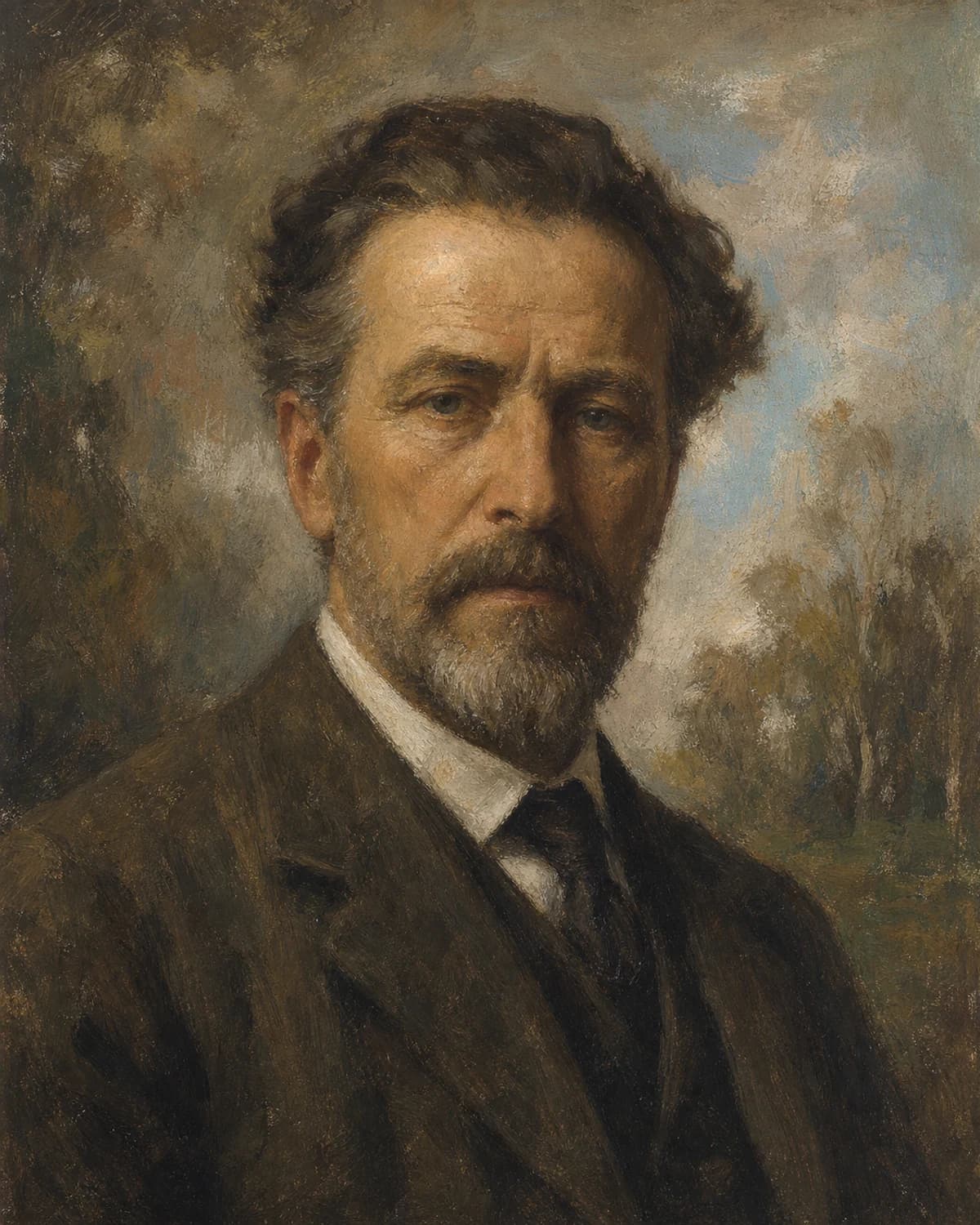
Biography
In the 1910s Martinus Johannes de Jongh was already becoming a little known in Amsterdam.
He was born on 31 January 1885 in Amsterdam, the son of Martinus Johannes de Jongh and Wilhelmina Krull; the family lived on the Weteringschans. His parents at first forbade him to become a painter. He had no teachers and learned the craft on his own, beginning as a decorator and only later taking up painting in earnest. In April 1911 he married Johanna Maria Verhoef; they had three children, among them a son, Gabriel, who also became a landscape painter. In the 1910s he was given permission to paint views of the Dam square from the windows of the royal palace. Among other things he depicted the Commandant’s House, a building demolished in 1912. His first notable success is said to have been the purchase of one of his early paintings by the Stedelijk Museum in Amsterdam. During his Amsterdam years he also worked as an etcher. The family lived at that time on the Weesperzijde, an area that in those years passed from the municipality of Watergraafsmeer to Amsterdam.
In 1921 he emigrated to South Africa and settled in Cape Town. For some time he sat on the board of the Hollandsche Kring, a Dutch community society (the name is rendered tentatively). His first works there were sober and in the Dutch tradition, as in “Still Life with Birds and Hare”. The light and landscape of South Africa fairly soon led him to abandon his muted tones for more saturated colours. I cannot give a date for this change: the sources do not have one.
The demand for Cape landscapes with farmhouses under gabled fronts was such that he began to repeat a successful formula. He exchanged his careful brushwork for a broader manner with the palette knife. His dealer was Louis Woolf, through whom hundreds of etchings and paintings were sold.
Tinus de Jongh died on 17 July 1942 in Bloemfontein.
Related context
Associations
Works connected through artistic movements, cultural context and period. Priced works available in this market appear first.








Profile notes
Profile and sources
Image
Artist image
На основе открытого изображения: Tinus de Jongh; Wikimedia Commons; Public domain.
