
29.09.1518–31.05.1594
Tintoretto
Tintoretto (Jacopo Robusti, 1518 or 1519 – 1594), a Venetian dyer’s son, spent half a century filling the Scuola di San Rocco, the Doge’s Palace and the churches of his city with canvases, hardly ever leaving it. He painted fast, often for a pittance or for nothing, so long as he got the commission; over his studio door he hung the motto “Michelangelo’s drawing and Titian’s colour”. His “Paradise” in the Doge’s Palace, nine metres by twenty-two, is reputed to be the largest painting on canvas.
Biography
In 1564 the Scuola Grande di San Rocco announced a competition for the ceiling of the Sala dell’Albergo: “Saint Roch in Glory”. The four finalists, Federico Zuccaro, Giuseppe Salviati, Paolo Veronese and Tintoretto, were asked to submit sketches. Instead of a sketch Tintoretto painted the picture full size, fixed it secretly to the ceiling, unveiled it finished on the day of the competition and announced that he was giving it to the confraternity. The scuola’s statutes, it appears, forbade the refusal of gifts. The episode has been called the most notorious of his career; it also opened to him the building he would decorate for the next quarter of a century.
Jacopo Robusti was born in Venice; the sources give the year differently, 1518 or 1519, and there is no exact day. His father, Battista, was a dyer of cloth, a tintore, hence the nickname “little dyer”. Of his childhood and training little is known. His early biographers, Carlo Ridolfi (1642) and Marco Boschini (1660), relate that his only formal apprenticeship was a few days in Titian’s studio, from which Titian drove him out, whether from jealousy of too gifted a pupil or from a clash of temperaments; relations stayed hostile to the end, though Tintoretto went on revering Titian. After that he taught himself: according to Ridolfi he worked alongside the craftsmen who decorated furniture with mythological scenes, drew from live models and dissected corpses, collected casts, reliefs and prints. At some point, possibly in the 1540s, he obtained models of Michelangelo’s “Dawn”, “Day”, “Dusk” and “Night” and with his assistants drew them from every angle on blue paper; he modelled little figures in wax and clay, set them up in boxes like a doll’s house and from these maquettes worked out his lighting and composition. He worked by night as well as by day. A notarial document of 1539 already calls him an independent painter.
His early works he painted almost for nothing. Andrea Schiavone, four years his junior, was his constant companion, and Tintoretto helped him with wall paintings free of charge; his own first murals, “Belshazzar’s Feast” and a “Cavalry Fight”, like all his frescoes, have not survived. Among the surviving early works: the “Presentation in the Temple” in the church of the Carmine (c. 1542), “Adam and Eve” and the “Death of Abel” for the Scuola della Trinità, now in the Gallerie dell’Accademia. The turning point came in 1548: for the Scuola di San Marco he painted the “Miracle of the Slave”, in which the evangelist, descending from the sky, shatters the instruments of torture over the slave. The picture was a success; Pietro Aretino praised it, singling out the figure of the slave, and warned the painter against haste. Commissions came in a flood: in 1549 “Saint Roch Cures the Plague Victims” for the church of San Rocco, one of his first horizontal pictures for the side walls of chapels, composed to be looked at from an angle. When Veronese arrived in Venice in 1551 and began receiving the commissions Tintoretto longed for, Tintoretto offered his parish church, the Madonna dell’Orto, two colossal canvases for the cost of materials. The “Worship of the Golden Calf” and the “Last Judgment” (c. 1559–1560), fourteen and a half metres high, became the tallest canvases of the Renaissance; in the same church hangs his “Presentation of the Virgin in the Temple” (c. 1556), with its figures on a staircase receding upwards. From then on he habitually outdid his rivals by speed and cheapness. His house by that church, on the Fondamenta dei Mori, is still standing.
At San Rocco he worked in 1565–1567 and 1575–1588. For the “Crucifixion” in the Sala dell’Albergo, a canvas 536 by 1,224 centimetres, he was paid 250 ducats; the “Brazen Serpent” for the ceiling of the great hall he gave as a gift in 1576, and in November 1577 he offered to paint the whole building and the adjoining church for a hundred ducats a year, three pictures annually, and kept to the agreement until his death. In all he received 2,447 ducats for the scuola; it and the church contain 52 of his large paintings, vast sketches rather than finished pictures, meant for half-light. For the Doge’s Palace he painted from 1560; after the fire of 1577 he began again alongside Veronese: four mythologies for the Sala dell’Anticollegio at fifty ducats each, nine battle compositions for the hall of the Great Council. While the commission for the “Paradise” for that same hall remained unassigned, he used to tell the senators that he had prayed to God to give him the work, so that paradise might be his reward after death. The commission went to Veronese and Francesco Bassano, but Veronese died in 1588, and the canvas fell to Tintoretto. He stretched it in the old Scuola della Misericordia, painted heads and costumes from life, and the picture was finished in place by assistants led by his son Domenico. Ridolfi wrote that it seemed to everyone that heavenly beatitude had been disclosed to mortal eyes. He was invited to name his own price, left it to the authorities and, it is said, even knocked something off the sum they offered.
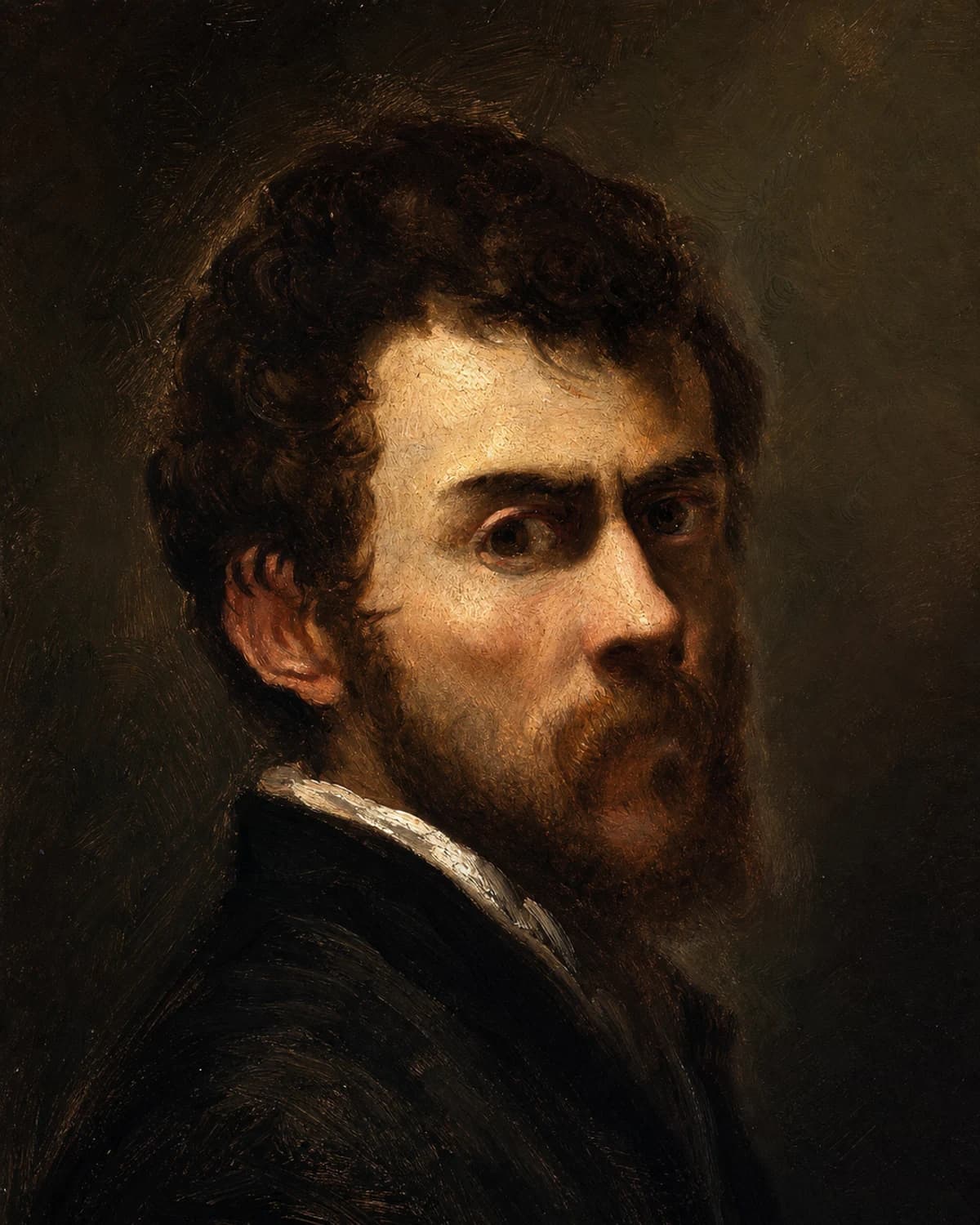
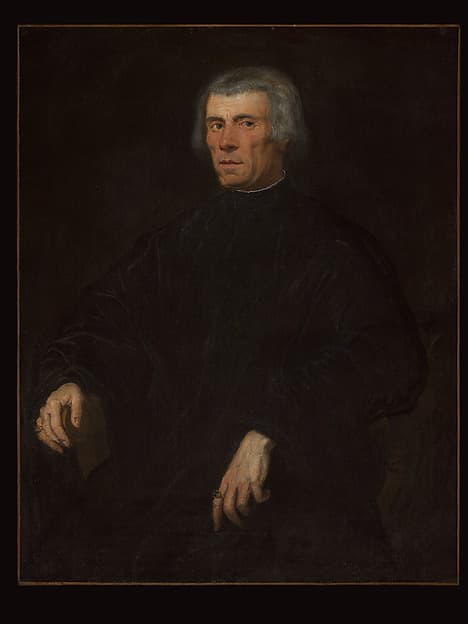
He painted more portraits than anyone in Venice. Those by his own hand are restrained and dark, unlike his narrative canvases. There are two self-portraits: the early one (c. 1546–1547, Philadelphia), without any trappings of status, with a direct gaze and open brushwork, and the late one (c. 1588, Louvre), severely symmetrical, in which the old man seems to be thinking of death. Manet copied it and considered it one of the most beautiful paintings in the world.
He hardly ever left Venice. In his youth he played the lute and instruments of his own invention, designed theatrical costumes, understood mechanics; in his studio, crowded with casts, he admitted hardly anyone and kept his methods secret, sharing them only with his assistants. The Venetians said he had three brushes: one of gold, one of silver and one of iron. Sebastiano del Piombo remarked that Tintoretto could paint in two days as much as he himself in two years. To my mind, what he was most often blamed for, his haste, reads today as a virtue: in his canvases you can see how he worked.
He had few pupils: his daughter Marietta, his sons Domenico and Marco, Maerten de Vos of Antwerp. Marietta, who had accompanied her father in the studio since childhood, became a good portraitist; the Emperor Maximilian and Philip II of Spain invited her to their courts, but she stayed in Venice and died in 1590, aged thirty. Around 1560 Tintoretto married Faustina de Vescovi, the daughter of a Venetian nobleman; three sons and four daughters of that marriage lived to adulthood.
After the “Paradise” he took on no more large works. In 1592 he joined the Scuola dei Mercanti. He died on 31 May 1594 in Venice and was buried in the church of the Madonna dell’Orto beside Marietta. In 1866 the grave was opened, the remains of nine members of the Robusti and Vescovi families were found in it, and it was moved to the right of the choir.
Artist works
Works by the artist
Works by Tintoretto available in this edition of NEOARCA.
Related context
Associations
Works connected through artistic movements, cultural context and period. Priced works available in this market appear first.
Profile notes
Profile and sources
Image
Artist image
На основе открытого изображения: Jacopo Tintoretto; Wikimedia Commons; Public domain.
