
1340–1410
Theophanes the Greek
Theophanes the Greek came to Rus from Byzantium and settled in Novgorod around 1370, where in 1378 he painted the Church of the Transfiguration on Ilyina Street. From the early 1390s he worked in Moscow, painting churches in the Kremlin, and in 1405 the Cathedral of the Annunciation together with Prokhor of Gorodets and Andrei Rublev. No signed icons by him exist, and every attribution is disputed.
Biography
Around 1413 the monk Epiphanius the Wise wrote to Kirill, abbot in Tver, about a painter he had known in Moscow. What struck him most was that the man worked without models. Other icon painters kept glancing at their pattern drawings, but no one ever saw Theophanes “looking at models”: he painted standing, without a pause, talked with those who came to watch, and all the while was thinking of something else.
This letter remains the main account of Theophanes by a contemporary. Everything else has to be pieced together from walls, icons and later attributions, and much of it is disputed.
He was born in Byzantium, hence his byname. His year of birth is known only roughly: around 1340 is the usual figure, but estimates of around 1330 and 1335 also occur. According to Epiphanius, before coming to Rus he painted churches in Constantinople, in nearby Chalcedon, and in the Genoese colonies of Galata and Kaffa. He may have come to Rus together with Metropolitan Cyprian.
Around 1370 Theophanes settled in Novgorod, and in 1378 he began painting the Church of the Transfiguration on Ilyina Street. It is the earliest of his known surviving works, and it survives only in part. In the dome he painted a half-length Christ Pantocrator, in the drum the forefathers and the prophets Elijah and John the Baptist. Of the sanctuary and the vaults, fragments remain: church fathers, the “Eucharist”, part of a figure of the Virgin on an altar pillar, the “Baptism”, the “Nativity”, the “Presentation in the Temple” and the “Descent into Hell”. The Trinity chapel is the best preserved: stylites in the upper part of the wall, the Old Testament Trinity, medallions with John Climacus, Agathon and Acacius, and a figure of Macarius of Egypt. The palette is almost monochrome, reddish brown with white; small details are not modelled, and faces, hands and garments are cut through with sharp white highlights that look like flashes of light. This rapid manner is called “skoropis”, quick writing. The Novgorod masters who painted the churches of the Dormition at Volotovo and of St Theodore Stratelates on the Brook took over the freedom of his brushwork and the way he built his compositions, and the seraphim from the walls of the Transfiguration were later repeated on the Novgorod icon of the “Paternity”.
His later movements are poorly known. Epiphanius mentions Nizhny Novgorod, but the paintings there have not survived; some scholars add Kolomna and Serpukhov. By the early 1390s Theophanes was in Moscow, where he was called a philosopher. There he took on churches, icons, books and private houses. In the palace of Prince Vladimir Andreyevich he painted Moscow itself on a stone wall, and the residence of the grand prince, Epiphanius says, he decorated with painting such as had never been seen. On grounds of style he is credited with the decoration of the Gospel of the boyar Fyodor Koshka, whose cover is dated 1392: it has no miniatures, but many coloured headpieces and initials in the form of animals.
In 1395, with Semyon Chorny and his pupils, he painted the Church of the Nativity of the Virgin “na Senyakh”, in 1399 the Archangel Cathedral of the Kremlin, and in 1405 the Cathedral of the Annunciation with the elder Prokhor of Gorodets and Andrei Rublev. Nine large icons of the Deesis tier, from around 1405, are associated with the Cathedral of the Annunciation: Christ, the Virgin, John the Baptist, the archangels Michael and Gabriel, the apostles Peter and Paul, and the church fathers Basil and John Chrysostom. It is the first iconostasis in Rus with full-length figures.
The icons are a harder matter. There are no signatures, and everything attributed to him has long been debated: the Virgin of the Don, a “Dormition” on a double-sided panel with a Virgin of the Eleusa type on the reverse, and the “Transfiguration” from the Cathedral of the Transfiguration in Pereslavl-Zalessky. The last, it seems to me, has the weakest link to him: the manner there is repeated rather on the surface.
Theophanes died around 1410; where, is not known. In Andrei Tarkovsky’s film “Andrei Rublev” (1966) he was played by Nikolai Sergeyev, and a crater on Mercury is named after him.
Related context
Associations
Works connected through artistic movements, cultural context and period. Priced works available in this market appear first.
Profile notes
Profile and sources
Image
Artist image
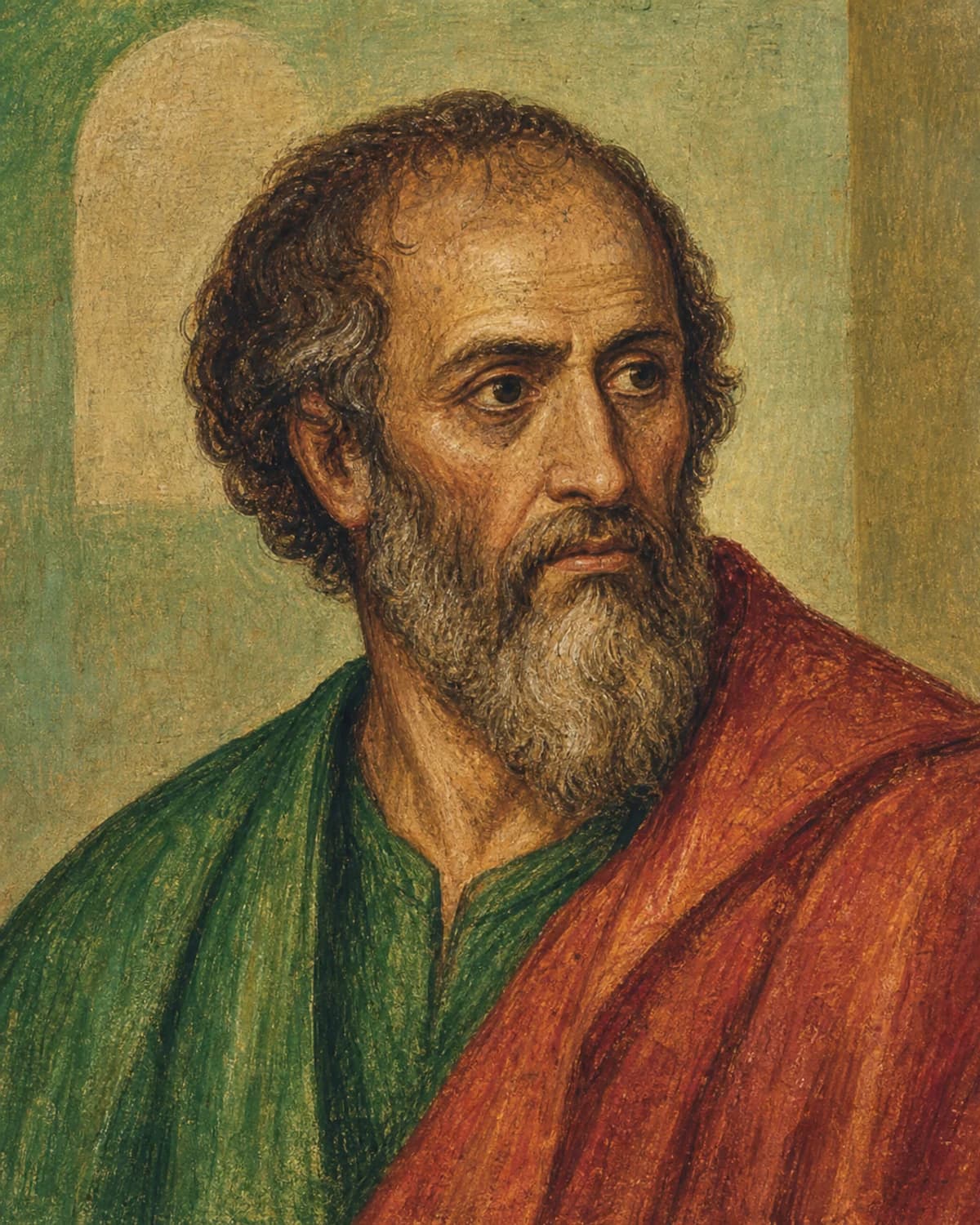
На основе открытого изображения: Anonymous Russian manuscript illuminators, 1560-1570s Facial Chronicle (Illustrated Chronicle of Ivan the Terrible) (in 10 volumes: pdf , pdf with translation ) Public domain image; Wikimedia Commons; Public domain.
