
26.09.1791–26.01.1824
Théodore Géricault
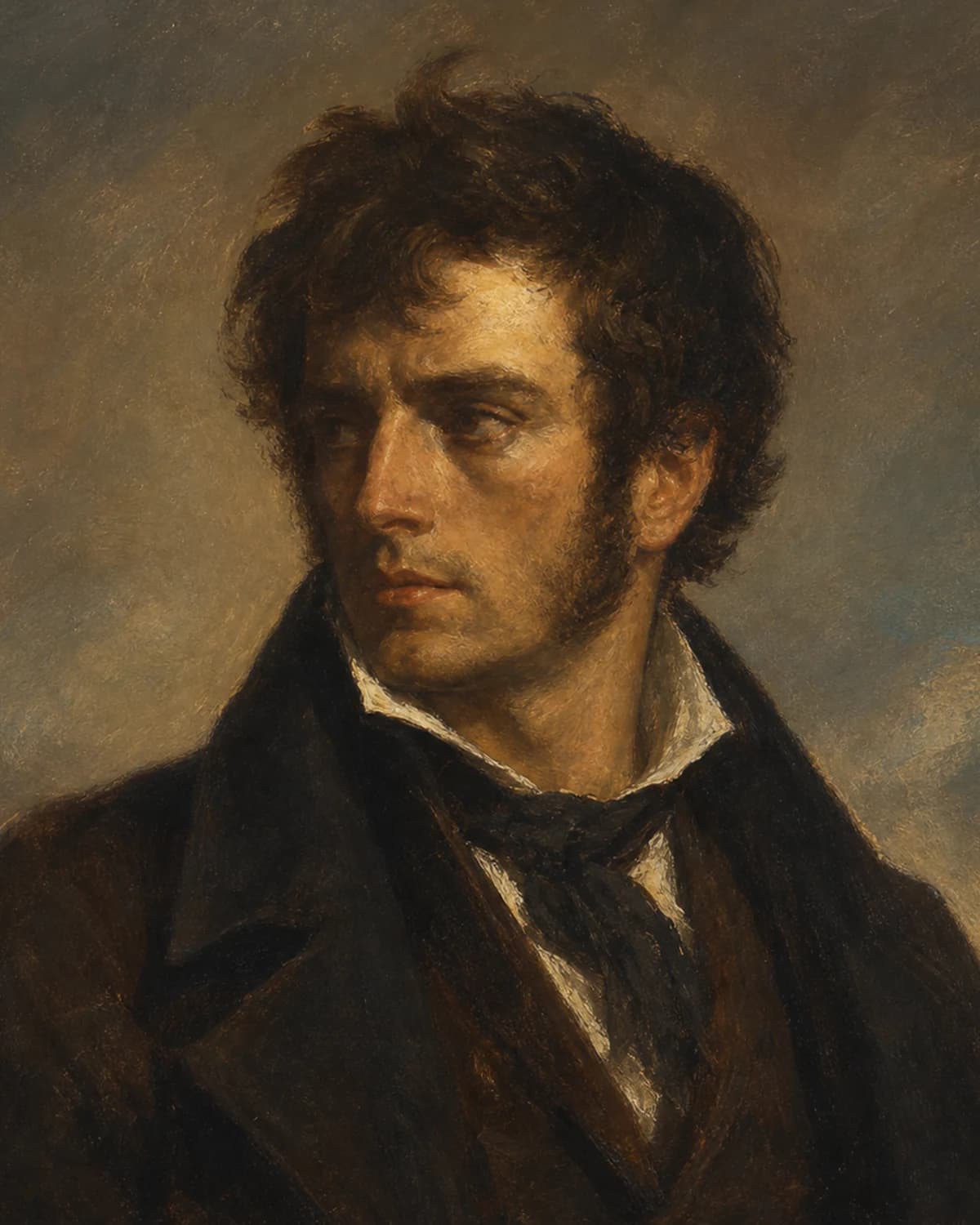
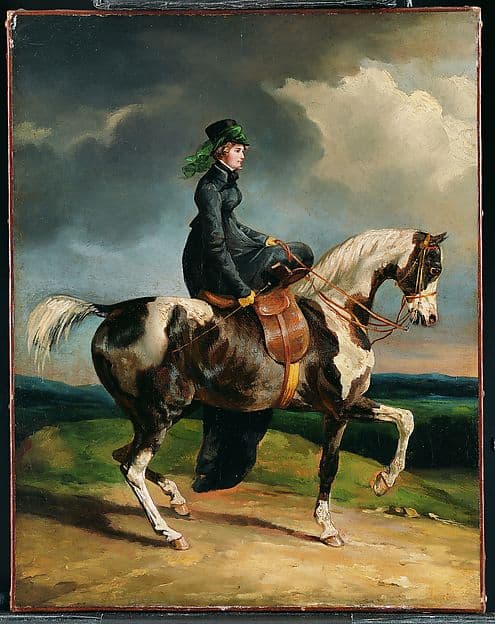
Théodore Géricault (1791–1824) lived thirty-two years and managed to show only a few large paintings at the Salon, among them “The Raft of the Medusa” (1818–1819), a huge canvas about a disaster that had happened three years before. A pupil of Carle Vernet and Pierre Guérin, all his life he painted horses and soldiers of Napoleon’s army, and at the end a series of portraits of the mentally ill; he was also one of the first masters of lithography.
Biography
A carpenter who had served on the frigate “Medusa” made Géricault a scale model of the raft. The painter modelled small figures of people in wax and arranged them on it, studying them from different sides. He sought out two survivors, the engineer-geographer Alexandre Corréard and the ship’s surgeon Henri Savigny, whose book on the loss of the frigate had come out in the autumn of 1817; he went to hospital morgues to draw heads and emaciated bodies, and at the end he travelled to Le Havre to paint the sea and sky.
He was not yet twenty-eight.
Jean-Louis-André-Théodore Géricault was born on 26 September 1791 in Rouen. His father, a lawyer, was involved in the family tobacco business, and his mother came from the Norman nobility; in the mid-1790s the family moved to Paris. His interest in painting was encouraged by his maternal uncle, Jean-Baptiste Caruel, who collected Flemish and Dutch pictures, and the boy spent his holidays in Normandy in stables and at races. At the end of 1808 he joined Carle Vernet, a painter of horses and everyday scenes; with him he drew horses, looked at engravings after English sporting pictures, went with his teacher to the Cirque Franconi, and made friends with his son Horace. In 1810 he moved to Pierre-Narcisse Guérin, a strict classicist, and studied with him irregularly for about six months. Guérin acknowledged his pupil’s talent but scolded him that such contrasts of light and shade made it look as though he painted by moonlight; Guérin also said of him that there were three or four painters inside Théodore at once. From 1810 to 1815 Géricault copied Rubens, Titian, Velázquez and Rembrandt in the Louvre; more than sixty of his copies are known. In 1811–1813 he spent long periods working in the stables at Versailles, painted “portraits” of famous racehorses and studied the anatomy of the horse; his plaster écorché “Horse” was well known to his contemporaries.
At the Salon of 1812 appeared “The Charging Chasseur” (Louvre). The critics noticed the picture by an unknown young painter, and David too praised it. Two years later, after the fall of Napoleon, Géricault showed it paired with the “Wounded Cuirassier Leaving the Field of Battle”, and the critics either kept silent or responded coolly. His next steps are hard for biographers to explain: in December 1814 he bought a commission in a privileged company of musketeers, during the Hundred Days he rode in the escort of the fleeing Louis XVIII, and then, disguised as a peasant, made his way to Normandy.
In 1816 he earned the money for a journey to Italy himself, by painting landscape panels for a friend’s house at Villers-Cotterêts, and this left him free: winning the competition of the École des Beaux-Arts would have obliged him to spend six years there. On 10 October he was in Florence, then in Naples, and he lived longest in Rome. The Sistine Chapel overwhelmed him, and his pen drawings of the Roman period recall Michelangelo. In early February 1817, at the end of the carnival, he saw the race of riderless horses along the Corso from Piazza del Popolo to Palazzo Venezia and conceived a composition about ten metres long. Sketches survive, among them “The Race of Riderless Horses in Rome” (Walters Art Museum, Baltimore), but the painting itself was never made. In September he left, and later called that year unhappy and sad. Of his first teacher’s horses he spoke without respect: one of his own horses, he said, would devour six of Vernet’s.
Corréard and Savigny described the thirteen days spent on the raft by people from the “Medusa”, which had run aground off the coast of Mauritania; the captain, a former émigré, had been given the command through patronage, and the affair became a national scandal. Working through possible subjects, Géricault made about a hundred sketches: mutiny on the raft, cannibalism, rescue. He chose the morning of the last day, when the few still alive see the ship “Argus” on the horizon. For the enormous canvas he rented a separate studio and for eight months hardly left it; Eugène Delacroix posed for one of the dying figures. A friend of the painter, Antoine Montfort, recalled that he painted straight onto the white canvas over the drawing and corrected almost nothing. That was how David had once painted, and Géricault knew the method from Guérin’s studio. At the Salon of 1819 “The Raft of the Medusa” caused a political controversy, and in 1820 Géricault himself took the painting to London, where between 12 June and 30 December about fifty thousand people saw it, and critics compared its author with Michelangelo and Caravaggio.
In England he drew the urban poor and published lithographs based on these drawings, free of any sentimentality; he spent much time with the lithographer and caricaturist Charlet, and in 1821 he painted “The Derby at Epsom”. His lithographs on military subjects, begun after Italy, are counted among the first masterpieces of the medium. After returning to France he painted ten portraits of the mentally ill, patients of his friend Dr Étienne-Jean Georget, one of the first psychiatrists; each had a different mania. Five survive, among them the “Insane Woman” and the portrait of a kleptomaniac. To my mind, they are the best things he painted after the “Raft”.
His last projects, “The Opening of the Doors of the Inquisition” and “The African Slave Trade”, remained in preparatory drawings. Géricault died in Paris on 26 January 1824. On his tomb in Père Lachaise Cemetery a bronze figure of the painter reclines, brush in hand, above a relief of “The Raft of the Medusa”.
Artist works
Works by the artist
Works by Théodore Géricault available in this edition of NEOARCA.
Related context
Associations
Works connected through artistic movements, cultural context and period. Priced works available in this market appear first.








Profile notes
Profile and sources
Image
Artist image
На основе открытого изображения: Théodore Géricault; Wikimedia Commons; Public domain.
